
Your knee hurts when you climb stairs. It swells after a short walk. You have tried physiotherapy, painkillers, rest, and everything your doctor suggested, but the pain keeps coming back and slowly starts affecting your daily life. Simple things like standing for long periods, getting up from a chair, or walking a few steps become difficult.
At some point, your orthopedic surgeon may recommend knee replacement surgery. That is when a new and important question comes up: should you go for total or partial knee replacement? For many patients, this decision can feel overwhelming because both options sound similar, but they are meant for different levels of joint damage and different recovery needs.
The right choice depends on how much of the knee is affected, how severe the pain is, and how well the remaining joint is still working. Understanding the difference between total and partial knee replacement can help patients feel more confident, ask better questions, and make a more informed treatment decision with their doctor.
Why do knees fail in the first place?
The knee is one of the hardest-working joints in the body. Every step, climb, squat, or movement puts pressure on it. Over the years, this constant wear and tear can gradually damage the joint.
The knee has three main compartments:
- Medial compartment (inner side).
- Lateral compartment (outer side).
- Patellofemoral compartment (behind the kneecap).
These compartments are lined with smooth cartilage that acts as a cushion, allowing the bones to move effortlessly against each other. Healthy cartilage helps the knee absorb shock and move without pain.
However, with age, injury, excess body weight, arthritis, or repetitive stress, this protective cartilage can begin to wear away. This process is known as cartilage degeneration.
As the cartilage becomes thinner:
- The joint loses its natural cushioning.
- Bones begin rubbing against each other.
- Friction increases inside the knee.
- Pain, stiffness, and swelling develop.
- Everyday activities become difficult.
Over time, the joint space narrows, bone spurs may form, and the knee can become deformed or unstable. Many people start avoiding activities they once enjoyed because of persistent pain and reduced mobility.
This gradual breakdown of cartilage is the leading reason why patients eventually require knee replacement surgery. When the damaged cartilage can no longer be repaired and conservative treatments stop providing relief, replacing the worn-out joint becomes the most effective solution for restoring mobility and quality of life.
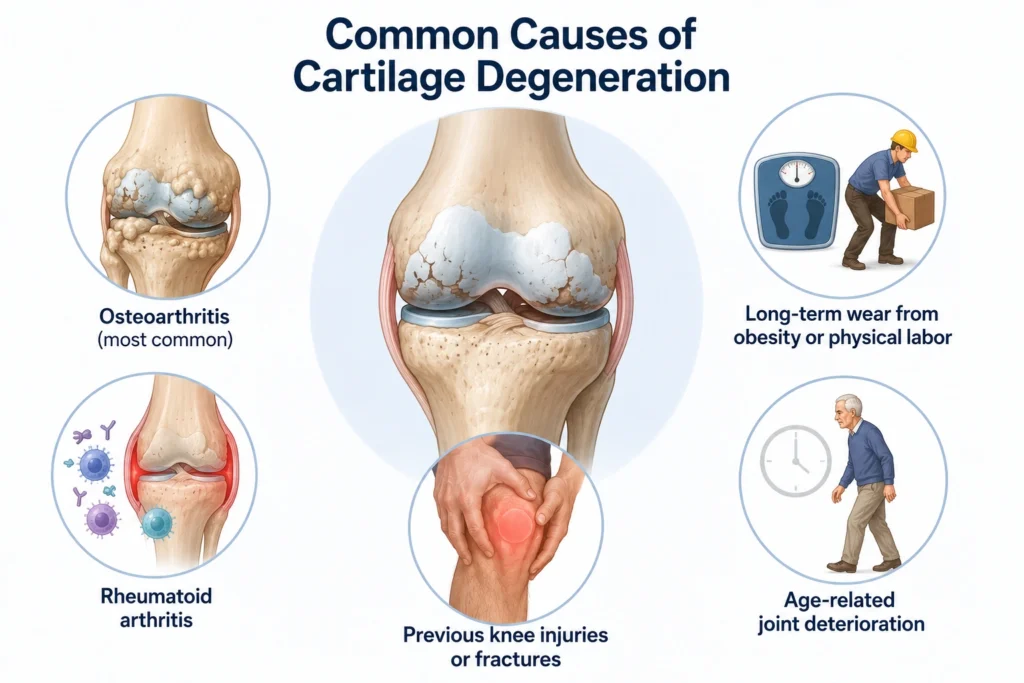
Common causes of cartilage degeneration:
Once cartilage is gone, it doesn’t regenerate. That’s when knee replacement surgery becomes the next logical step.
- Osteoarthritis (most common)
- Rheumatoid arthritis
- Previous knee injuries or fractures
- Long-term wear from obesity or physical labor
- Age-related joint deterioration
Total vs partial knee replacement: the core difference
Neither option is universally “better.” The right choice depends entirely on where the damage is and how much of the knee is involved.
Here’s the simplest way to understand it:
| Feature | Total Knee Replacement | Partial Knee Replacement |
| What gets replaced | All three compartments | Only the damaged compartment |
| Who is it for | Widespread arthritis across the knee | Arthritis limited to one compartment |
| Incision size | Larger | Smaller |
| Hospital stay | 3–5 days | 2–3 days |
| Recovery time | 3–6 months | 4–8 weeks |
| Longevity | 15–20+ years | 10–15 years |
| Implant feel | Takes adjustment | Often feels more natural |
| Risk of revision surgery | Lower | Slightly higher |
What is total knee replacement?
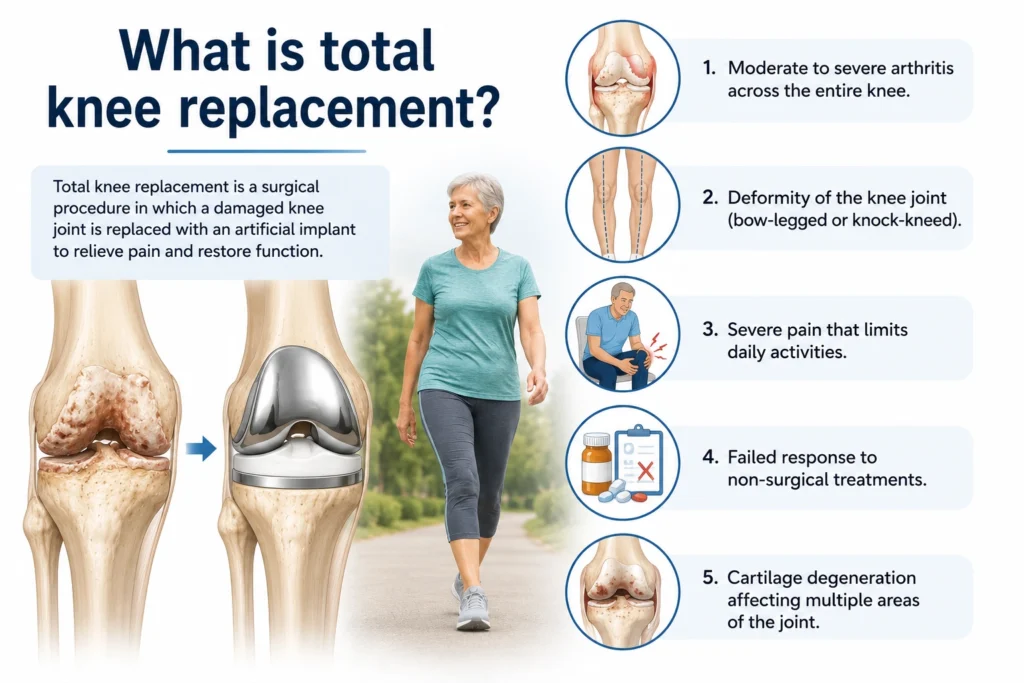
In a total replacement surgery, the surgeon removes the damaged bone and cartilage from all three knee compartments and replaces them with metal and plastic implants.
Total knee replacement is one of the most successful elective surgeries in modern medicine. With proper rehabilitation, it dramatically improves quality of life.
Who needs total knee replacement:
- Moderate to severe arthritis across the entire knee.
- Deformity of the knee joint (bow-legged or knock-kneed).
- Severe pain that limits daily activities.
- Failed response to non-surgical treatments.
- Cartilage degeneration affecting multiple areas of the joint.
What to expect:
- Surgery lasts 1.5 to 2 hours
- Physiotherapy begins within 24 hours post-surgery
- Most patients walk without support in 6–8 weeks
- Full recovery takes 3–6 months
What is partial knee replacement?
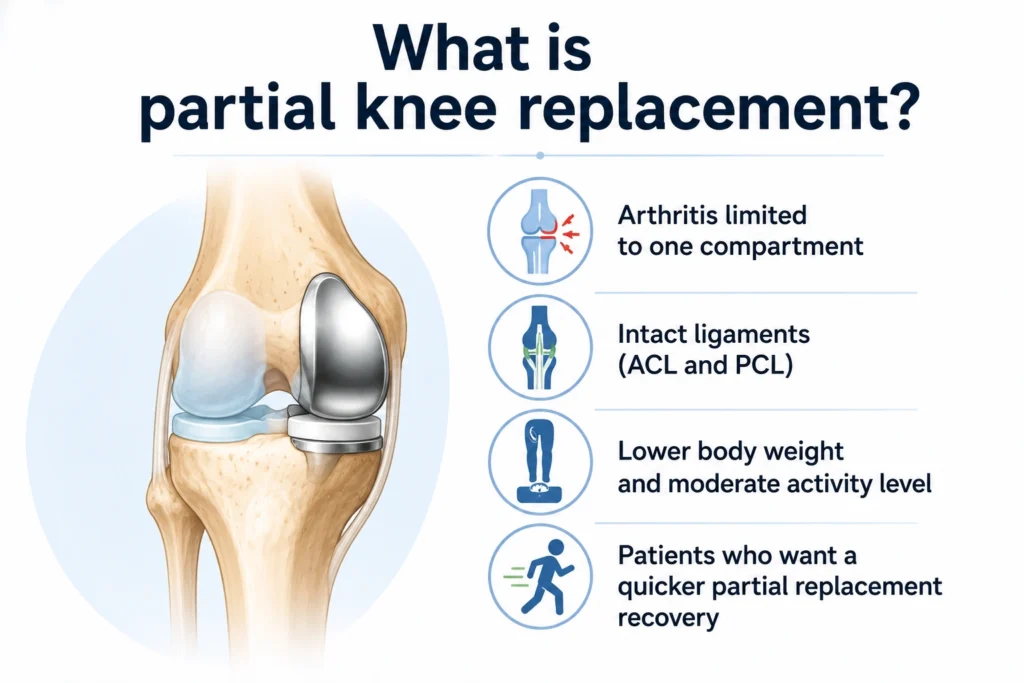
Partial replacement (also called unicompartmental knee replacement) replaces only the damaged section of the knee. The healthy cartilage and bone are left untouched.
However, if arthritis progresses to other compartments, a revision or conversion to total knee replacement may be needed later.
Who is a good candidate:
- Arthritis limited to one compartment
- Intact ligaments (ACL and PCL)
- Lower body weight and moderate activity level
- Patients who want a quicker partial replacement recovery
What to expect:
- Smaller incision and less bone removal
- Less blood loss during surgery
- Shorter hospital stay
- Quicker return to light activities
- The knee often feels closer to natural
Partial Knee Replacement Recovery: How Long Does It Take?
Partial knee replacement recovery is noticeably faster than total knee replacement. Total knee replacement recovery takes longer. But the long-term durability is strong, especially for patients with widespread cartilage degeneration.
Recovery timeline:
| Week | What to Expect |
| Week 1–2 | Pain managed with medication; physiotherapy starts |
| Week 3–4 | Walking with support; swelling reduces |
| Week 5–6 | Light activities resume, and stair climbing improves |
| Week 8–12 | Most patients return to normal daily life |
| 6 months | Full activity recovery for most patients |
How the decision is made for total & partial knee replacement?
Your surgeon will confirm the right option using X-rays, MRI scans, and a clinical examination.
If Arthritis Affects Only One Compartment
- Partial Knee Replacement may be recommended.
- Benefits include:
- Faster recovery
- Smaller surgical incision (scar)
- More natural knee movement
- Regular follow-up is important, as arthritis can spread to other parts of the knee over time.
If Arthritis Affects Two or Three Compartments
- Total Knee Replacement may be recommended.
- Benefits include:
- Comprehensive treatment of the entire knee joint
- Long-lasting pain relief and improved function
- Lower likelihood of needing another knee replacement procedure
- Typically considered the definitive surgical solution for advanced knee arthritis.
Key questions to discuss with your surgeon
A good orthopedic surgeon will walk you through all of this patiently and honestly. Before finalizing your knee replacement surgery options, ask:
- How many compartments of my knee are damaged?
- Am I a good candidate for partial or total knee replacement?
- What are the risks for my age and health condition?
- What does partial knee replacement recovery look like in my case?
- How long will the implant last?
- What happens if I delay surgery further?
Risks to Know Before Surgery
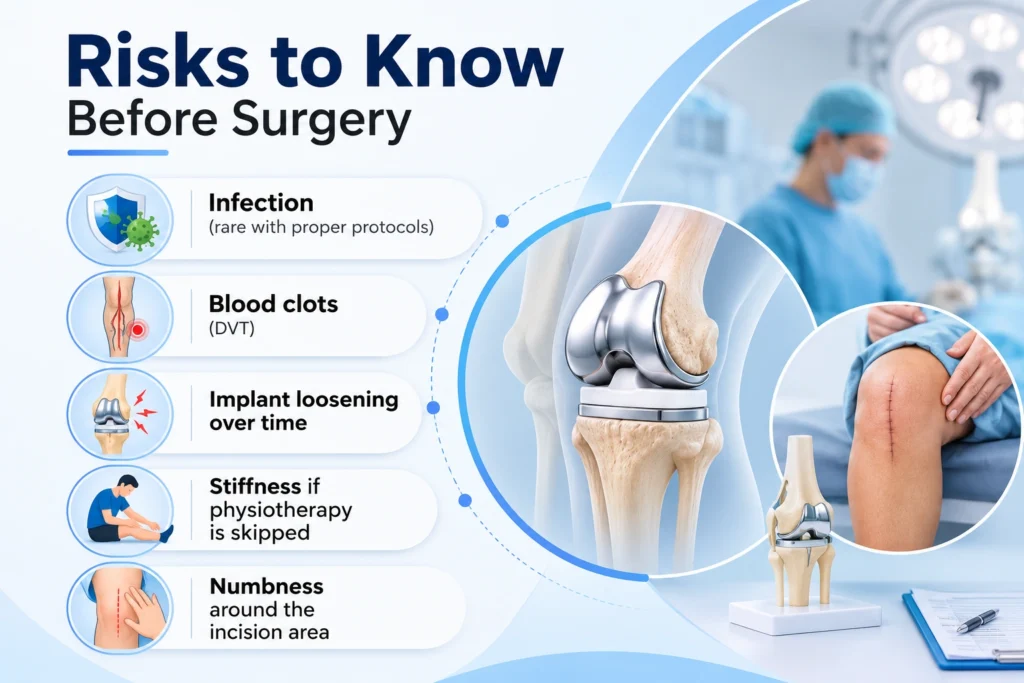
All surgical procedures carry risks. Knee replacement surgeries are considered low-risk with high success rates, but it’s still important to know what to watch for.
Common risks (manageable with expert care):
- Infection (rare with proper protocols)
- Blood clots (DVT)
- Implant loosening over time
- Stiffness if physiotherapy is skipped
- Numbness around the incision area
Frequently Asked Questions (FAQs)
Q: How do I know if I need knee replacement surgery at all?
If pain is affecting your sleep, making stairs difficult, limiting your daily walk, or hasn’t improved with 6 months of conservative treatment, it’s time to consult an orthopedic specialist.
Q: Is partial knee replacement better than total knee replacement?
Not necessarily better, just different. Partial knee replacement works well when damage is limited to one area. Total knee replacement is the right call when arthritis has spread. Your surgeon decides based on X-rays and clinical findings, not personal preference.
Q: Will the knee feel normal after surgery?
Most patients report significant improvement in pain and function. Partial knee replacement tends to feel more natural since healthy tissue is preserved. Both options, with proper rehab, allow patients to walk, climb stairs, and return to an active life.
Q: At what age can someone get knee replacement surgery?
There is no strict age rule. Knee replacement is performed in patients from their 40s to their 80s. Surgeons weigh the severity of damage, overall health, and lifestyle needs before recommending surgery.
Q: How long does the implant last?
Total knee replacement implants typically last 15–20 years or more. Partial implants last around 10–15 years. Regular follow-ups and maintaining a healthy weight help extend implant life.
Q: Can I avoid knee replacement surgery with injections or physiotherapy?
In early stages, yes. Physiotherapy, weight management, anti-inflammatory medications, and joint injections can delay surgery. But once cartilage degeneration reaches an advanced stage, surgery becomes unavoidable.
Q: How soon can I walk after knee replacement surgery?
Most patients begin walking with support within 24 hours of surgery. Independent walking typically follows within 6–8 weeks for a total knee replacement and sooner for a partial knee replacement.
Conclusion
Choosing the right orthopedic care is not just about finding a nearby hospital; it is about trusting a team that can guide you with the right diagnosis, treatment plan, and recovery support. At Rama Hospital, patients receive care that focuses not only on pain relief but also on restoring mobility, confidence, and quality of life.
Whether you are dealing with joint pain, a sports injury, a fracture, or a long-term bone and spine condition, timely consultation can make a major difference in recovery outcomes. With experienced specialists, modern facilities, and a patient-first approach, Rama Hospital stands out as a dependable choice for orthopedic care in Noida.
If you are looking for the best orthopedic hospital in Noida or a trusted hospital for joint and bone treatment, Rama Hospital brings together expertise, compassion, and personalized care under one roof. The right treatment today can help you move better, heal faster, and live more comfortably tomorrow.