A persistent backache may seem like a minor problem at first. You might experience discomfort after sitting for long hours, feel pain while bending forward, or notice a sharp sensation travelling from your lower back into your legs. While these problems are often associated with muscle strain, they can sometimes indicate an underlying spinal condition, such as a slipped disc.
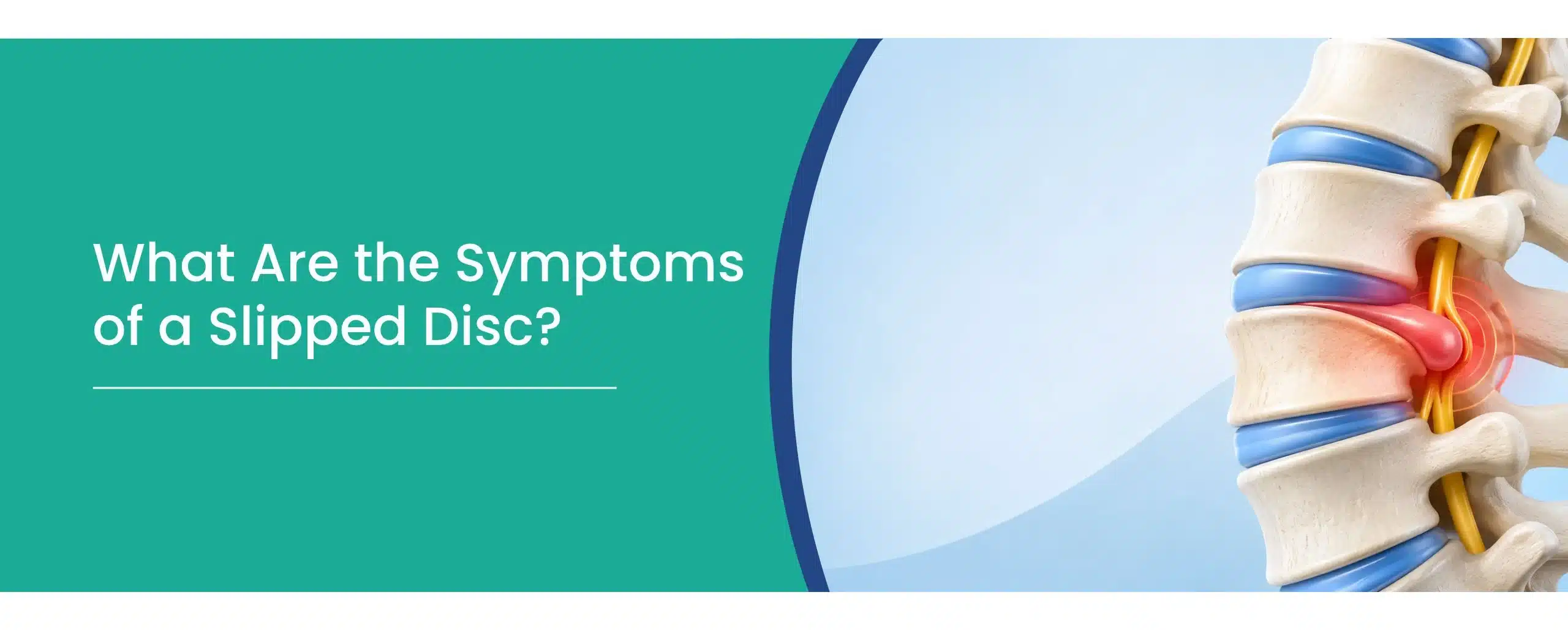
A slipped disc is one of the common conditions affecting the spine. It occurs when the soft inner material of a spinal disc pushes through a weakened or damaged outer layer. Depending on its location and severity, it may irritate or compress nearby nerves, leading to pain, numbness, tingling or muscle weakness.
Recognising slipped disc symptoms early can help you understand when your discomfort needs medical attention. Some people experience only mild back pain, while others develop shooting pain in their legs, difficulty walking or changes in muscle strength.
The condition can affect different parts of the spine, which means its symptoms are not always the same. Understanding these differences is important before deciding what kind of treatment or medical evaluation may be required.
What Is a Slipped Disc?
Your spine is made up of small bones called vertebrae, arranged one above another. Between these bones are flexible structures known as intervertebral discs. These discs act as cushions, absorb everyday pressure and allow your spine to bend, twist and move comfortably.
Each disc has two main components:
- Annulus fibrosus: The tough outer ring that provides structural support.
- Nucleus pulposus: The soft, gel-like centre that helps absorb pressure and distribute weight.
A slipped disc, medically known as a herniated or prolapsed disc, occurs when some of the inner disc material pushes through a weakened area of the outer layer.
Despite its name, the disc does not usually slip out of its position completely. Instead, it bulges or herniates and may put pressure on nearby spinal nerves.
This nerve irritation is often responsible for the pain, tingling and weakness associated with the condition.
What Are the Common Symptoms of a Slipped Disc?
The location of the affected disc and the degree of nerve involvement determine the type of discomfort a person experiences.
Some people notice symptoms gradually, while others develop pain after lifting a heavy object, bending suddenly or performing a physically demanding activity.
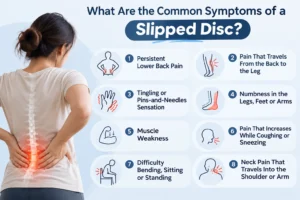
The most commonly reported slipped disc symptoms include the following.
1. Persistent Lower Back Pain
One of the most common signs is pain in the lower back, particularly when the affected disc is in the lumbar spine.
The discomfort may feel like a dull ache, sharp pain or deep pressure around the lower back. It may become more noticeable when bending, twisting, sitting for extended periods or changing positions.
Unlike temporary muscular discomfort, pain associated with a herniated disc may also travel into the buttocks or legs if nearby nerves are affected.
However, lower back pain has several possible causes. Muscle strain, spinal degeneration, arthritis and other conditions can produce similar discomfort. Therefore, pain alone cannot confirm a slipped disc.
2. Pain That Travels From the Back to the Leg
Another important warning sign is pain that starts around the lower back or buttocks and travels down one leg.
This may happen when a herniated disc compresses or irritates a nerve root in the lumbar spine.
The pain may feel:
- Sharp or shooting.
- Burning or electric-like.
- Deep and uncomfortable.
- Worse while sitting, coughing or sneezing.
This pattern is commonly associated with sciatica.
Among the different slipped disc symptoms, radiating leg pain is particularly important because it may indicate nerve irritation rather than an isolated back problem.
3. Tingling or Pins-and-Needles Sensation
Some individuals experience unusual sensations in their legs, feet, arms or fingers.
You may feel as though small needles are pricking your skin, or notice a mild buzzing sensation that comes and goes.
This occurs when pressure or irritation affects the nerves responsible for transmitting sensory information.
The location of tingling often depends on which nerve root is involved. For example, a lumbar disc problem may cause tingling in the leg or foot, while a cervical disc problem may affect the arm or fingers.
4. Numbness in the Legs, Feet or Arms
Numbness is another symptom that should not be ignored, particularly when it develops alongside back or neck pain.
A person may notice reduced sensation in a particular part of the body, difficulty feeling touch normally or an unusual loss of sensation.
These slipped disc symptoms can occur when a herniated disc irritates or compresses a spinal nerve.
For example:
- A lumbar disc herniation may cause numbness in the thigh, calf or foot.
- A cervical disc herniation may cause numbness in the shoulder, arm or fingers.
Persistent or worsening numbness requires medical assessment, particularly if it is accompanied by muscle weakness.
5. Muscle Weakness
When a spinal nerve is compressed, it may interfere with the signals travelling between the brain and muscles.
As a result, you may experience weakness in the affected arm or leg.
Some everyday activities may become difficult, such as:
- Walking normally.
- Climbing stairs.
- Lifting the front part of your foot.
- Standing on your toes.
- Holding objects firmly.
Muscle weakness is more concerning than pain alone because it may indicate significant nerve involvement.
If weakness is new, progressive or affecting your ability to walk or use an arm, seek prompt medical evaluation.
6. Pain That Increases While Coughing or Sneezing
Have you noticed that your back or leg pain suddenly becomes worse when you sneeze, cough or strain?
This can happen because these activities temporarily increase pressure within the spinal canal and surrounding structures.
If a herniated disc is already irritating a nerve, the additional pressure may intensify the discomfort.
This is one of the less obvious slipped disc symptoms, particularly when the pain travels from the lower back towards the buttocks or legs.
7. Difficulty Bending, Sitting or Standing
A person with a symptomatic herniated disc may find certain movements uncomfortable.
Sitting for extended periods, bending forward, getting out of bed or standing for too long may aggravate the pain.
The discomfort may also interfere with daily activities such as driving, working at a desk, lifting groceries or performing household tasks.
These movement-related limitations can be associated with several back pain causes, so an appropriate clinical examination is important before attributing them to a slipped disc.
8. Neck Pain That Travels Into the Shoulder or Arm
Not all disc herniations occur in the lower back.
When a disc in the cervical spine (neck region) becomes herniated, it may irritate nearby nerves and produce symptoms in the neck, shoulder, arm or hand.
You may notice:
- Pain while turning or bending your neck.
- Discomfort around the shoulder blades.
- Pain travelling down one arm.
- Tingling in the fingers.
- Reduced grip strength.
These symptoms may indicate cervical radiculopathy, a condition involving irritation or compression of a nerve root in the neck.
Slipped Disc Symptoms Based on Its Location
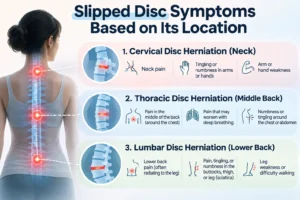
The spine is divided into different regions, and a herniated disc can affect each region differently.
Understanding the location helps explain why one person experiences lower back pain while another develops neck pain or discomfort around the chest.
1. Cervical Disc Herniation (Neck)
The cervical spine consists of seven vertebrae located in the neck.
A herniated disc in this region can irritate the nerves travelling towards the shoulders, arms and hands.
Common manifestations include:
- Neck stiffness and pain.
- Shoulder blade discomfort.
- Pain travelling down the arm.
- Tingling or numbness in the fingers.
- Weakness in the hand or arm.
In more serious cases, compression of the spinal cord may affect balance, walking and coordination. Such symptoms require prompt medical evaluation.
2. Thoracic Disc Herniation (Middle Back)
The thoracic spine is located between the neck and lower back. Disc herniation in this region is relatively uncommon.
Depending on the location, symptoms may include:
- Pain around the middle back.
- Discomfort around the ribs or chest.
- Pain that travels around the torso.
- Numbness or altered sensation.
- Weakness or stiffness in the legs if the spinal cord is affected.
3. Lumbar Disc Herniation (Lower Back)
The lumbar spine carries a considerable amount of the body’s weight and is frequently affected by disc herniation.
When a disc in this region presses against a nerve root, it may cause pain that travels towards the buttocks, thighs, calves or feet.
Common manifestations include:
- Persistent lower back pain.
- Pain travelling down one leg.
- Tingling or numbness in the legs.
- Weakness in the foot or leg.
- Difficulty sitting, bending or walking comfortably.
What Causes a Slipped Disc?
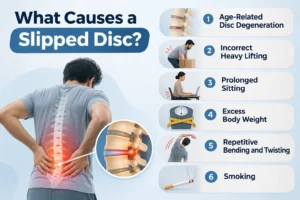
A slipped disc can develop due to gradual changes in the spinal discs or sudden physical strain.
As people grow older, spinal discs naturally lose some of their water content and flexibility. This can make them less resilient to everyday pressure.
However, age is not the only factor. Certain activities, lifestyle habits and physical conditions may also increase the likelihood of disc herniation.
Some common back pain causes and contributing risk factors include:
1. Age-Related Disc Degeneration
As you age, the spinal discs gradually undergo structural changes.
They may lose hydration, become less flexible and develop areas of weakness. This makes them more vulnerable to damage or herniation.
2. Incorrect Heavy Lifting
Lifting a heavy object without proper technique can place excessive pressure on the spine.
Sudden bending, twisting or lifting while the back is unsupported may contribute to disc injury, particularly when the discs are already weakened.
3. Prolonged Sitting
Spending long hours sitting at a desk or driving may contribute to back discomfort, especially when combined with limited physical activity.
Sitting itself does not automatically cause a slipped disc, but prolonged inactivity and poor movement habits may contribute to spinal strain.
4. Excess Body Weight
Carrying excess body weight can increase mechanical stress on the spine.
Over time, this additional loading may contribute to discomfort and other musculoskeletal problems.
5. Repetitive Bending and Twisting
Jobs or activities involving repeated bending, pulling, lifting and twisting can place repeated stress on the spinal structures.
Using appropriate movement and lifting techniques can help reduce unnecessary strain.
6. Smoking
Smoking may negatively affect the health of spinal disc tissues by reducing their nutrient and oxygen supply.
It is considered one of the factors associated with disc degeneration.
Slipped Disc vs Sciatica: Are They the Same?
Many people use the terms slipped disc and sciatica interchangeably. However, they describe two different medical conditions.
A slipped disc refers to a structural problem involving an intervertebral disc. Sciatica refers to pain caused by irritation or compression of the sciatic nerve or its contributing nerve roots.
A herniated disc in the lower back is one possible cause of sciatica, but it is not the only one.
Understanding the difference
| Feature | Slipped Disc | Sciatica |
| Meaning | A spinal disc pushes through its outer layer | Pain associated with sciatic nerve irritation |
| Main location | Neck, middle back or lower back | Usually lower back, buttocks and leg |
| Common symptoms | Back pain, numbness, tingling and weakness | Shooting or burning pain travelling down the leg |
| Possible causes | Disc degeneration, injury or physical strain | Herniated disc, spinal stenosis or other nerve compression |
| Treatment | Depends on disc condition and nerve involvement | Depends on the underlying cause |
What are the common sciatica symptoms?
People experiencing sciatica may notice:
- Sharp pain travelling from the buttock into the leg.
- Burning or electric-like sensations.
- Tingling in the calf or foot.
- Numbness along the affected leg.
- Muscle weakness in severe cases.
These sciatica symptoms may become more noticeable while sitting, coughing, sneezing or moving the affected leg.
How Is a Slipped Disc Diagnosed?
Recognising slipped disc symptoms is only the first step. A proper diagnosis requires an assessment of your medical history, physical symptoms and neurological function.
An orthopaedic doctor or spine specialist may recommend the following evaluations depending on your condition.
1. Medical History and Physical Examination
The doctor will first understand your symptoms, including when the pain started, where it travels and which activities make it worse.
You may also be asked about previous back injuries, daily activities, occupation and existing medical conditions.
During the physical examination, the doctor may assess:
- Spinal movement and flexibility.
- Muscle strength in the arms or legs.
- Reflex responses.
- Sensation in different parts of the body.
- Walking pattern and balance.
2. MRI Scan
Magnetic Resonance Imaging (MRI) is commonly used when imaging is clinically indicated to evaluate a suspected herniated disc.
It provides detailed images of the spinal discs, nerves and surrounding soft tissues.
An MRI can help identify:
- The location of the herniated disc.
- The extent of disc protrusion.
- Whether a nerve root is compressed.
- Other possible causes of spinal symptoms.
3. X-Ray
An X-ray can help evaluate the alignment and structure of the spinal bones.
It may identify:
- Changes in spinal alignment.
- Bone-related abnormalities.
- Fractures.
- Certain signs of degenerative changes.
However, an ordinary X-ray cannot directly show a herniated disc because spinal discs are soft tissues. Additional imaging may be required when a disc problem is suspected.
4. Nerve Function Tests
In selected cases, the doctor may recommend tests such as electromyography (EMG) or nerve conduction studies.
These tests help evaluate how electrical signals travel through nerves and muscles.
They may be useful when the diagnosis is uncertain or when the doctor needs to distinguish nerve-related symptoms from other conditions.
What Are the Treatment Options for a Slipped Disc?
Treatment depends on the location of the affected disc, the severity of symptoms and whether there is significant nerve compression.
The good news is that many people with a symptomatic herniated disc improve without surgery. Treatment generally begins with non-surgical approaches unless there is an urgent neurological concern.
1. Medication
A doctor may recommend suitable medication to manage pain and inflammation.
Depending on the patient’s condition, this may include:
- Pain-relieving medicines.
- Anti-inflammatory medicines.
- Certain medicines for nerve-related pain.
- Short-term muscle relaxants in selected cases.
2. Physiotherapy
Physiotherapy is an important part of conservative management for many patients.
A physiotherapist may develop an individualised programme to improve movement, support spinal stability and gradually restore physical function.
Treatment may include:
- Gentle mobility exercises.
- Core-strengthening activities.
- Posture correction.
- Movement and lifting education.
- Gradual return to daily activities.
3. Activity Modification
Complete bed rest is generally not recommended for uncomplicated back pain associated with a herniated disc.
Depending on the severity of discomfort, patients may benefit from temporarily modifying activities that aggravate their symptoms while maintaining gentle movement as tolerated.
For example, reducing prolonged sitting, avoiding heavy lifting and taking short walking breaks may help improve comfort.
4. Epidural Steroid Injections
In selected patients with persistent nerve-related pain, a specialist may consider an epidural steroid injection.
The injection delivers anti-inflammatory medication into the epidural space around the affected spinal nerves.
It may provide temporary pain relief and help some patients participate more comfortably in rehabilitation.
5. Surgery for a Slipped Disc
Surgery may be considered when symptoms remain severe despite appropriate non-surgical treatment or when there is significant or progressive neurological weakness.
One commonly performed procedure is discectomy, in which the surgeon removes the portion of the herniated disc that is pressing on the nerve.
Depending on the patient’s condition, surgical approaches may include:
- Microdiscectomy: Removal of the problematic disc material using specialised instruments and magnification.
- Endoscopic discectomy: A minimally invasive approach using an endoscope in appropriately selected patients.
- Other decompression procedures: Considered when additional spinal structures contribute to nerve compression.
When Should You See a Doctor for a Slipped Disc?
Occasional back discomfort may improve with appropriate activity modification and conservative care. However, persistent or worsening symptoms should not be ignored.
An assessment by a spine specialist can help identify the underlying cause and determine whether you need medication, physiotherapy, further investigation or another treatment approach.
Warning signs that require emergency medical attention
Some symptoms may indicate cauda equina syndrome, a serious condition involving compression of the nerve roots at the lower end of the spinal canal.
Seek immediate emergency care if you experience:
- New difficulty passing urine or inability to urinate.
- Loss of bladder or bowel control.
- Numbness around the genitals, buttocks or inner thighs (saddle area).
- Severe or rapidly progressing weakness, particularly in both legs.
How Can You Reduce the Risk of a Slipped Disc?
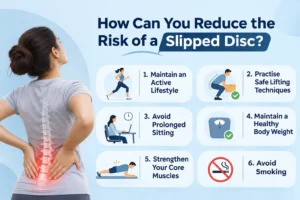
Although not every disc herniation can be prevented, certain lifestyle habits may help reduce unnecessary stress on the spine and support overall back health.
1. Maintain an Active Lifestyle
Regular physical activity helps maintain muscle strength, flexibility and general spinal health. Walking, swimming and other suitable low-impact activities may help support movement and physical conditioning.
2. Practise Safe Lifting Techniques
When lifting heavy objects, avoid bending and twisting your back suddenly.
Instead:
- Keep the object close to your body.
- Bend at your hips and knees.
- Avoid twisting while carrying weight.
- Ask for assistance when an object is too heavy.
3. Avoid Prolonged Sitting
If your work involves sitting for extended periods, take regular movement breaks. Adjust your workstation so that your screen, chair and desk support a comfortable working posture.
4. Maintain a Healthy Body Weight
Excess body weight can increase the mechanical load placed on the spine. Maintaining a healthy weight through balanced nutrition and regular activity may help reduce unnecessary stress on the back.
5. Strengthen Your Core Muscles
The abdominal and back muscles help support the spine during everyday movements. A physiotherapist can recommend suitable strengthening exercises based on your fitness level and spinal health.
6. Avoid Smoking
Smoking is associated with poorer disc health and accelerated disc degeneration. Avoiding tobacco can support overall musculoskeletal and general health.
Frequently Asked Questions (FAQs)
1. What are the first signs of a slipped disc?
The early slipped disc symptoms may include mild back or neck pain, stiffness, discomfort while bending and occasional tingling. If a spinal nerve becomes irritated, pain may travel into the arms or legs. Early evaluation can help identify the cause.
2. Can a slipped disc cause pain in both legs?
Yes, although pain is often more prominent on one side, a disc herniation can affect nerves on both sides. Bilateral symptoms, particularly when accompanied by progressive weakness or bladder or bowel changes, require urgent medical evaluation.
3. How do I know if my back pain is caused by a slipped disc?
Back pain alone cannot confirm a slipped disc. When pain is accompanied by radiating leg discomfort, numbness, tingling or muscle weakness, a disc-related nerve problem may be considered. A clinical examination and, when appropriate, MRI can help establish the diagnosis.
4. Can a slipped disc heal without surgery?
Yes. Many people recover with non-surgical treatment, including appropriate medication, physiotherapy and activity modification. Surgery is generally considered when conservative treatment does not provide sufficient relief or when significant neurological problems develop.
5. How long does it take to recover from a slipped disc?
Recovery varies depending on the severity of the herniation, nerve involvement and the patient’s overall health. Many people improve over several weeks, while others may need a longer rehabilitation period or additional treatment.
6. Can walking help with a slipped disc?
Gentle walking may help maintain mobility and reduce stiffness in many patients. However, the amount of activity should depend on your symptoms. Stop and seek medical advice if walking increases pain, numbness or weakness.
7. Are herniated disc symptoms different from slipped disc symptoms?
No. The terms describe the same general condition. A herniated disc is the more medically precise term, while slipped disc is commonly used by patients. The symptoms depend on the disc’s location and whether nearby nerves are affected.
8. Can a slipped disc cause permanent nerve damage?
In some cases, prolonged or severe nerve compression can lead to lasting neurological problems. However, this does not happen to everyone. New or worsening weakness, significant numbness or bladder and bowel changes require urgent assessment.
Conclusion
Back pain is easy to dismiss, particularly when it appears after a long working day or physical activity. However, when discomfort is accompanied by tingling, numbness, shooting leg pain or muscle weakness, it is important to understand what may be causing it.
Recognising slipped disc symptoms can help you seek timely medical attention and avoid overlooking potentially serious nerve-related problems.
Not every disc herniation requires surgery, and many patients improve with appropriate non-surgical care. The right treatment depends on the location of the affected disc, the severity of nerve compression and the patient’s overall health.
If you are experiencing persistent lower back pain, radiating leg pain or other signs of a spinal problem, consider consulting an experienced orthopaedic doctor.
At Rama Hospital, Noida, patients can seek orthopaedic consultation and evaluation for back pain, spinal conditions, joint problems and other musculoskeletal concerns. Whether you need an assessment for a suspected slipped disc or are exploring orthopaedic services such as knee replacement in Noida, timely specialist guidance can help you understand the available treatment options.
If you are looking for an orthopaedic hospital in Noida, consult an orthopaedic specialist to understand the cause of your discomfort and the appropriate next steps.
Don’t let persistent back pain decide how you live your day. Get your spine evaluated and take an informed step towards better mobility.