
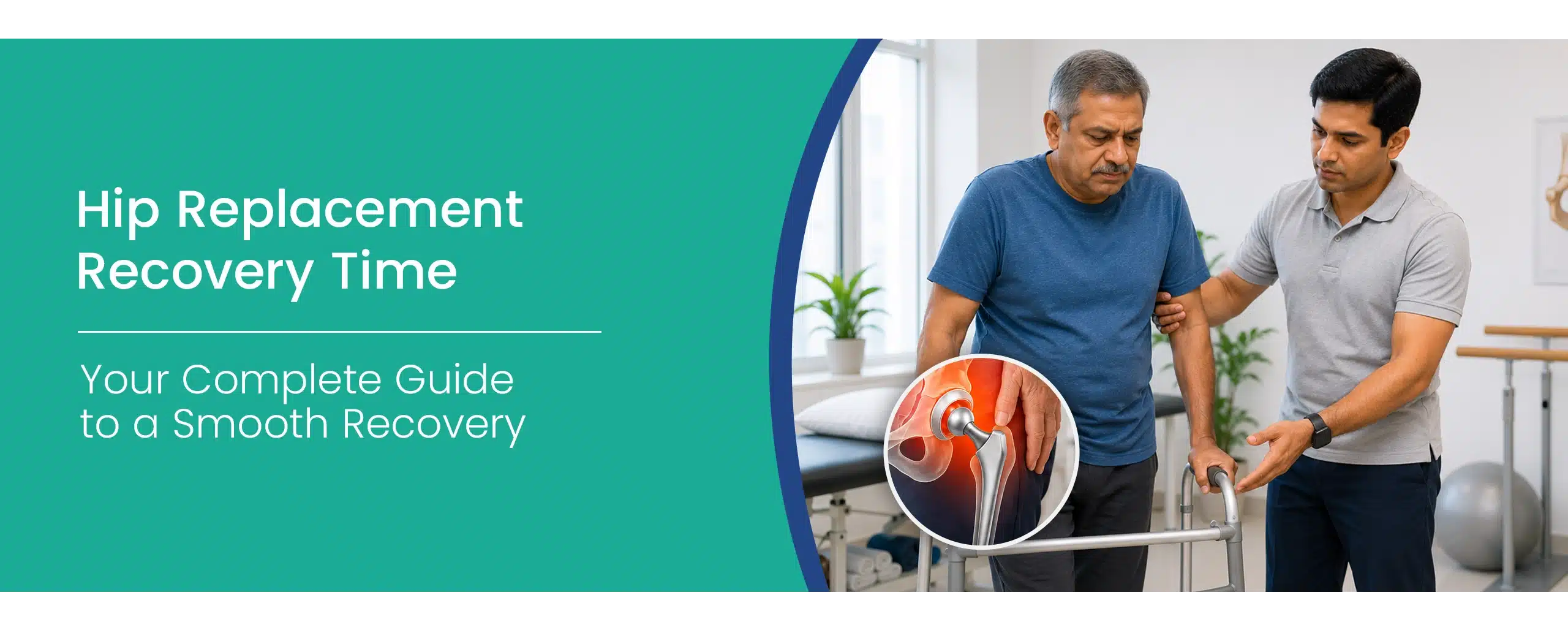
Hip replacement recovery time is different for everyone, but most patients are surprised by how quickly things move. The majority of people are up and walking with support within 24 hours of surgery. By 6 weeks, most return to light daily activities. By 3 to 6 months, many are living largely pain-free, doing things they couldn’t do in years.
Full recovery, where you feel truly back to yourself, typically happens between 6 to 12 months. That timeline sounds long, but consider this: most patients start feeling better than before surgery within just 6 to 8 weeks.
Hip replacement recovery time depends on several factors: your age, your weight, how damaged the joint was before surgery, and most importantly, how consistently you follow your physiotherapy plan. Younger, active patients often recover faster. The type of surgery also matters.
Minimally invasive approaches generally mean less tissue damage, less pain after surgery, and a shorter hospital stay. Most patients go home within 2 to 4 days.
How long does the surgery actually take?
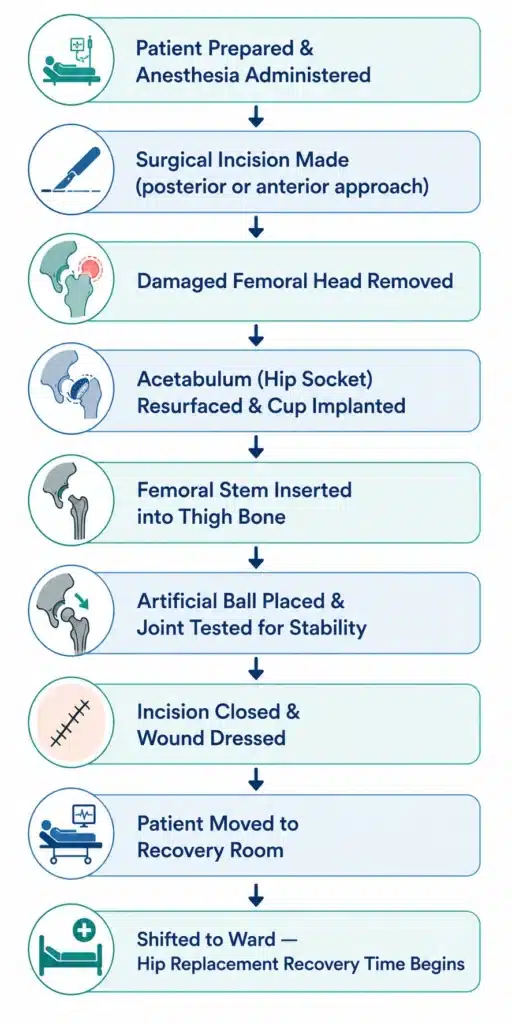
So from the time you enter the OT to the time you’re back in your hospital room, expect roughly 3 to 5 hours total, depending on your case. Most patients are surprised to learn the surgery itself is relatively short.
- Total hip replacement (THR): 1.5 to 2.5 hours on average.
- Partial hip replacement: 1 to 1.5 hours.
- Revision surgery (replacing an old implant): 2.5 to 4+ hours.
- Pre-op preparation (anesthesia, positioning): 30 to 45 minutes extra.
- Post-op recovery room stay: 1 to 2 hours before moving to the ward.
What happens during those 1.5–2.5 hours?
What is hip replacement recovery time?
Here’s where patients often get confused. The surgery takes 2 hours. But hip replacement recovery time is a completely different story, and it has phases.
Phase 1: Hospital stay (Day 1 to Day 3–4)
- Most patients stay in the hospital for 2 to 4 days.
- You will be asked to sit up within 24 hours of surgery.
- A physiotherapist will visit you on Day 1 itself; this is not optional.
- You’ll be doing ankle pumps, knee bends, and gentle movements in bed.
- Pain is managed through medications and ice therapy.
- A walker or crutches will be introduced.
Key milestone: Most patients take their first few steps with support within 24–48 hours of surgery. Yes, that soon.
Phase 2: Early home recovery (Week 1 to Week 6)
This is the phase where patients need the most support and the most patience.
| Week | What to Expect |
| Week 1–2 | Walking short distances with a walker, pain and swelling, and wound care. |
| Week 2–3 | Gradually increasing walking distance, beginning to manage daily tasks. |
| Week 3–4 | Transitioning from walker to cane in many cases. |
| Week 4–6 | Light daily activities, climbing stairs with support, and physiotherapy continue. |
Important: Hip replacement recovery time during this phase varies significantly based on age, weight, bone quality, and how regular you are with physiotherapy.
Phase 3: Active recovery (Week 6 to Month 3)
- Most patients stop needing a walking aid between 6 to 8 weeks.
- Walking after hip replacement surgery starts feeling more natural and less painful.
- Driving is typically allowed after 6 weeks (for right hip, consult your surgeon).
- Return to desk work: around 4 to 6 weeks.
- Return to physical work or field jobs: 3 to 6 months.
Phase 4: Full recovery (Month 3 to Month 12)
Full hip replacement recovery time is often quoted as 6 to 12 months, and here’s what that actually means:
- The implant continues to integrate with the bone for up to 6 months.
- Swelling and occasional discomfort can persist until month 4–5.
- Muscle strength fully returns around month 6–9.
- Most patients report feeling “back to normal” between months 6 and 12.
- High-impact activities (running, heavy lifting) typically cleared after 1 year.
Walking after hip replacement surgery: What’s normal, what’s not
Walking after hip replacement surgery is one of the most anxious topics for patients. Here’s what to expect realistically:
Normal milestones:
- Day 1–2: First steps with physiotherapist and walker support.
- Week 2–3: Walking 10–15 minutes continuously without resting.
- Week 4–6: Walking more confidently, less dependence on walker.
- Week 6–8: Many patients walk without any aid for short distances.
- Month 3–6: Walking feels genuinely normal again.
Signs that recovery is going well:
- Steady reduction in pain week by week.
- Improving walking distance without fatigue.
- Less swelling around the joint.
- Increasing confidence in movement.
Signs to report to your doctor immediately:
- Sudden sharp pain after days of improvement.
- Redness, warmth, or discharge from the wound.
- Fever above 101°F.
- One leg visibly shorter than the other (possible dislocation).
- Clicking or grinding sounds in the hip.
What affects hip replacement recovery time?
Not everyone heals at the same speed. Several factors influence how long hip replacement recovery time takes for you personally.
Factors that speed up recovery:
- Age under 65: younger bone and muscle respond faster.
- Healthy body weight: less stress on the new joint.
- Good pre-surgery fitness: stronger muscles recover faster.
- Consistent physiotherapy: the single biggest controllable factor.
- No smoking: smoking slows bone healing significantly.
- Positive mental attitude: this is backed by research, not just motivational talk.
Factors that slow down recovery:
- Obesity (BMI above 30).
- Poorly controlled diabetes.
- Osteoporosis or weak bone density.
- Skipping physiotherapy sessions.
- Returning to activity too soon.
- Previous surgeries or complications in the same joint.
- Advanced age with multiple comorbidities.
Anterior vs. posterior hip replacement: Does the approach change recovery time?
The anterior approach is gaining popularity because it avoids cutting major muscles. However, not every patient is a candidate; your surgeon at Rama Hospital or your treating facility will recommend the right approach based on your anatomy and condition.
Yes, and this is worth knowing before surgery.
| Factor | Anterior Approach | Posterior Approach |
| Muscle damage | Minimal | Moderate |
| Hospital stay | Slightly shorter | Standard |
| Early walking | Faster (often Day 1) | Day 1–2 |
| Dislocation risk | Lower | Slightly higher |
| Overall recovery | Typically faster | Standard |
| Common use | Younger, active patients | Broader range of cases |
Hip replacement surgery in Noida: what patients should know
If you’re looking for total hip replacement surgery in Noida, here’s what the local context looks like for patients from Delhi-NCR.
Noida has emerged as one of the stronger orthopedic hubs in NCR, with hospitals offering modern joint replacement facilities, experienced surgical teams, and post-operative rehabilitation programs.
Patients from Greater Noida, Noida Extension, Indirapuram, Vaishali, and Ghaziabad commonly seek hip replacement surgery in Noida to avoid the traffic and distance of central Delhi hospitals.
When evaluating a center for hip pain treatment in Noida, look for:
- Dedicated joint replacement unit: not just a general orthopedics department.
- High surgical volume: hospitals doing 200+ joint replacements annually have better outcomes.
- In-house physiotherapy: critical for faster hip replacement recovery time.
- Navigation or robotic-assisted surgery: improves implant precision.
- Transparent implant disclosure: you should know what brand and grade of implant is being used.
- Patient counseling before surgery: good hospitals prepare patients mentally too.
How to find the best orthopedic surgeon in Noida
- The surgeon’s training and fellowship in joint replacement directly impacts how precise and safe your surgery will be.
- Annual volume matters; a surgeon performing 100+ hip replacements a year has significantly sharper hands and judgment than one doing 10.
- Experience with complex and revision cases means your surgeon can handle complications, not just routine procedures.
- A good consultation tells you everything; if the surgeon listens, explains, and is honest about whether you even need surgery yet, that’s a green flag.
- Preoperative planning at a hospital like Rama Hospital is where recovery actually begins, long before you enter the operation theater.
Hip pain treatment in Noida: When is replacement actually necessary?
Not all hip pain needs a replacement. This matters, because many patients seek hip pain treatment in Noida and are immediately told to consider surgery without exploring all options first.
The right center for hip pain treatment in Noida will go through these options with you honestly before recommending surgery.
Conservative treatments that should be tried first:
- Physiotherapy and muscle strengthening.
- Anti-inflammatory medications.
- Corticosteroid injections.
- Activity modification and weight management.
- Hyaluronic acid injections (for early-stage arthritis).
When hip replacement becomes the right call:
- Severe pain that isn’t controlled by medications.
- Hip pain that disturbs sleep consistently.
- Significant loss of mobility and daily function.
- X-ray showing advanced joint space narrowing or bone-on-bone arthritis.
- Pain that has persisted and worsened over 6+ months despite treatment.
Frequently Asked Questions
Q1. I’m scared of the surgery. Is hip replacement a major operation?
It is a significant surgery, yes, but it is also one of the most commonly performed and well-studied orthopedic procedures in the world. Millions of hip replacements are done every year globally. Surgical techniques and implants have improved dramatically over the last two decades, helping improve hip replacement recovery time for many patients. Most patients who were hesitant say it was the best decision they made.
Q2. My mother is 72. Is she too old for hip replacement surgery?
Age alone is rarely a contraindication. Surgeons assess overall health, heart function, blood pressure control, and bone quality. Many patients in their 70s and 80s have successful hip replacements and return to functional independence. While hip replacement recovery time may vary based on age, overall health, and rehabilitation efforts, the quality-of-life improvement is often more dramatic for older patients who were severely limited before surgery.
Q3. How much pain will I have after surgery? Will I be able to handle it?
Pain is managed aggressively in the first few days through oral medications, injectable pain relief, and ice packs. Most patients describe the post-surgical discomfort as manageable, and importantly, it reduces steadily each week. The pain from surgery is very different from the chronic grinding pain of a damaged joint. Understanding the expected hip replacement recovery time can help patients stay confident during recovery, as pain levels typically improve significantly with proper rehabilitation and follow-up care.
Q4. When will I be able to climb stairs after hip replacement?
Most patients start climbing stairs with support around 2 to 3 weeks post-surgery. During this phase of hip replacement recovery time, patients typically take one step at a time, leading with the operated leg going down and the non-operated leg going up. By week 6, most patients can manage stairs fairly comfortably as their strength, balance, and overall hip replacement recovery time progress steadily.
Q5. Can I sleep normally after surgery? What position is safe?
For the first 6 weeks, you need to avoid certain positions that risk hip dislocation:
- Don’t cross your legs
- Don’t bend your hip beyond 90 degrees
- Sleep on your back or on the non-operated side with a pillow between your knees
Your surgeon will give you a specific precaution list based on your surgical approach.
Q6. How long before I can travel, like take a train or a long car journey?
Short car rides (15–20 minutes) are usually fine from week 2–3. Longer journeys are advisable only after week 6, and you should stop every 45–60 minutes to walk around and stretch. Air travel is typically cleared around 6 weeks, subject to clot risk assessment.
Q7. Will I need a second hip replacement eventually? How long does the implant last?
Modern hip implants typically last 15 to 25 years, sometimes longer. Factors that affect longevity include your activity level, body weight, implant type, and bone quality. Younger patients may need a revision surgery in their lifetime. This should be discussed honestly with your surgeon before you decide.
Q8. My doctor says I need hip replacement, but I’m not in unbearable pain. Should I rush?
Not necessarily. Some patients delay surgery until pain significantly impacts daily life. However, waiting too long can weaken the surrounding muscles, worsen bone quality, and make surgery more complex. The right time is a conversation between you and your surgeon, based on functional limitation, not just a pain score alone.
Q9. What is the difference between total and partial hip replacement?
- Total hip replacement (THR): Both the ball (femoral head) and socket (acetabulum) are replaced. Most common procedure for arthritis.
- Partial hip replacement (hemiarthroplasty): Only the femoral head (ball) is replaced. Common in femoral neck fractures, especially in older patients.
Hip replacement recovery time is slightly faster for partial replacements, but the choice is based on diagnosis, not convenience.
Q10. What should I prepare at home before hip replacement surgery?
Preparing your home in advance makes hip replacement recovery time significantly smoother:
- Arrange a ground-floor or single-level living space for the first few weeks
- Get a raised toilet seat (bending below 90 degrees is restricted)
- Remove loose rugs and floor clutter (fall risk)
- Keep frequently used items at accessible height
- Prepare meals in advance or arrange for cooking support
- Arrange transport for follow-up visits
- Have a reacher/grabber tool ready for picking things up
Conclusion
Hip replacement surgery takes roughly 1.5 to 2.5 hours in the operating room. But hip replacement recovery time is a 6- to 12-month journey, with the most significant progress happening in the first 3 months.
The good news: with the right surgeon, the right facility, consistent physiotherapy, and realistic expectations, most patients return to a pain-free, active life that they couldn’t have imagined during their worst days of hip pain.
If you’re experiencing hip pain, don’t wait until you can’t walk without help. Early evaluation and timely treatment, whether surgical or non-surgical, deliver far better outcomes.
For those looking for hip replacement surgery in Noida, hip pain treatment in Noida, or the best orthopedic surgeon in Noida, start with a detailed consultation. Bring your X-rays. Ask every question on this list. And choose a team, like the one at Rama Hospital, that takes the time to guide you through the entire journey, not just the surgery.