You wake up. You drink tea, skip breakfast, sit at a desk for 8 hours, and maybe drink one glass of water before dinner.
Sounds normal, right?
For millions of Indians, this routine is quietly building kidney stones, and most people don’t find out until the pain hits.
The truth is, daily habits causing kidney stones are not dramatic. They are ordinary. And that’s exactly what makes them dangerous.
Why kidney stones are becoming so common in India
Kidney stone cases in India have risen sharply over the last decade. Urban lifestyle, heat, processed food, and poor hydration form a perfect storm.
The uncomfortable fact: most kidney stones are preventable. The problem is the lifestyle causes of kidney stones that nobody talks about.
- India has one of the highest rates of kidney stone recurrence globally.
- Noida, Delhi NCR, and North India see higher stone prevalence due to hard water and extreme summer heat.
- Most patients don’t know they have a stone until it moves.
The daily habits causing kidney stones (Most people ignore these)
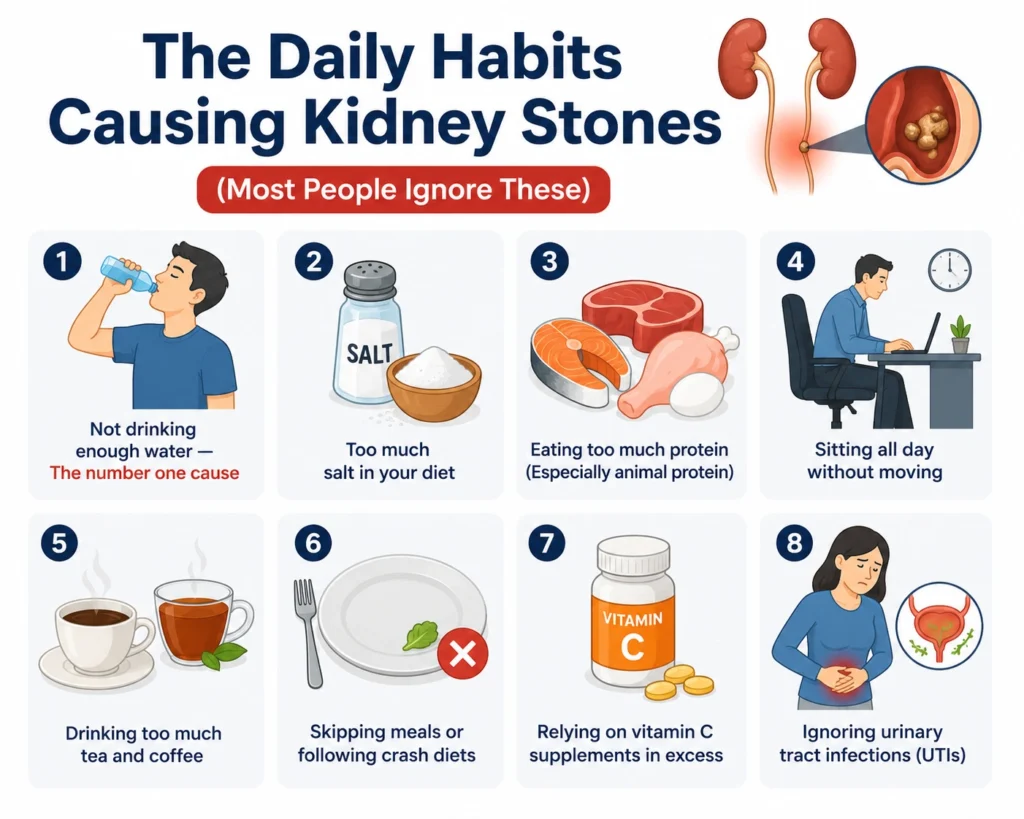
1. Not drinking enough water: The number one cause
This one is simple and still ignored.
- The average Indian drinks 1–1.5 liters of water daily. The requirement is 2.5–3 liters.
- When you’re dehydrated, urine becomes concentrated. Minerals start to crystallize.
- That crystallization is how kidney stones begin.
Daily habits causing kidney stones almost always start here; low water intake is the most common and most correctable risk factor.
If your urine is dark yellow, you are not drinking enough.
2. Too much salt in your diet
Most Indians consume salt far beyond the WHO-recommended 5 grams per day.
- High salt = high sodium in blood = kidneys excrete more calcium into urine.
- Excess urinary calcium binds with oxalate = calcium oxalate stones (the most common type).
- Packaged foods, pickles, papads, and instant noodles are all high-sodium traps.
Daily habits causing kidney stones often hide in your kitchen, not just your glass.
| Food Item | Approximate Sodium Content |
| 1 packet instant noodles | 800–1,100 mg sodium |
| 2 tablespoons pickles (achar) | 400–600 mg sodium |
| 1 serving salted chips | 300–500 mg sodium |
| WHO daily limit | 2,000 mg sodium |
3. Eating too much protein (Especially animal protein)
High-protein diets are trending. But excess protein, especially animal protein, raises uric acid and reduces urinary citrate, both of which increase stone risk.
- Red meat, chicken, and eggs in large daily quantities raise uric acid levels.
- Uric acid stones are the second most common type in India.
- Even gym-goers on protein supplements can be at risk if hydration is poor.
The key isn’t avoiding protein. It’s balance. Lifestyle causes of kidney stones are rarely about one food; they’re about consistent excess.
4. Sitting all day without moving
A sedentary lifestyle does something specific: it causes calcium to leach from bones into the bloodstream.
- That excess calcium is excreted through the kidneys.
- Combined with low water intake, it raises stone risk significantly.
- Office workers, drivers, and people with desk jobs are especially vulnerable.
Daily habits causing kidney stones are not just dietary. Physical inactivity plays a real role that most patients never hear about.
5. Drinking too much tea and coffee
That doesn’t mean stop drinking chai. It means balance it with water. This one surprises people.
- Tea (especially black tea) is high in oxalate, a key compound in calcium oxalate stones.
- Drinking 4–6 cups of tea daily without adequate water is a well-documented daily mistake causing kidney stones in India.
- Coffee, while a mild diuretic, increases urinary calcium excretion in high quantities.
6. Skipping meals or following crash diets
Kidney stone prevention habits must include regular, balanced meals, not just hydration. Fasting or very low-calorie diets increase uric acid production.
- Rapid weight loss increases uric acid in blood.
- Extended fasting reduces urinary pH, making it easier for uric acid stones to form.
- Irregular eating patterns also affect how the gut processes oxalate.
7. Relying on vitamin C supplements in excess
Vitamin C supplements are popular, and in high doses, they convert to oxalate in the body.
- More than 1,000 mg/day of supplemental vitamin C significantly raises urinary oxalate.
- This is one of the less obvious daily habits causing kidney stones, particularly for health-conscious individuals.
- Getting Vitamin C from fruits (amla, oranges) is safer than megadose supplements.
8. Ignoring urinary tract infections (UTIs)
Recurrent or untreated UTIs can directly cause struvite stones.
- Certain bacteria create an environment where minerals clump together.
- Women with recurrent UTIs are at higher risk.
- Delayed treatment is one of the daily mistakes causing kidney stones that gets overlooked entirely.
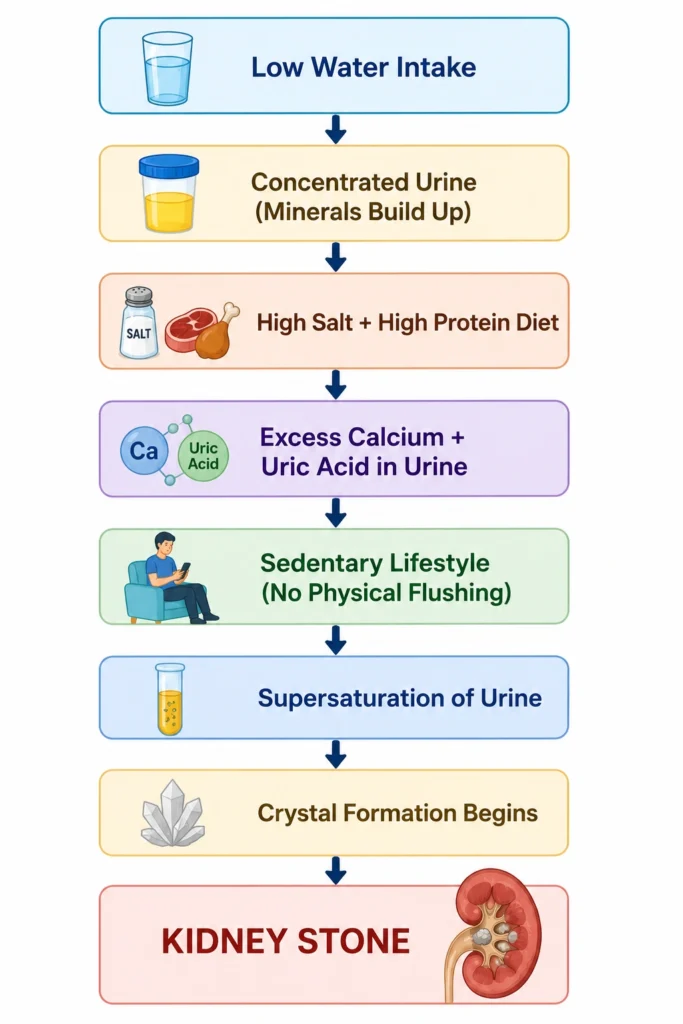
How these habits stack up: A risk profile flow
The process isn’t overnight. It takes weeks to months. But daily habits causing kidney stones accumulate silently until one day the pain becomes unbearable.
Kidney stone prevention habits: What to do instead
These kidney stone prevention habits don’t require dramatic lifestyle overhauls. Small, consistent adjustments change your risk profile significantly.
| Harmful Habit | Better Alternative |
| Drinking < 1.5L water/day | Drink 2.5–3 L of water, more in summer. |
| Excess salt in food | Use lemon juice and herbs for flavour instead. |
| High red meat consumption | Balance with plant protein like dal and legumes. |
| Sitting 8–10 hours without breaks | Walk 5 minutes every hour. |
| 5–6 cups of tea daily | Replace 2 cups with plain water or coconut water |
| Crash dieting | Maintain consistent, balanced nutrition |
| Taking megadoses of Vitamin C | Limit supplements to 500 mg/day unless prescribed |
When should you see a urologist?
Most people wait until the pain is unbearable. Don’t.
See a doctor if:
- You feel pain in the lower back, sides, or groin without an obvious cause.
- There is blood in your urine (even light pink).
- You have a burning sensation while urinating.
- You’ve had a kidney stone before (recurrence rate is high without lifestyle changes).
- You have a family history of kidney stones.
If you are in Noida or Delhi NCR, kidney stone treatment in Noida is available with advanced diagnostic and treatment options, including minimally invasive procedures that don’t require large incisions or long hospital stays.
The best urologist in Noida can assess your stone type, identify your personal risk factors, and create a treatment and prevention plan specific to you.
Frequently Asked Questions (FAQs)
Q1. Can kidney stones go away on their own without treatment?
Yes, small kidney stones (usually less than 5 mm in size) can sometimes pass naturally through the urinary tract with adequate hydration and time. Drinking plenty of water helps increase urine flow, which may assist in flushing the stone out. However, larger stones or stones causing severe pain, infection, or blockage often require medical treatment. If symptoms persist, it is important to consult a doctor.
Q2. I drink enough water. Can I still get kidney stones?
Yes. While hydration is one of the most effective ways to reduce the risk of kidney stones, it is not the only factor involved. A diet high in salt, sugar, or animal protein, certain medical conditions, obesity, and genetic factors can also contribute to stone formation. Even people who drink sufficient water can develop stones if other risk factors are present. A balanced diet and healthy lifestyle are equally important for prevention.
Q3. My pain stopped. Does that mean the stone has passed?
Not necessarily. Kidney stone symptoms can come and go depending on the stone’s location within the urinary tract. Sometimes the pain decreases because the stone has moved to a less sensitive area, not because it has left the body. The stone may still be present and capable of causing future symptoms or complications. Imaging tests such as an ultrasound or CT scan can confirm whether the stone has passed completely.
Q4. Are kidney stones hereditary?
Yes, genetics can increase your risk of developing kidney stones. If a close family member, such as a parent or sibling, has had kidney stones, you may be more likely to experience them as well. Certain inherited conditions can also affect how the body processes minerals and increase stone formation. If you have a family history, adopting preventive habits and regular health check-ups can help lower your risk.
Q5. What foods should I avoid completely if I’ve had a kidney stone?
The answer depends on the type of stone you had. For example, people with calcium oxalate stones may need to limit foods such as spinach, beetroot, nuts, chocolate, and excessive tea. Those with uric acid stones may benefit from reducing red meat and high-purine foods. Rather than avoiding foods completely, it is best to identify your stone type and follow a personalized dietary plan recommended by your doctor or dietitian.
Q6. Is kidney stone treatment painful?
Most modern kidney stone treatment procedures are designed to be minimally invasive and are performed under anesthesia, so patients do not feel pain during the procedure. Techniques such as laser stone removal, ureteroscopy, and shock wave therapy are generally safe and effective. Some mild discomfort may occur during recovery, but it is usually manageable with medication. Many patients are able to return home within a day or two.
Q7. How soon can kidney stones recur after treatment?
Unfortunately, kidney stones can return if the underlying causes are not addressed. Studies show that recurrence rates may reach 50% within five years in some patients. Factors such as poor hydration, unhealthy dietary habits, and untreated medical conditions can increase the chances of developing another stone. Following your doctor’s advice and adopting long-term prevention strategies can significantly reduce the risk of recurrence.
Conclusion
Kidney stones are painful, preventable, and increasingly common.
Daily habits causing kidney stones don’t announce themselves. They hide in your chai routine, your desk job, your evening snacks, and your forgetting to refill the water bottle. Recognizing these everyday risk factors and making simple lifestyle changes can go a long way in preventing kidney stones. Seeking timely guidance from the best hospital in Noida can help you understand your risk, adopt preventive measures, and protect your kidney health before problems develop.
The fix starts small: drink more water, reduce salt, move your body, and get a check-up if something feels off.
If you’re in Noida or nearby and experiencing symptoms, or if you want to understand your personal kidney stone risk, consult the best urologist in Noida at Rama Hospital for an expert evaluation.
Your kidneys work every second of every day. They deserve the same attention in return.
For appointments and consultations, contact Rama Hospital, the trusted choice for kidney stone treatment in Noida.