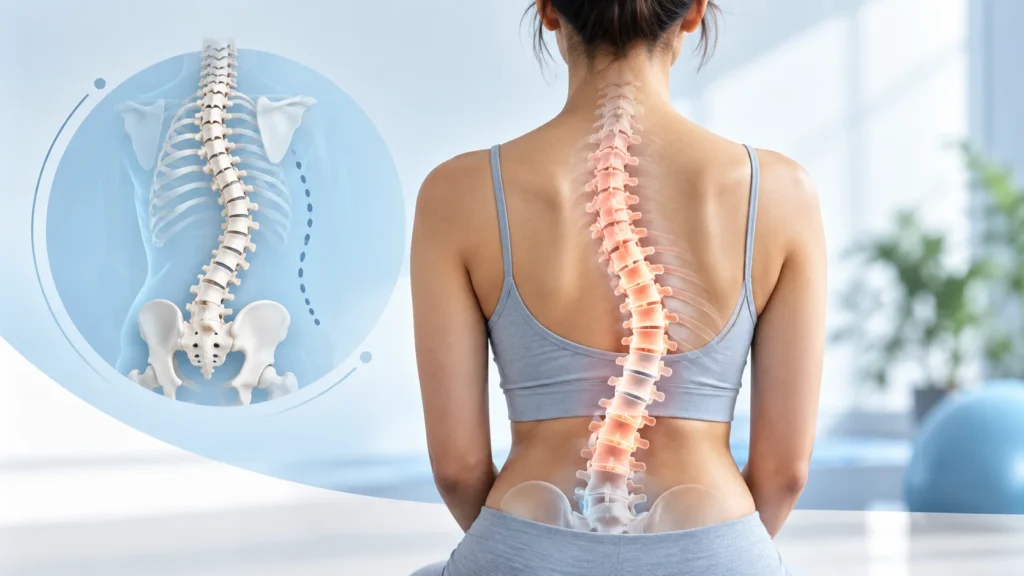
Scoliosis is a condition in which the spine curves sideways instead of staying straight. Instead of a normal vertical line, the spine may form a C-shape or S-shape when viewed from behind. This curvature can happen in children, teenagers, or adults. In many cases, scoliosis is mild and causes no major problems. In other cases, the curve can progress over time and affect posture, appearance, breathing, and daily function.
Most people first notice scoliosis as uneven shoulders, a tilted waist, one hip appearing higher than the other, or a visible curve in the back. Some people feel pain, while others have no pain at all. The condition can be present from childhood or develop later due to degeneration, injury, or other spine problems. Early detection and proper management are important to prevent worsening of the curve and reduce long-term complications.
What is Scoliosis?
Scoliosis is a three-dimensional deformity of the spine. It involves sideways curvature along with rotation of the vertebrae. This means the spine not only bends to one side but also twists slightly. The degree of curvature is measured in degrees using an X-ray. A curve of more than ten degrees is generally considered scoliosis.
Scoliosis can affect any part of the spine, including the upper back, mid-back, or lower back. The curve may be small and stable, or it may increase over time, especially during growth spurts in children and teenagers. In adults, scoliosis may develop due to wear and tear of the spine, disc degeneration, or previous untreated curvature from childhood.
Many people with mild scoliosis live normal lives without major limitations. However, moderate to severe scoliosis can affect posture, body symmetry, breathing, and self-confidence. In some cases, it can cause back pain, nerve compression, or reduced lung capacity if the curve is very severe.
Types of Scoliosis
Scoliosis can be classified in different ways based on age of onset, cause, and pattern of curvature.
Based on age of onset
- Infantile scoliosis, which occurs in children under three years of age.
- Juvenile scoliosis, which occurs in children between four and ten years of age.
- Adolescent idiopathic scoliosis, which is the most common type and occurs between ten and eighteen years of age.
- Adult scoliosis, which may be a continuation of adolescent scoliosis or develop due to degeneration later in life.
Based on cause
- Idiopathic scoliosis, where the exact cause is not known. This is the most common type.
- Congenital scoliosis, which is present at birth due to abnormal formation of the vertebrae.
- Neuromuscular scoliosis, which is associated with conditions such as cerebral palsy, muscular dystrophy, or spinal cord injury.
- Degenerative scoliosis, which develops in adults due to wear and tear of the spine, disc degeneration, or arthritis.
- Syndromic scoliosis, which is associated with certain genetic or connective tissue disorders.
Based on curve pattern
- Thoracic scoliosis, which affects the upper and mid-back.
- Lumbar scoliosis, which affects the lower back.
- Thoracolumbar scoliosis, which affects both the mid and lower back.
- Double major curve, where there are curves in two different parts of the spine.
Causes of Scoliosis
In many cases, especially in adolescents, the exact cause of scoliosis is not known. This is called idiopathic scoliosis. However, several factors may contribute to the development or progression of the curve.
Common causes and contributing factors
- Genetic predisposition, as scoliosis often runs in families.
- Abnormal growth of the spine during childhood or adolescence.
- Congenital vertebral abnormalities present at birth.
- Neuromuscular conditions affecting muscle control and spine support.
- Degenerative changes in the spine in older adults.
- Previous spine injury or surgery.
- Connective tissue disorders affecting ligament strength.
- Hormonal or growth-related factors during puberty.
Why the spine curves
The spine is supported by muscles, ligaments, and bones working together. If one side grows faster than the other, or if muscle control is uneven, the spine may begin to curve. Over time, this curvature can become more pronounced, especially during rapid growth periods. In adults, disc degeneration and arthritis can cause the spine to shift and curve unevenly.
Risk Factors for Scoliosis
Some people are more likely to develop scoliosis or experience curve progression than others.
Higher-risk groups
- Children and teenagers going through growth spurts.
- Girls, who are more likely to have progressive curves than boys.
- People with a family history of scoliosis.
- Children with neuromuscular conditions.
- Adults with significant spine degeneration.
- People with connective tissue disorders.
- Individuals with previous spine injury or surgery.
Why risk increases in these groups
- Rapid growth can accelerate curve progression in adolescents.
- Hormonal and genetic factors may influence spine development.
- Muscle weakness or imbalance can reduce spine support.
- Degenerative changes can alter spine alignment over time.
- Connective tissue disorders can affect ligament and joint stability.
Symptoms of Scoliosis
Symptoms depend on the age of the patient, the severity of the curve, and whether there is an underlying condition.
Common symptoms in children and teenagers
- Uneven shoulders, with one shoulder blade more prominent than the other.
- Uneven waist or hips, with one side appearing higher.
- Visible curvature of the spine when bending forward.
- Clothes hanging unevenly on the body.
- Leaning to one side when standing.
- In some cases, mild back discomfort or fatigue.
Common symptoms in adults
- Chronic back pain or stiffness.
- Visible curvature or postural changes.
- Reduced height or stooped posture.
- Numbness, tingling, or weakness in the legs if nerves are compressed.
- Reduced walking distance due to pain or fatigue.
- Breathing difficulty in very severe curves.
- Difficulty standing upright for long periods.
Warning signs that need medical attention
- Rapidly worsening curvature during growth.
- Severe or increasing back pain.
- Numbness, weakness, or balance problems.
- Breathing difficulty or reduced exercise tolerance.
- Noticeable postural changes affecting daily life.
- Emotional distress due to body appearance.
Scoliosis in Children and Adolescents
Scoliosis is most commonly diagnosed during the adolescent growth spurt. Many children have no pain and are diagnosed only because of visible asymmetry or during school screening.
Key points for parents
- Look for uneven shoulders, waist, or hips.
- Check for a rib hump when the child bends forward.
- Notice if clothes do not hang evenly.
- Do not ignore visible curvature even if there is no pain.
- Early evaluation can help decide if monitoring, bracing, or other treatment is needed.
Why early detection matters
During growth, curves can progress quickly. Early detection allows for timely intervention, which may include observation, exercises, or bracing to prevent worsening. Severe curves may require surgery if they continue to progress despite other measures.
Scoliosis in Adults
Adult scoliosis may be a continuation of untreated adolescent scoliosis or may develop due to degeneration of the spine.
Common features in adults
- Back pain and stiffness are more common than in adolescents.
- Curves may progress slowly over years.
- Nerve compression can cause leg pain, numbness, or weakness.
- Postural changes may affect balance and walking.
- Breathing may be affected in very severe curves.
Why adult scoliosis needs attention
Adults may have additional spine problems such as disc degeneration, arthritis, or spinal stenosis. These can worsen symptoms and complicate treatment. Proper evaluation helps distinguish between curvature-related symptoms and other spine conditions.
How is Scoliosis Diagnosed?
Diagnosis is based on physical examination, medical history, and imaging tests.
Diagnostic steps
- Detailed history of symptoms and family history.
- Physical examination of posture, shoulder and hip alignment.
- Forward bending test to check for rib hump or asymmetry.
- Neurological examination to check strength, sensation, and reflexes.
- Imaging tests to measure the curve and assess spine structure.
Common tests that may be done
- Standing X-ray of the full spine to measure the curvature in degrees.
- MRI of the spine if there are neurological symptoms or atypical features.
- CT scan in selected cases for detailed bone assessment.
- Bone density test in adults to assess osteoporosis risk.
- Lung function tests in severe curves affecting breathing.
Why diagnosis matters
Accurate diagnosis helps determine the type of scoliosis, the severity of the curve, and the risk of progression. This guides whether the patient needs observation, bracing, exercises, or surgery.
Treatment for Scoliosis
Treatment depends on the age of the patient, the severity of the curve, the risk of progression, and the presence of symptoms.
Treatment for mild scoliosis
- Regular observation with periodic X-rays.
- Postural awareness and core strengthening exercises.
- General physical activity to maintain fitness.
- Pain management if discomfort is present.
- Education for parents and patients about warning signs.
Treatment for moderate scoliosis in growing children
- Bracing to prevent curve progression during growth.
- Specific scoliosis exercises under guidance.
- Regular follow-up to monitor curve changes.
- Activity modification if certain sports worsen symptoms.
- Emotional support to cope with body image concerns.
Treatment for severe or progressive scoliosis
- Surgical evaluation if the curve is severe or worsening.
- Preoperative optimization of nutrition and fitness.
- Discussion of surgical options, risks, and benefits.
- Postoperative rehabilitation and long-term follow-up.
1. Observation and monitoring
For mild curves, especially in children who are still growing, regular monitoring is often the first step.
- X-rays every six to twelve months depending on growth and curve size.
- Assessment of posture and symptoms at each visit.
- Early intervention if the curve shows signs of progression.
2. Bracing
Bracing is commonly used in growing children with moderate curves to prevent worsening.
- The brace is worn for many hours each day as advised.
- It does not usually straighten the spine but helps stop progression.
- Compliance with brace wear is important for effectiveness.
- Regular adjustments are needed as the child grows.
3. Exercises and physiotherapy
Specific exercises can help improve posture, core strength, and body awareness.
- Scoliosis-specific exercise programs under trained guidance.
- General strengthening and stretching for back and core muscles.
- Breathing exercises to improve chest expansion.
- Postural training for daily activities.
4. Pain management
Pain management is important, especially in adults or those with discomfort.
- Medicines for pain and inflammation when needed.
- Heat or cold therapy for muscle relief.
- Activity modification to avoid aggravating movements.
- Core strengthening to support the spine.
5. Surgical treatment
Surgery is considered when the curve is severe, progressive, or causing significant symptoms.
- Spinal fusion with rods and screws to straighten and stabilize the spine.
- Growth-friendly techniques for younger children who are still growing.
- Decompression surgery in adults if nerves are compressed.
- Goal is to prevent progression, improve alignment, and reduce symptoms.
Recovery After Treatment
Recovery depends on the type of treatment, the severity of the curve, and the patient’s overall health.
Recovery after bracing
- Continued normal activities with brace wear as advised.
- Regular follow-up to assess fit and curve stability.
- Gradual weaning off the brace when growth is complete.
- Ongoing exercises to maintain strength and posture.
Recovery after surgery
- Hospital stay for monitoring and pain control.
- Gradual increase in walking and activity.
- Restrictions on bending, lifting, and twisting initially.
- Physiotherapy to improve strength and mobility.
- Long-term follow-up to monitor spine healing and function.
Long-term care
- Periodic check-ups even after treatment is complete.
- Maintenance of core strength and general fitness.
- Attention to bone health, especially in adults.
- Prompt evaluation if new symptoms develop.
Possible Complications
Scoliosis can lead to complications, especially if the curve is severe or left untreated.
Complications in children and adolescents
- Progression of the curve during growth.
- Body asymmetry affecting self-confidence.
- Rarely, breathing or heart issues in very severe curves.
- Need for surgery if bracing is not effective.
Complications in adults
- Chronic back pain and stiffness.
- Nerve compression causing leg pain or weakness.
- Reduced walking distance and activity tolerance.
- Spinal stenosis or disc problems.
- Breathing difficulty in very severe curves.
- Emotional impact due to posture and appearance.
Why complications happen
As the curve progresses, it can alter the alignment of the spine, ribs, and pelvis. This can affect muscle balance, joint loading, and nerve space. Over time, this may lead to pain, functional limitations, and reduced quality of life.
When to See a Doctor
Medical evaluation is important for anyone with suspected scoliosis or worsening symptoms.
- Uneven shoulders, waist, or hips.
- Visible curvature of the spine.
- One shoulder blade more prominent than the other.
- Clothes hanging unevenly on the body.
- Persistent back pain or stiffness.
- Numbness, tingling, or weakness in the legs.
- Breathing difficulty or reduced exercise tolerance.
Prevention and Long-Term Management
Not all scoliosis can be prevented, especially idiopathic types. However, early detection and proper management can reduce complications.
Management pointers
- Regular check-ups for children during growth years.
- Prompt evaluation of visible postural changes.
- Adherence to bracing and exercise advice when prescribed.
- Maintenance of core strength and general fitness.
- Attention to bone health through diet and lifestyle.
- Avoidance of smoking and excessive alcohol in adults.
- Weight management to reduce spine load.
For families with history of scoliosis
- Be alert to early signs in children.
- Consider screening if there is strong family history.
- Maintain regular follow-up during growth spurts.
Why Choose Rama Hospital for Scoliosis Treatment?
Scoliosis requires careful evaluation, individualized treatment planning, and long-term follow-up. A hospital with experienced orthopedic and spine specialists, advanced imaging, and rehabilitation support can make a major difference in outcomes.
- Expert assessment by orthopedic and spine specialists.
- Accurate measurement of curvature and progression risk.
- Access to bracing, physiotherapy, and surgical options.
- Coordinated care for children, adolescents, and adults.
- Long-term follow-up to monitor spine health.
Frequently Asked Questions (FAQs)
Is scoliosis painful?
Not always. Many children and teenagers with scoliosis have little or no pain. Adults with scoliosis are more likely to experience back pain, stiffness, or nerve-related symptoms due to degeneration and curve progression.
Can scoliosis be cured?
Scoliosis cannot always be completely cured, but it can be managed effectively. Mild curves may only need monitoring. Moderate curves may be controlled with bracing. Severe or progressive curves may require surgery to prevent worsening and improve alignment.
Does scoliosis get worse over time?
It can, especially during growth spurts in children and teenagers. In adults, curves may progress slowly due to degeneration. Regular monitoring helps detect progression early and guide appropriate treatment.
Can adults develop scoliosis?
Yes, adults can develop scoliosis due to degeneration of the spine, disc problems, or untreated curvature from childhood. Adult scoliosis often causes back pain, stiffness, and sometimes nerve symptoms.
Is surgery always needed for scoliosis?
No, surgery is not needed for everyone. It is considered for severe or progressive curves, or when symptoms significantly affect quality of life. Many patients are managed with observation, exercises, or bracing.
Can exercises correct scoliosis?
Exercises alone usually cannot straighten a significant curve, but they can improve posture, core strength, and body awareness. Specific scoliosis exercises are often used along with other treatments such as bracing or surgery.
Can scoliosis affect breathing?
In very severe curves, especially in the upper back, scoliosis can reduce chest space and affect lung function. This is more common in large, untreated curves. Most mild to moderate curves do not significantly affect breathing.
Conclusion
Scoliosis is a common spine condition that can affect children, teenagers, and adults. It involves sideways curvature of the spine and can range from mild to severe. While many people with mild scoliosis live normal lives, moderate to severe curves can affect posture, appearance, pain levels, and in some cases, breathing and nerve function.
The most important steps are early detection, accurate diagnosis, and appropriate management based on age, curve severity, and symptoms. For patients with visible postural changes, back pain, or known scoliosis, regular follow-up and individualized treatment can make a major difference. With the right care, most patients can maintain good function and quality of life.
Rama Hospital can help evaluate scoliosis, measure curve progression, and provide a clear treatment plan that includes monitoring, bracing, exercises, pain management, and surgical options when needed.