If you have been told that you may need dialysis, one of the first questions you may have is: “Should I choose peritoneal dialysis or hemodialysis?”
The answer is not the same for everyone. Peritoneal dialysis (PD) and hemodialysis (HD) are both established treatments for kidney failure, but they work differently and affect your daily life in different ways. Your kidney function, overall health, other medical conditions, ability to manage treatment, home environment, lifestyle and personal preferences can all influence which option is more suitable.
For some people, PD offers greater flexibility because it can be performed at home. Others may prefer HD at a centre because trained healthcare professionals manage the treatment. Neither option is automatically “better” for every patient.
Understanding the differences can help you have a more informed conversation with your nephrologist.
What Is Dialysis and Why Is It Needed in Kidney Failure?
Healthy kidneys remove waste products and excess fluid from the blood, help maintain electrolyte balance and perform several other important functions.
When the kidneys become severely damaged and can no longer perform enough of this work, waste and extra fluid can build up in the body. At this stage, treatment may include procedure, kidney transplantation or, for some patients, conservative kidney care, depending on the individual situation.
This does not cure kidney failure. Instead, it performs part of the work that healthy kidneys normally do.
The two main types of dialysis are:
- Hemodialysis (HD)
- Peritoneal dialysis (PD)
What Is Hemodialysis?
HD uses a machine and a special filter called a dialyzer to clean your blood.
During treatment, blood is taken from your body through a vascular access, passed through the dialyzer to remove waste and excess fluid, and then returned to your bloodstream. HD can be performed at a centre or, for suitable patients, at home.
In-centre hemodialysis is commonly scheduled several times a week. A typical session may last around four hours, although the exact schedule depends on the patient’s medical needs and the prescription.
Before starting long-term HD, patients generally need a suitable vascular access, such as an arteriovenous fistula or graft, when possible.
What Is Peritoneal Dialysis?
PD uses the lining of your abdomen, called the peritoneum, as a natural filter.
A soft catheter is placed into the abdomen. A cleansing fluid called dialysate enters the abdominal cavity through the catheter. Waste products and excess fluid move from the blood across the peritoneal membrane into the dialysate. The used fluid is then drained and replaced with fresh solution.
There are two main types:
- Continuous Ambulatory Peritoneal Dialysis (CAPD): CAPD is performed manually during the day. The patient usually performs several fluid exchanges throughout the day.
- Automated Peritoneal Dialysis (APD): APD uses a machine called a cycler to perform exchanges, commonly while the patient sleeps.
Peritoneal Dialysis vs Hemodialysis: What Is the Difference?
The biggest difference is where the blood is filtered.
With HD, blood leaves the body and passes through an external dialysis machine.
With PD, the blood remains inside the body and the peritoneal lining acts as the filtering membrane. The choice is not simply about which treatment removes more waste. The treatment must also be safe, sustainable and practical for the patient’s life.
| Feature | Peritoneal Dialysis | Hemodialysis |
| How it works | Peritoneal lining filters blood | Dialyzer machine filters blood |
| Location | Usually performed at home | Centre or home |
| Frequency | Usually performed every day | Schedule varies; in-centre treatment is commonly several times weekly |
| Access | Abdominal catheter | Vascular access |
| Needles | No needles during PD exchanges | Needles are commonly used with fistula/graft access |
| Lifestyle | Greater flexibility for some patients | More structured schedule for in-centre HD |
| Training | Patient/caregiver training required | Centre-based treatment is managed by trained staff |
| Main infection concern | Peritonitis/catheter infection | Vascular-access infection |
| Storage | Requires space for PD supplies | Less home storage for in-centre HD |
| Travel | Can be convenient with planning | Centre availability and scheduling may affect travel |
Which Is Better: PD or Hemodialysis?
Neither PD nor HD is universally better. Both can effectively provide dialysis for people with kidney failure, and the most suitable option depends on the patient’s medical condition, lifestyle, preferences, support system and ability to manage the treatment.
For example, a person who values independence, wants to avoid regular travel to a centre and can safely perform treatment at home may prefer PD.
Another person may feel more comfortable having procedure performed by a trained healthcare team at a dialysis centre and may therefore prefer in-centre HD.
Your nephrologist will consider the full picture rather than choosing a treatment based on one factor alone.
What Are the Advantages of PD?
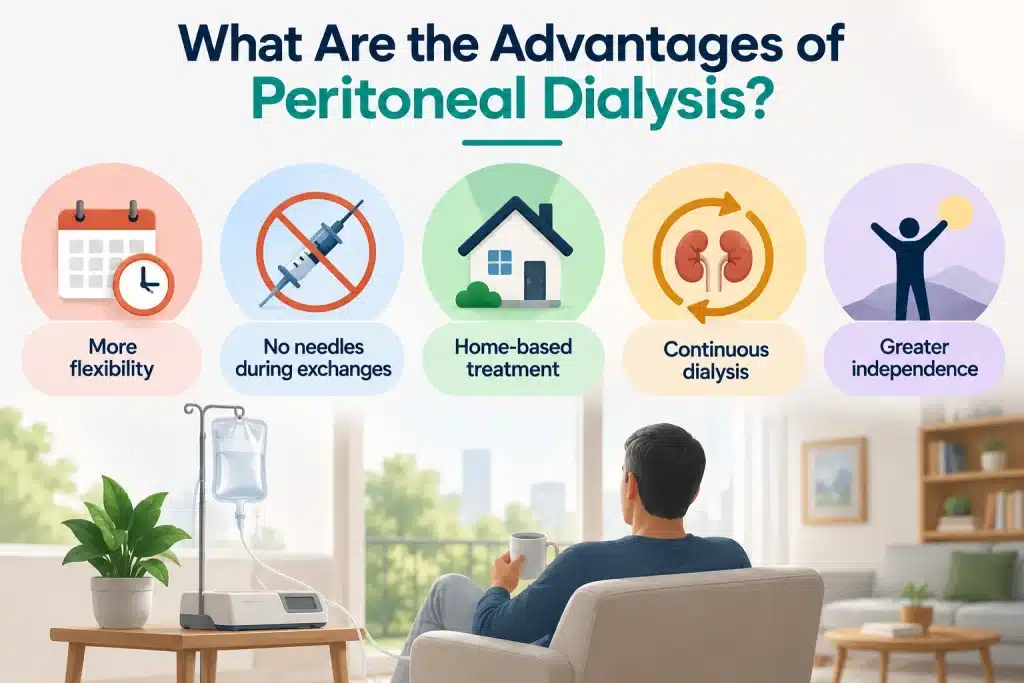
PD can offer several practical benefits. However, these advantages come with responsibilities. PD usually needs to be performed every day, and patients must follow careful hygiene and catheter-care procedures.
- More flexibility: Because PD is generally performed at home, it may give patients greater control over when and where treatment takes place. It can also make work, travel and daily activities easier for some people.
- No needles during exchanges: PD does not require repeated needle insertion for each exchange.
- Home-based treatment: Patients can perform PD at home, work or other suitable clean environments after appropriate training.
- Continuous dialysis: PD provides a more continuous form of fluid and waste removal compared with conventional in-centre HD schedules. This may help some patients manage fluid levels more gradually.
- Greater independence: For patients who are comfortable managing their treatment, PD can provide a greater sense of control over their daily routine.
What Are the Advantages of Hemodialysis?
Hemodialysis also has important benefits.
- Healthcare professionals can manage treatment: In-centre HD is performed with trained staff available during treatment.
- Less dialysis equipment at home: Patients receiving in-centre HD do not need to store large quantities of dialysis fluid at home in the same way that many PD patients do.
- A structured routine: Some patients prefer having fixed procedure appointments rather than managing treatment themselves at home.
- Home hemodialysis is another option: Hemodialysis is not necessarily limited to a centre. Suitable patients may be able to receive home hemodialysis, which can offer greater flexibility and, depending on the prescription, more frequent or longer treatments.
What Are the Risks and Disadvantages of PD?
PD is effective, but it is not suitable for everyone.
One of the most important concerns is infection, particularly peritonitis, an infection involving the peritoneal cavity. Proper catheter care and hygiene are essential to reduce this risk. The suitability of PD should therefore be assessed individually.
Other considerations may include:
- Daily treatment responsibilities
- Need for proper training
- Storage space for proocedure supplies
- Possible weight gain related to glucose absorbed from procedure fluid
- Blood glucose management may become more challenging for some people with diabetes
- Some abdominal conditions or previous abdominal surgeries may make PD difficult or unsuitable
What Are the Risks and Disadvantages of HD?
HD also has potential challenges.
In-centre treatment requires regular travel and adherence to a fixed schedule. Some patients may find this difficult alongside work, family responsibilities or other daily activities.
Home HD can provide greater scheduling flexibility, but it requires training, appropriate equipment and, in some cases, a care partner.
Other considerations include:
- Need for reliable vascular access
- Needle use during treatment
- Possible blood pressure changes
- Travel to the dialysis centre
- Time spent during each dialysis session
- Dietary and fluid restrictions depending on the patient’s condition
- Risk of complications involving vascular access
Which Dialysis Is Better for Your Lifestyle?
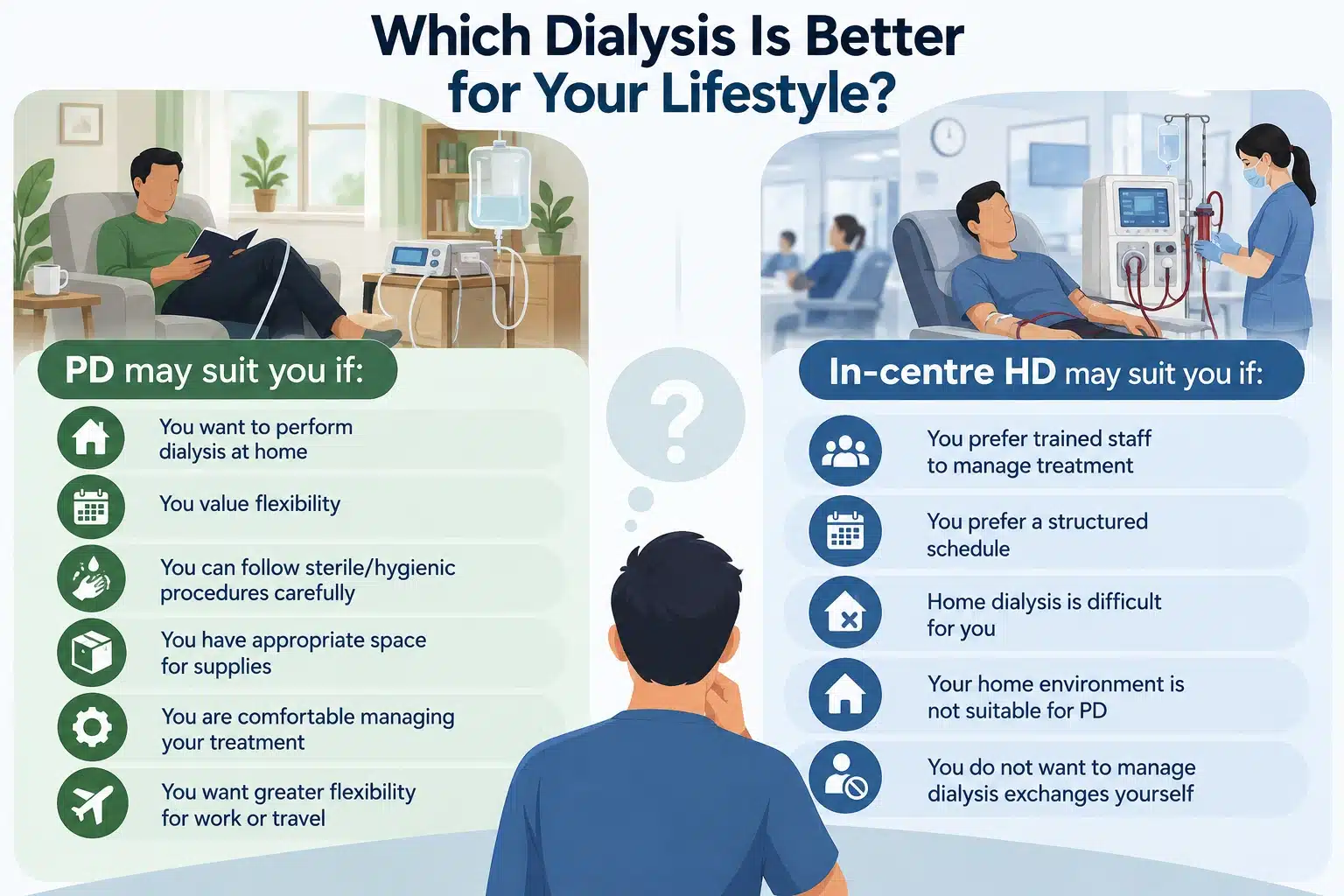
Lifestyle can be an important part of the decision. These are general considerations, not rules. Your medical situation remains an important part of the decision.
PD may suit you if:
- You want to perform procedure at home
- You value flexibility
- You can follow sterile/hygienic procedures carefully
- You have appropriate space for supplies
- You are comfortable managing your treatment
- You want greater flexibility for work or travel
In-centre HD may suit you if:
- You prefer trained staff to manage treatment
- You prefer a structured schedule
- Home procedure is difficult for you
- Your home environment is not suitable for PD
- You do not want to manage procedure exchanges yourself
How Do Doctors Decide Between PD and HD?
Your nephrologist may consider several factors before recommending a dialysis option.
- Your overall health: Other medical conditions can influence which method is appropriate.
- Remaining kidney function: Some patients still have meaningful residual kidney function, which can be considered when planning dialysis.
- Abdominal health: Previous abdominal surgeries, certain abdominal conditions or other problems may affect whether PD is appropriate.
- Vascular access: HD requires suitable vascular access. The condition of your blood vessels can therefore influence planning.
- Your home environment: PD requires a clean, appropriate space for treatment and storage of supplies.
- Your ability to perform treatment: PD requires training and the ability to follow the treatment process safely. A trained caregiver may be able to help in some situations.
- Your lifestyle and preferences: Your work schedule, travel plans, family support and personal comfort with each treatment should also be discussed.
Does PD Work as Well as HD?
Both treatments can effectively provide dialysis for kidney failure.
However, “better” should not be judged only by how much waste is removed during a single treatment. This effectiveness also depends on the prescribed treatment schedule, adequacy of dialysis, remaining kidney function, fluid management, nutrition, other health conditions and how consistently treatment is performed.
Current patient guidance recognises advantages and disadvantages with both options rather than identifying one universal winner.
Your nephrology team can monitor whether your chosen dialysis treatment is providing adequate clearance and fluid removal.
PD vs HD: Which Is More Convenient?
Convenience depends on the patient. For someone who lives far from a dialysis centre, PD or home HD may reduce travel. For someone who does not want to manage treatment at home, in-centre HD may feel more convenient.
So the better question is not: “Which dialysis is easiest?”
It is: “Which dialysis fits my medical needs and can I safely maintain over the long term?”
Can You Switch From PD to HD?
In some circumstances, patients can change from one type of dialysis to another.
Your health needs can change over time. PD may eventually become less suitable, or a patient may decide that another procedure approach fits their circumstances better.
The National Kidney Foundation notes that patients are not necessarily locked into one type and may be able to change treatment when medically appropriate.
This is why choosing a best option should be viewed as an ongoing care decision rather than a choice that can never be changed.
Can Dialysis Cure Kidney Failure?
No. This does not cure kidney failure.
HD and PD replace only some of the functions normally performed by healthy kidneys. They can remove waste and excess fluid and help people with kidney failure live longer and feel better, but they do not restore normal kidney function.
For eligible patients, a kidney transplant may provide a different treatment pathway. Some patients may also receive conservative management rather than this procedure, depending on their health and personal goals.
When Should You See a Nephrologist?
If your kidney function is declining or you have been told that you may need dialysis, an early discussion with a nephrologist can help you understand your treatment options before procedure becomes urgent.
Do not wait until you feel severely unwell to discuss kidney failure treatment. Early planning can allow time for:
- Kidney function assessment
- Dialysis education
- Choosing an appropriate treatment
- Preparing vascular or peritoneal access when needed
- Nutrition and lifestyle planning
- Discussing kidney transplantation when appropriate
Frequently Asked Questions (FAQs)
Is PD better than HD?
Not necessarily. Both are effective treatments, but the better option depends on your medical condition, lifestyle, home environment, support system and personal preferences.
Which dialysis is better for kidney failure?
There is no single best method for everyone. PD may offer greater flexibility for some patients, while in-centre HD may be preferable for those who want treatment managed by healthcare professionals.
Is PD safer than HD?
Both treatments have potential risks. PD has important infection risks such as peritonitis, while HD has risks related to vascular access and treatment-related changes such as blood pressure fluctuations. Your doctor can assess which risks are more relevant to you.
Can I travel while on PD?
Many people can travel while receiving PD, but proper planning is necessary. Supplies, treatment arrangements and medical support should be discussed with your specialist team before travelling.
Can I work while on dialysis?
Many people continue working while receiving dialysis. PD and home procedure may provide greater flexibility for some patients, while others may prefer scheduling work around in-centre HD.
Does PD require a machine?
Not always. CAPD is performed manually, while automated PD uses a cycler machine to perform exchanges, usually during sleep.
Can I switch from PD to HD?
Sometimes. A patient may be able to change dialysis methods if their medical needs or personal circumstances change. The decision should be made with the nephrology team.
Does dialysis cure kidney failure?
No. Dialysis replaces only part of the work healthy kidneys normally perform. It is a treatment for kidney failure, not a cure.
Conclusion
PD and HD can both be effective treatments for kidney failure, but neither is automatically better for everyone.
Peritoneal dialysis may appeal to patients who value home-based treatment, flexibility and independence. HD may suit patients who prefer a structured treatment schedule and professional support at a dialysis centre. Home hemodialysis is another option for selected patients.
The right choice depends on much more than the dialysis machine or technique. Your kidney function, overall health, abdominal and vascular health, home environment, lifestyle, support system and personal preferences all matter.
If you are approaching kidney failure or have been advised to consider dialysis, speak with a nephrologist about your options early. A personalised treatment plan can help you choose a dialysis method that is medically appropriate and fits your everyday life.