Transanal Minimally Invasive Surgery, commonly called TAMIS, is an advanced surgical technique used to remove growths and early cancers from the rectum. The rectum is the last part of the large intestine, just before the anus. In the past, many rectal growths required major abdominal surgery with large incisions and longer recovery. TAMIS offers a less invasive option for selected patients.
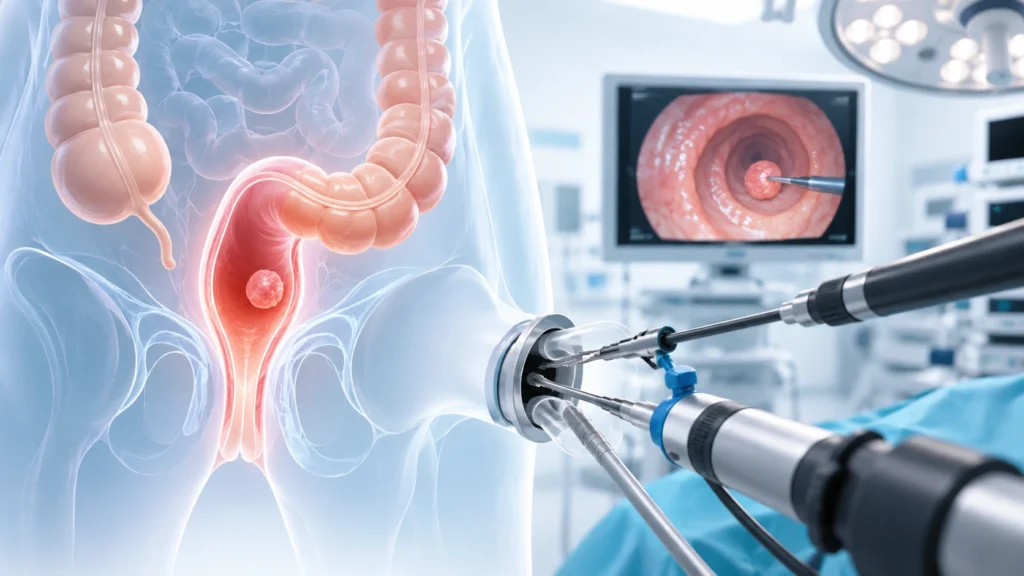
In TAMIS, the surgeon works through the anus using specialized instruments and a high-definition camera. There is no cut on the abdomen. The growth is removed through the natural opening of the body. This approach can reduce pain, shorten hospital stay, and allow faster return to normal activities compared to traditional surgery.
TAMIS is mainly used for benign rectal polyps that are difficult to remove by standard colonoscopy, and for very early-stage rectal cancers that have not spread deeply. It is not suitable for all rectal tumors, so careful evaluation is essential. When done in the right patients by an experienced team, TAMIS can provide excellent outcomes with minimal disruption to daily life.
What is Transanal Minimally Invasive Surgery (TAMIS)?
TAMIS is a modern surgical technique that allows removal of rectal lesions through the anus using specialized equipment. The surgeon inserts a special port into the anus and uses long instruments and a camera to view and operate inside the rectum. The growth is carefully cut out with a clear margin and then removed through the anal opening.
Unlike traditional rectal surgery, TAMIS does not require any incision on the abdomen. There is no need to cut through the abdominal wall or move the intestines out of the body. This makes the procedure less invasive for suitable patients.
TAMIS combines the advantages of local excision with the precision of minimally invasive surgery. It allows better visualization and more accurate removal of lesions compared to older transanal techniques. This is especially helpful for growths located higher in the rectum, which were previously difficult to reach.
Conditions Treated with TAMIS
TAMIS is not used for all rectal problems. It is reserved for carefully selected cases where the growth is limited and has not spread deeply.
Common conditions where TAMIS may be considered
- Large benign rectal polyps that cannot be removed safely by colonoscopy.
- Recurrent rectal polyps after previous endoscopic removal.
- Very early-stage rectal cancers confined to the inner layers of the rectal wall.
- Selected small neuroendocrine tumors in the rectum.
- Certain benign rectal tumors such as adenomas.
- Some rectal lesions that are difficult to access with standard techniques.
Conditions where TAMIS is usually not suitable
- Rectal cancers that have grown deeply into the rectal wall.
- Tumors with evidence of spread to lymph nodes or distant organs.
- Very large tumors that cannot be removed safely through the anus.
- Cases where clear margins cannot be achieved by local excision.
- Patients who are not fit for any form of anesthesia or surgery.
Why patient selection is critical
- The success of TAMIS depends on choosing the right cases.
- Incorrect selection can lead to incomplete removal or need for additional surgery.
- Detailed imaging and biopsy help determine suitability.
- A multidisciplinary team review ensures the best treatment plan.
Pre-Surgical Evaluation for TAMIS
Before deciding on TAMIS, a thorough evaluation is done to confirm that the procedure is appropriate and safe.
Evaluation steps
- Detailed medical history and symptom review.
- Physical examination, including digital rectal examination.
- Review of previous colonoscopy and biopsy reports.
- Assessment of overall fitness for anesthesia and surgery.
- Discussion of risks, benefits, and alternatives with the patient.
Common tests that may be done
- Colonoscopy to visualize the entire colon and rectum.
- Biopsy to confirm the type of growth.
- Endorectal ultrasound to assess the depth of the lesion.
- MRI of the pelvis to evaluate the rectal wall and nearby lymph nodes.
- CT scan of the abdomen and pelvis if cancer is suspected.
- Blood tests to check general health, anemia, and clotting.
- Heart and lung evaluation in older patients or those with medical conditions.
Why evaluation matters
- It confirms whether the lesion is suitable for TAMIS.
- It helps rule out deeper invasion or spread.
- It identifies any medical issues that need optimization before surgery.
- It supports informed decision-making for the patient and family.
The TAMIS Procedure
TAMIS is performed under anesthesia, so the patient does not feel pain during the procedure.
Step-by-step overview
- The patient is positioned appropriately, usually lying on their back or side.
- General or regional anesthesia is given based on the case.
- A special TAMIS port is gently inserted into the anus and secured in place.
- Carbon dioxide gas may be used to gently inflate the rectum for better visibility.
- A high-definition camera is introduced through the port to view the lesion.
- Specialized long instruments are used to mark and cut around the growth.
- The lesion is removed with a margin of healthy tissue.
- The defect in the rectal wall is closed with sutures or clips.
- The removed tissue is sent for detailed pathological examination.
- The port is removed, and the patient is taken to recovery.
Key features of the procedure
- No abdominal incision is made.
- The entire surgery is done through the anal opening.
- High-definition visualization allows precise removal.
- The rectal wall is closed immediately after removal.
- The procedure duration varies depending on the size and location of the lesion.
Anesthesia and pain control
- Most patients receive general anesthesia.
- Some may have spinal or regional anesthesia depending on fitness.
- Pain after surgery is usually mild to moderate.
- Pain medicines are given as needed during recovery.
Benefits of TAMIS
TAMIS offers several advantages over traditional open or laparoscopic rectal surgery for suitable cases.
Main benefits
- No external abdominal scar.
- Less postoperative pain.
- Shorter hospital stay.
- Faster return to normal diet and activities.
- Lower risk of wound complications.
- Preserves the rectum in many cases.
- Can avoid the need for a permanent stoma in selected early cancers.
- Suitable for patients who may not tolerate major abdominal surgery.
Why these benefits matter
- Patients experience less physical trauma.
- Recovery is quicker and more comfortable.
- There is less disruption to work and daily life.
- Cosmetic outcome is better with no abdominal incision.
- For early lesions, TAMIS can be curative without major surgery.
Risks and Possible Complications
Like any surgical procedure, TAMIS carries some risks. Most patients do well, but it is important to be aware of possible complications.
Possible risks
- Bleeding from the surgical site.
- Infection in the rectal area.
- Leakage from the suture line in the rectal wall.
- Narrowing of the rectum due to scarring.
- Temporary difficulty controlling gas or stool.
- Injury to nearby structures in rare cases.
- Need for additional surgery if margins are not clear or if cancer is more advanced than expected.
- Recurrence of the polyp or tumor in some cases.
Factors that can increase risk
- Large or complex lesions.
- Poor tissue quality or healing.
- Underlying medical conditions such as diabetes.
- Previous radiation to the pelvic area.
- Inexperienced surgical team or inadequate equipment.
How risks are minimized
- Careful patient selection before surgery.
- Detailed imaging and biopsy to confirm suitability.
- Surgery performed by trained colorectal surgeons.
- Closure of the rectal defect with secure suturing.
- Close monitoring after the procedure.
- Prompt management of any early signs of complications.
Recovery After TAMIS
Recovery is usually faster compared to major rectal surgery, but proper care is still important.
Hospital stay
- Many patients stay in the hospital for one to three days.
- Some may go home the same day if the case is straightforward and recovery is smooth.
- Observation is done for pain control, bleeding, and ability to pass urine and stool.
Pain and discomfort
- Mild to moderate pain in the rectal area is common.
- Pain medicines are given orally or by injection as needed.
- Discomfort usually improves over a few days.
Diet and bowel movements
- Liquids are started soon after surgery.
- Diet is advanced to soft foods and then normal diet as tolerated.
- Stool softeners may be prescribed to avoid straining.
- Patients are advised to avoid constipation during recovery.
Activity and return to normal life
- Light walking is encouraged from the first day.
- Heavy lifting and strenuous activity are avoided for a few weeks.
- Most patients return to routine work within one to two weeks, depending on the job and recovery.
- Full healing of the rectal wall takes several weeks.
Follow-up after discharge
- A follow-up visit is scheduled within one to two weeks.
- The pathology report is discussed in detail.
- Further treatment plan is decided based on the final report.
- Additional surveillance colonoscopy or imaging may be advised.
Long-Term Follow-Up and Surveillance
Follow-up is an essential part of TAMIS care, especially when the lesion is a polyp with high-risk features or an early cancer.
Follow-up plan may include
- Regular clinical examinations.
- Periodic colonoscopy to check for recurrence or new polyps.
- MRI or endorectal ultrasound in selected cases.
- Blood tests such as tumor markers if cancer was present.
- Ongoing surveillance based on the pathology findings.
Why surveillance is important
- Some polyps can recur at the same site.
- Early cancers may need additional treatment if deeper invasion is found on final pathology.
- Regular checks help detect any new growths early.
- Long-term monitoring supports better outcomes.
When Additional Treatment May Be Needed
In some cases, TAMIS alone may not be enough.
Situations where further treatment may be advised
- Final pathology shows deeper invasion than expected.
- Margins are not clear, meaning some abnormal tissue may remain.
- High-risk features are found in the removed tissue.
- Lymph node involvement is suspected or confirmed.
- Recurrence is detected during follow-up.
Possible additional treatments
- Completion surgery with removal of part of the rectum.
- Chemotherapy and radiation therapy for certain rectal cancers.
- Closer surveillance with more frequent tests.
- Multidisciplinary discussion to plan the next steps.
Why this is not a failure
- TAMIS can still provide valuable information about the tumor.
- It may convert a major surgery into a smaller one in some cases.
- It helps tailor treatment based on exact pathology.
- The goal is always the best long-term outcome for the patient.
Why Choose Rama Hospital for TAMIS?
TAMIS is a specialized procedure that requires experienced colorectal surgeons, advanced equipment, and a supportive team. A hospital with dedicated colorectal services can provide comprehensive care from evaluation to long-term follow-up.
- Accurate assessment of lesion suitability for TAMIS.
- Access to high-definition imaging and specialized instruments.
- Experienced surgeons trained in advanced rectal techniques.
- Coordinated care with gastroenterology, radiology, and oncology.
- Structured follow-up and surveillance programs.
Frequently Asked Questions (FAQs)
Who is a candidate for TAMIS?
Suitable candidates include patients with large benign rectal polyps or very early rectal cancers that have not spread deeply. Detailed imaging and biopsy are needed to confirm eligibility.
Is TAMIS painful?
Most patients experience mild to moderate discomfort after surgery, which is managed with pain medicines. Pain is generally less than with open or laparoscopic rectal surgery.
How long is the hospital stay?
Many patients stay in the hospital for one to three days. Some may go home the same day if recovery is smooth and the case is straightforward.
Will I need a stoma bag after TAMIS?
In most TAMIS procedures, a stoma bag is not needed. The rectum is preserved, and bowel continuity is maintained. Stoma is rarely required unless complications occur.
How long does it take to recover?
Most patients resume light activities within a few days and return to routine work within one to two weeks. Full healing of the rectal wall takes several weeks.
Can cancer be treated with TAMIS?
Selected very early-stage rectal cancers can be treated with TAMIS. However, if deeper invasion or high-risk features are found, additional surgery or therapy may be needed.
What happens if the polyp comes back?
If a polyp recurs, it can often be managed with repeat local excision or other treatments depending on the type and risk. Regular surveillance helps detect recurrence early.
Conclusion
Transanal Minimally Invasive Surgery is an advanced, less invasive option for carefully selected rectal polyps and early rectal cancers. It allows removal of growths through the anus without abdominal cuts, leading to less pain, shorter hospital stay, and faster recovery for suitable patients.
The most important steps are proper evaluation, expert surgical technique, and structured follow-up. For patients with large or recurrent rectal polyps, or early rectal tumors, a specialist colorectal opinion can clarify whether TAMIS is appropriate. With the right case selection and experienced care, TAMIS can provide excellent outcomes while preserving quality of life.
Rama Hospital can evaluate rectal lesions, determine suitability for TAMIS, and provide comprehensive care from pre-surgical assessment through surgery, recovery, and long-term surveillance.