

Most people don’t think about their hips until they can’t ignore the pain anymore.
That’s the problem.
By the time many patients reach an orthopedic surgeon, the joint damage is already advanced. The window for conservative treatment has closed. And surgery becomes not just an option, but the only one.
The early signs of hip replacement are real, recognizable, and far more common than people realize. Knowing what to look for can change the outcome entirely.
This guide will walk you through every stage, from the first subtle aches to the advanced symptoms that signal it’s time to consider surgery. If you or someone in your family is dealing with persistent hip trouble, read this carefully.
Why hip replacement decisions get delayed
People ignore hip pain for a long time. In India especially, there’s a tendency to push through pain, attribute it to age, or try home remedies first.
Patients arrive with severe joint destruction when early intervention could have bought years of better mobility.
Understanding the early signs of hip replacement is not about rushing into surgery. It’s about making informed decisions before your options narrow.
Common reasons for delay:
- Fear of surgery.
- Assuming pain is “normal aging.”
- Relying on painkillers without diagnosis.
- Not knowing which doctor to see.
- Lack of awareness about hip replacement warning signs.
How the hip joint works (and how it breaks down)
The hip is a ball-and-socket joint. The ball (femoral head) fits into the socket (acetabulum) of the pelvis. A smooth layer of cartilage lines both surfaces, allowing fluid, painless movement.
When cartilage begins to wear down due to arthritis, injury, or age, the early signs of hip replacement may start to appear, including persistent hip pain, stiffness, reduced mobility, and discomfort during daily activities. As cartilage continues to deteriorate, bone begins rubbing against bone, causing chronic pain, inflammation, and eventually, structural joint damage that may require hip replacement surgery.
Stages of Hip Joint Deterioration
Most surgeons recommend hip replacement at Stage 3–4. But the warning signs begin long before that.
| Stage | What’s Happening | Symptoms |
| Stage 1 – Early | Mild cartilage thinning | Occasional ache, morning stiffness |
| Stage 2 – Moderate | Cartilage loss progressing | Pain with activity, reduced range of motion |
| Stage 3 – Severe | Significant cartilage damage | Pain while walking, night pain, limping |
| Stage 4 – End Stage | Bone-on-bone hip arthritis | Constant pain, deformity, near-total loss of function |
Early signs of hip replacement: what to watch for
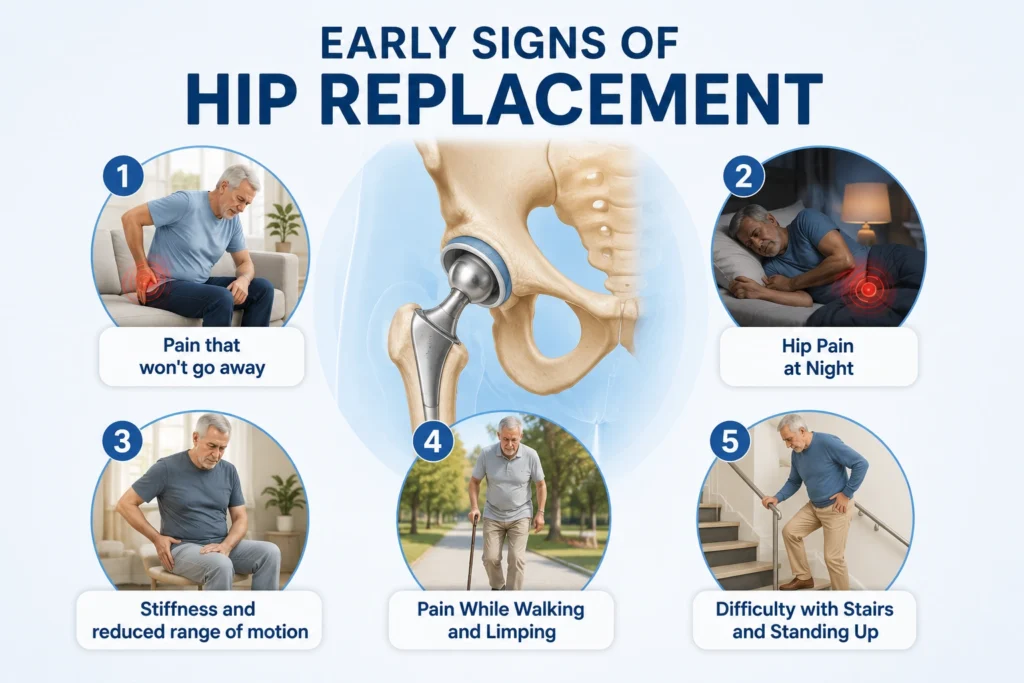
1. Pain that won’t go away
This is the most consistent signal.
The pain might start as a dull ache after activity. Over time, it shows up earlier in your day, stays longer, and responds less to rest or medication.
If pain has become your daily companion, that’s an early sign of hip replacement evaluation being needed.
Key patterns to note:
- Pain in the groin, hip, or outer thigh.
- Groin pain and hip arthritis are especially telling; groin pain is often the first location where hip joint damage presents.
- Aching that starts during activity but lingers for hours after.
- Pain that no longer responds to standard painkillers.
- Chronic hip pain lasting more than 3–6 months despite treatment.
2. Hip pain at night
Daytime pain during activity is one thing. Hip pain at night is something else entirely.
When pain wakes you up at night or makes it impossible to find a comfortable sleeping position, it may be one of the early signs of hip replacement. At this stage, the joint is often inflamed beyond the point of functional compensation, indicating advanced wear and ongoing joint damage.
Hip pain at night is one of the clearest hip replacement warning signs because it indicates constant joint stress, not just activity-related wear.
Watch for:
- Waking up multiple times due to hip discomfort.
- Inability to sleep on the affected side.
- Morning stiffness lasting more than 30–45 minutes.
- Pain that’s worse after lying still for a long period.
3. Stiffness and reduced range of motion
Hip stiffness is often dismissed as “tightness” or something a few stretches will fix. It’s not.
These mobility symptoms are a direct reflection of structural change in the joint. They don’t improve with stretching alone once the cartilage is compromised.
One of the early signs of hip replacement is a noticeable loss of hip mobility. As arthritis damages the joint, surrounding tissues contract, joint fluid quality declines, and bone spurs form. Over time, movement becomes physically restricted, making simple daily tasks more challenging.
Mobility symptoms to look for:
- Difficulty tying shoelaces or putting on socks.
- Trouble sitting and bending, especially forward bending.
- Can’t cross one leg over the other.
- Reduced range of motion when rotating the hip inward or outward.
- Getting in and out of a car becomes a significant effort.
4. Pain while walking and limping
When walking becomes a daily challenge, the joint has crossed a functional threshold.
Pain while walking, especially over longer distances, is a defining early sign of hip replacement consideration. Patients often adjust their gait unconsciously to reduce weight on the painful hip. This is where limping while walking begins.
Limping while walking isn’t just a gait problem. It shifts abnormal load to the knee, lower back, and opposite hip, creating secondary problems over time.
What this looks like:
- A visible lean or tilt to one side while walking.
- Shortening your stride on the affected side.
- Avoiding walking more than a few hundred meters.
- Needing to stop frequently due to pain or fatigue in the hip.
5. Difficulty with stairs and standing up
Two activities that reveal hip joint function very clearly: climbing stairs and getting up from a seated position.
Pain while climbing stairs is often one of the early signs of hip replacement. Stair climbing places significantly greater pressure on the hip joint than level walking. If you have started avoiding stairs, taking them one step at a time, or dreading them because of pain, it may indicate advancing hip joint damage that warrants medical evaluation.
This combination of pain climbing stairs and difficulty standing up points to significant loss of hip joint capacity.
Similarly, difficulty standing up from a low chair, toilet seat, or floor is a red flag.
Signs to track:
- Needing to push off with arms to stand from a chair.
- Pain climbing stairs, especially going up.
- Avoiding ground-level activities (floor sitting, gardening, prayer positions).
- Significant discomfort when transitioning from sitting to standing.
When early signs become advanced symptoms
There’s a point where early signs of hip replacement cross into advanced symptoms, the zone where surgery is no longer just “worth considering” but genuinely necessary.
Advanced symptom 1: bone-on-bone hip arthritis
Bone-on-bone hip arthritis means the cartilage has been almost entirely worn away. Bone is now grinding directly against bone with every movement.
When hip arthritis reaches this stage, it is considered one of the most advanced early signs of hip replacement. Severe joint degeneration causes extensive cartilage loss, bone-on-bone contact, and significant functional limitations. At this point, physiotherapy, injections, and medications can no longer restore the damaged joint, making total hip replacement the most effective long-term treatment.
On an X-ray, the joint space appears very narrow or absent entirely. Pain becomes:
- Constant, not just with activity.
- Present even at rest.
- Resistant to all medications.
- Accompanied by visible joint deformity.
Advanced symptom 2: hip locking and catching
Hip-locking symptoms are among the early signs of hip replacement that should not be ignored. The hip may suddenly “catch,” “lock,” or give way during movement, making everyday activities painful and unpredictable.
Hip-locking symptoms can occur mid-stride, when rising from a chair, or even during sleep. They’re unpredictable and, in some cases, can cause falls.
This happens when:
- Loose bone fragments or cartilage debris get trapped in the joint
- Bone spurs obstruct smooth movement
- The joint structure has become mechanically unstable
Advanced symptom 3: hip weakness and instability
Hip weakness and instability develops when the muscles surrounding the joint can no longer compensate for structural loss.
You may notice:
- The hip “giving way” unexpectedly.
- Feeling unsteady on your feet.
- Inability to bear weight on the affected side for any length of time.
- Muscle wasting in the thigh and buttock area.
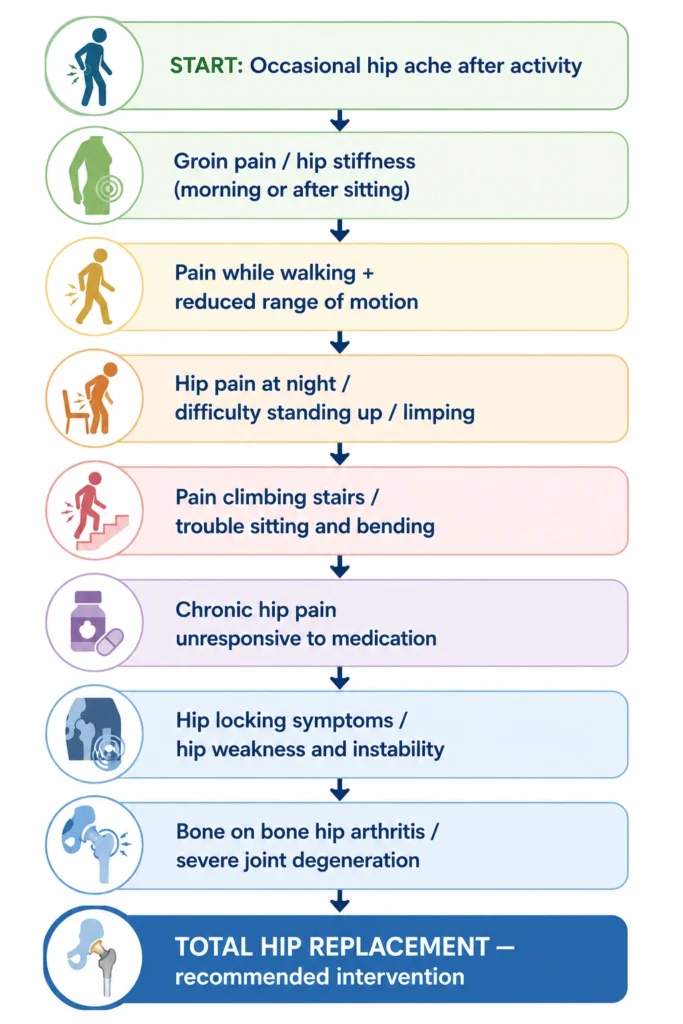
The complete symptom progression: a visual flowchart
If you are anywhere in this progression and symptoms are worsening, consult an orthopedic surgeon without delay.
When doctors actually recommend hip replacement surgery
If you are experiencing early signs of hip replacement, surgery is generally considered only after non-surgical treatments fail to provide adequate pain relief and mobility improvement.
Non-Surgical Options Tried First
| Treatment | What It Does | Effective Until |
| Physiotherapy | Strengthens muscles, improves mobility. | Stage 1–2 |
| Anti-inflammatory medications | Manages pain and inflammation. | Stage 1–3 |
| Corticosteroid injections | Temporary pain relief. | Stage 2–3 |
| Hyaluronic acid injections | Lubricates joints. | Stage 2 |
| Walking aids / lifestyle modification | Reduces load on joint. | Stage 2–3 |
When surgery becomes necessary
The decision is never taken lightly. But when the joint is gone, no medication can rebuild it.
Surgeons recommend chronic hip pain treatment through total hip replacement when:
- Pain is constant and severe, even at rest.
- Non-surgical treatments have failed over 6–12 months.
- Severe joint degeneration or bone-on-bone hip arthritis is confirmed on imaging.
- Daily activities, walking, climbing stairs, sleeping, are significantly impaired
- Quality of life has deteriorated substantially.
- Hip weakness and instability create fall risk.
Hip arthritis surgery symptoms checklist: know where you stand
Use this checklist honestly. If you check five or more boxes, you should consult an orthopedic surgeon.
Pain Symptoms:
- Chronic hip pain lasting more than 3 months.
- Groin pain, hip arthritis, and deep groin ache, especially with rotation.
- Hip pain at night disrupting sleep.
- Pain unresponsive to standard painkillers.
Mobility Symptoms:
- Hip stiffness lasting more than 30 minutes in the morning.
- Reduced range of motion; can’t rotate hip freely.
- Limping while walking.
- Pain while walking, which worsens over distance.
Functional Symptoms:
- Difficulty standing up from a seated position.
- Pain climbing stairs, especially going up.
- Trouble sitting and bending; can’t reach feet easily.
- Avoiding activities you used to enjoy.
Advanced Symptoms:
- Hip locking symptoms, joint catches, or gives way.
- Hip weakness and instability, feeling unsafe on your feet.
- Visible limb length difference.
- X-ray confirmed bone-on-bone hip arthritis.
Hip replacement surgery: where to get evaluated
If you’re in the Delhi-NCR region and recognizing these early signs of hip replacement in yourself or a family member, early evaluation makes all the difference.
Rama Hospital is a leading joint replacement hospital in Noida, offering comprehensive orthopedic care for patients dealing with hip arthritis, joint degeneration, and mobility loss.
Why patients choose Rama Hospital for hip replacement surgery in Noida:
- Experienced team, the best orthopedic surgeon in Noida, and specialists with high-volume joint replacement expertise.
- Advanced surgical techniques including minimally invasive hip replacement.
- Comprehensive pre-surgical assessment and post-surgical rehabilitation.
- Dedicated physiotherapy and recovery programs.
- Transparent treatment planning with a focus on long-term outcomes.
As a trusted joint replacement hospital in Noida, Rama Hospital combines clinical expertise with patient-centered care, from your first consultation through your complete recovery.
If you’ve been living with chronic hip pain and waiting to see if it gets better on its own, stop waiting. The early signs of hip replacement are often visible months, sometimes years, before surgery becomes unavoidable.
The earlier you get evaluated, the more options you have.
Frequently Asked Questions
Q. My hip hurts, but I can still walk. Do I really need to see a doctor?
Yes. Many patients with significant early signs of hip replacement can still walk; they’ve just adjusted their gait and lifestyle around the pain without realizing it. Pain that has been present for more than 8–12 weeks, especially with any hip stiffness or reduced range of motion, warrants a proper evaluation.
Q. How do I know if my groin pain is coming from the hip joint?
Groin pain from hip arthritis is one of the early signs of hip replacement that patients often overlook. It typically presents as a deep ache in the groin, inner thigh, or sometimes the knee, especially when rotating the leg inward. The pain often worsens when getting in and out of a car or after prolonged sitting. Unlike a muscle strain, this specific pain pattern may indicate advanced hip joint damage and should be evaluated with an X-ray.
Q. I’m only 50. Isn’t hip replacement a surgery for older people?
No. Early signs of hip replacement and hip arthritis symptoms can appear in people in their 40s and 50s, especially those with a history of hip injuries, high-impact sports, or a genetic predisposition. Age alone is not the deciding factor. The severity of joint damage, the presence of early signs of hip replacement, and the impact on your quality of life are what determine whether surgery may be needed.
Q. What happens if I keep delaying hip replacement?
Delaying surgery once severe joint degeneration has been confirmed leads to worsening bone-on-bone hip arthritis, muscle wasting around the joint, secondary problems in the knee and back due to altered gait, and a more complex surgical procedure. Earlier surgery, when the patient is physically stronger, typically gives better outcomes.
Q. Will I be able to walk normally after hip replacement?
Most patients who recognize the early signs of hip replacement and undergo surgery at the right time experience significant improvement in pain while walking, hip stiffness, and overall mobility within weeks of the procedure. Full recovery typically takes 3–6 months. The goal is to restore an active, pain-free lifestyle, allowing patients to walk, climb stairs, and return to daily activities that hip arthritis had gradually taken away.
Q. Is the surgery very painful? I’m scared of the procedure.
This is the most common concern patients share. Modern hip replacement uses advanced anesthesia and pain management protocols. Most patients are walking with assistance within 24 hours of surgery. Post-operative pain is managed actively. The pain of surgery is temporary; the chronic hip pain it resolves has often been present for years.
Q. Can physiotherapy replace hip replacement surgery?
Physiotherapy is valuable and is always tried first. It strengthens the muscles around the joint and can delay the need for surgery. However, recognizing the early signs of hip replacement is important. Once bone-on-bone hip arthritis is confirmed and the cartilage is completely worn away, no amount of physiotherapy can regenerate it. At that stage, chronic hip pain treatment through hip replacement surgery is often the only effective path to lasting pain relief and improved mobility.
Q. My doctor mentioned hip replacement, but I want a second opinion. Is that okay?
Absolutely. Getting a second opinion before any major surgery is not just okay; it’s encouraged. Consult the best orthopedic surgeon in Noida or a specialist at a reputed joint replacement hospital in Noida like Rama Hospital to confirm your diagnosis, understand your options fully, and make a confident decision.
Q. How do I book a consultation at Rama Hospital for hip pain?
You can contact Rama Hospital directly for a consultation with their orthopedic team. Bring any previous X-rays, MRI reports, and a description of your pain symptoms, how long they’ve been present, and what treatments you’ve already tried. The more detail you bring, the more precise your evaluation will be.
Conclusion
Hip joint damage is progressive. It doesn’t reverse on its own.
The early signs of hip replacement, groin pain, hip pain at night, hip stiffness, pain while walking, difficulty standing up, and pain climbing stairs are your body telling you something is wrong. Listening early gives you more options, better outcomes, and often, the ability to avoid or delay surgery altogether.
If you’re past early signs and into advanced symptoms, bone-on-bone hip arthritis, hip locking symptoms, hip weakness, and instability, the conversation shifts. Surgery may be the most important health decision you make.
Don’t let fear of the unknown keep you in daily pain.
Get evaluated. Get clarity. Get your life back.
For expert orthopedic consultation and hip replacement surgery in Noida, visit Rama Hospital, a trusted joint replacement hospital in Noida with a dedicated team of specialists committed to your full recovery.