
Have you ever wondered what keeps your stomach, intestines, and internal organs perfectly packed inside your body? It is all thanks to a thick, flexible wall of core muscles and connective tissue. But sometimes, that protective wall develops a localized tear, gap, or structural weak spot, and what causes a hernia is often hiding in your everyday habits long before the first symptom appears.
When an internal organ, usually a loop of your intestine or a layer of belly fat, pushes right through that tear, it forms a visible lump under your skin. That is a hernia.
Many people who find an unexpected lump ask themselves, “Why do hernias happen out of nowhere?” Is it caused by a single wrong move, or has it been growing silently for months? Understanding what causes a hernia is the single best way to protect your body from structural damage.
If you suspect you have a bulge, getting a timely hernia diagnosis from the best hernia doctor near me at a premier facility like Rama Hospital is your fastest route to a safe, complete recovery.
The Core Equation: Weakness + Pressure
At its fundamental level, what causes a hernia is a simple mechanical equation happening deep inside your body.
Muscle Wall Weakness + Increased Internal Pressure = Hernia
- Internal Push Force: High pressure pushing outward from inside the abdominal cavity.
- Muscular Containment Wall: The layers of muscle and connective tissue (fascia) meant to keep your organs locked safely in place.
- The Structural Failure: If the containment wall has a natural gap or a weakened zone, any sudden spike in the internal push force will rip the muscle fibers apart, creating a gateway for internal organs to escape.
Essential Structural Components of a Hernia
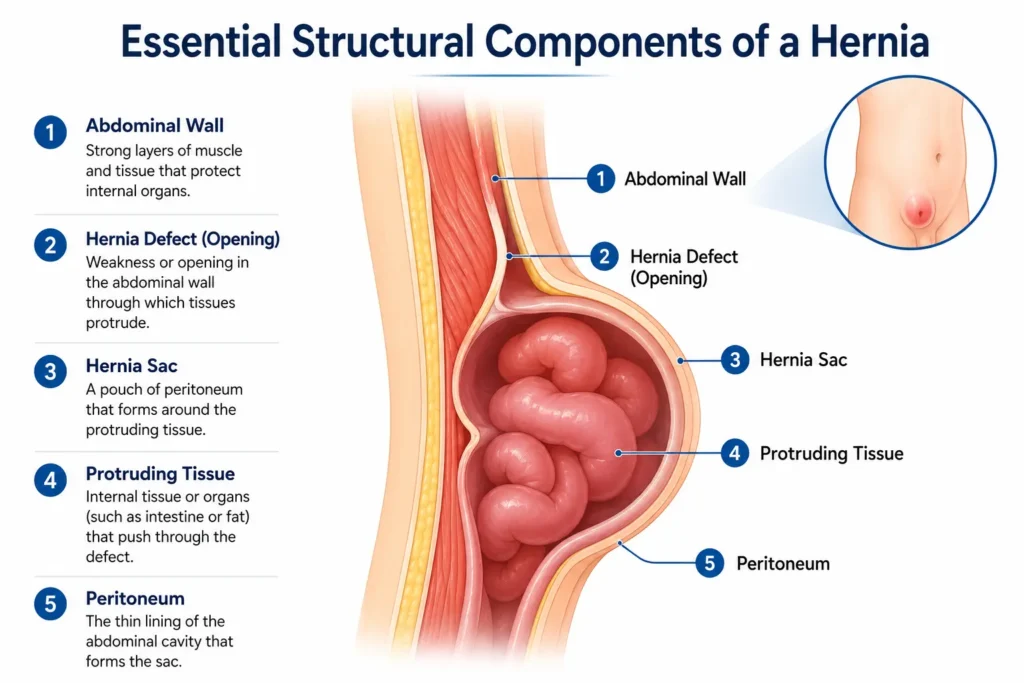
To truly understand what causes a hernia and its symptoms, it helps to look at the three physical parts that make up every single hernia bulge:
| THE THREE STRUCTURAL PIECES OF A HERNIA | |
| Component Name | What It Actually Is Inside Your Body |
| The Muscle Defect | The actual hole, rip, or thinned-out gap inside your abdominal wall tissue. |
| The Hernial Sac | A pouch made of your inner abdominal lining (peritoneum) that gets pushed through the muscle hole first. |
| The Contents | The actual bodily materials, like loops of intestine or fatty tissue that slide out inside the pouch. |
Main Everyday Triggers: What Causes a Hernia?
What causes a hernia is rarely a single dramatic moment. Hernias are almost always built over months or years through everyday activities that place continuous strain on your abdominal core.
1. Chronic and Long-Term Constipation
- Straining intensely during daily bowel movements spikes the pressure inside your pelvis and lower stomach.
- Forces your internal organs to grind aggressively against the lower pelvic floor muscles day after day.
- Over time, this non-stop daily pressure weakens the connective tissue sheets, causing them to tear open.
2. Persistent, Heavy Coughing or Sneezing
- Common in individuals with long-term respiratory conditions like smoker’s cough, asthma, or chronic bronchitis.
- A severe cough acts like a sudden, explosive internal hammer striking against your abdominal wall.
- Repetitive coughing attacks stretch and thin out the delicate muscle fibers around your belly button and groin.
3. Improper Heavy Lifting Habits
- Bending directly at your waist to lift heavy gym weights, Amazon delivery boxes, or heavy furniture pieces.
- Fails to use your strong leg muscles for support, forcing your abdominal wall to bear the entire physical weight load.
- Creates an immediate, massive spike in internal pressure that can instantly pop a weak muscle zone open.
4. Rapid and Significant Weight Changes
- Obesity Factors: Carrying a large amount of extra body fat constantly stretches and thins your abdominal muscle walls out like an over-inflated balloon.
- Sudden Extreme Weight Loss: Dropping weight too fast can cause your core muscles to lose their protective structural fat pads, leaving old surgical scars or natural gaps highly vulnerable.
Can Lifestyle Habits Cause Hernias?
When looking closely at what causes a hernia, the answer to “Can lifestyle habits cause hernias?” is a clear and absolute yes. The choices you make every single day can either reinforce your abdominal wall or slowly chip away at its strength.
- Poor Nutritional Choices: Diets low in natural fiber cause chronic constipation and daily bathroom straining, which slowly breaks down your lower muscle walls.
- Tobacco and Smoking Habits: Nicotine directly halts the production of collagen in your body, meaning your muscle walls cannot repair everyday wear and tear effectively.
- Sedentary Living Patterns: Spending your entire day sitting at an office desk without engaging in core workouts leaves your abdominal muscles soft, thinned out, and weak.
- Rapid Physical Overexertion: Throwing your body into heavy backyard landscaping or extreme gym workouts without building baseline core strength first.
Can a Hernia Happen Suddenly?
It is an incredibly common question: can a hernia happen suddenly? Understanding what causes a hernia reveals that hernias operate on a combination of long-term wear and sudden moments of failure.
- The Silent Setup: For months, your muscle wall may be thinning out quietly without creating a visible bulge or causing any physical pain.
- The Breaking Point: You lift a heavy object, experience a massive sneezing fit, or strain in the bathroom, and you instantly feel a distinct “pop” or sharp pinch.
- The Instant Bulge: The final physical strain tears the remaining thin muscle fibers completely open, forcing your internal tissues out under the skin in a single moment.
- Can a hernia start without pain? Yes, many sudden hernias present as a soft, painless lump that you only notice while showering or looking in a mirror.
Who is at a higher risk of hernia?
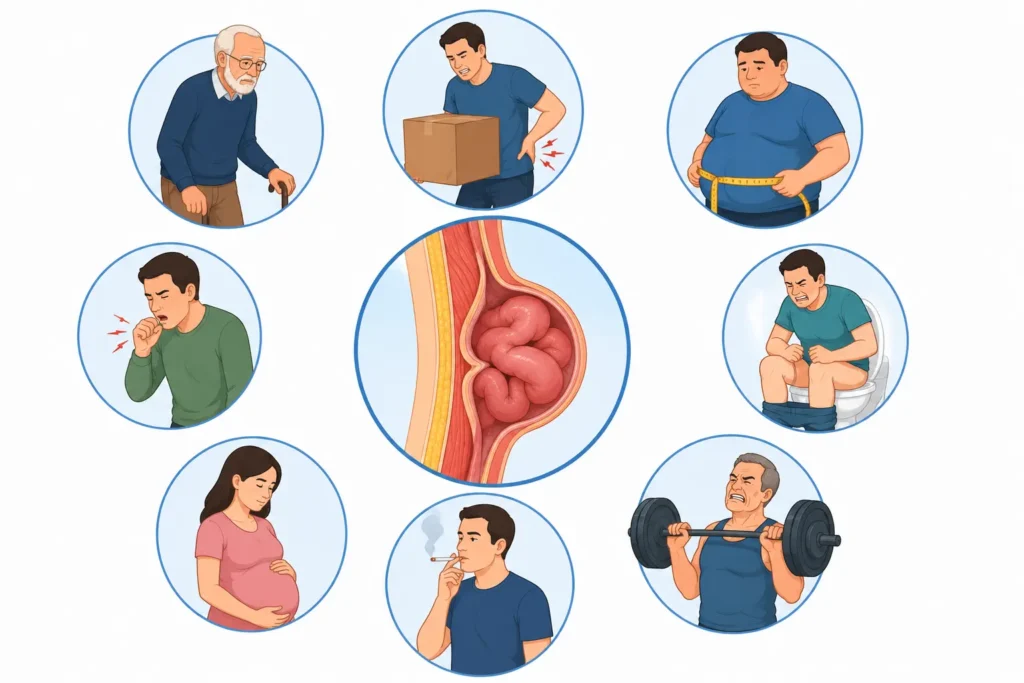
Certain demographic factors, medical histories, and genetic profiles can make an individual far more likely to experience what causes a hernia, a structural muscle wall failure.
- Gender Differences: Men are nearly 8 times more likely to develop groin (inguinal) hernias because of the natural gap left behind where the testicles descend before birth.
- The Aging Factor: As the human body ages, natural muscle tissues naturally lose their tone, elasticity, and overall structural strength, making older adults highly vulnerable to tears.
- Genetic Connections: If your parents or siblings have dealt with muscle wall tears, your body may naturally produce less durable collagen fibers.
- History of Abdominal Surgeries: Older surgical incisions leave behind a permanent structural weak spot because scar tissue is never as flexible as original, untouched muscle.
- Chronic Pregnancy Strains: Carrying a child stretches the midline abdominal muscles out significantly, which can leave behind a lasting vulnerability around the belly button (umbilical hernia).
Is Hernia Dangerous? The Real Truth
If you discover a soft bulge, it is absolutely vital to look at the big question: Is a hernia dangerous? Understanding what causes a hernia makes it clear that while a fresh, soft hernia is not an immediate life-threatening crisis, leaving a physical tear unmanaged opens the door to severe medical complications.
- They Never Shrink: A physical hole in a muscle layer will never sew itself back together with rest, belts, or medications; it will only grow wider over time under everyday pressure.
- Incarceration Trapping: As the hole grows, a loop of your intestine can slide out and become firmly trapped, turning hard, rigid, and impossible to gently push back inside.
- Strangulation Emergencies: If the muscle wall clamps down tightly around the trapped intestine, it cuts off all vital blood flow, causing the tissue to die and decay within hours.
- Systemic Infection Risks: Dead tissue inside your abdomen releases dangerous toxins directly into your bloodstream, turning a simple lump into a life-threatening emergency.
How Specialists Perform a Precise Hernia Diagnosis
If you notice a strange lump or feel a dragging weight in your core, finding out what causes a hernia and exactly what is going on inside your body is a quick, completely painless process.
| THE HERNIA DIAGNOSIS ROADMAP | |
| Diagnostic Step | What the Specialist Does During Your Exam |
| Physical Review | The doctor checks the bulge while you stand up, then asks you to cough to see if the lump expands. |
| Reducibility Test | The specialist checks if the lump easily slides back inside your stomach when you lie flat on your back. |
| Ultrasound Scan | Uses gentle sound waves to map the exact size of the muscle hole and see what tissue is sliding through. |
Advanced Treatment Options
Because what causes a hernia is a physical breakdown of muscle tissue, lifestyle adjustments, core workouts, and support belts cannot close the gap. Modern surgery is the only path to a permanent, reliable cure.
- Laparoscopic Keyhole Repairs: Modern surgeons perform the entire repair through three tiny, millimeter-sized entry points, avoiding the need for a large, deep incision.
- Protective Mesh Technology: A durable, medical-grade mesh screen is placed flat over the muscle tear, acting like a structural patch that reinforces your core and stops the hernia from returning.
- Rapid Recovery Timelines: Most young adults can walk around comfortably right after surgery, return home within 24 hours, and get back to light office work in less than a week.
When planning your care, understanding what causes a hernia helps you make informed decisions at every step. It is essential to consult the best hernia doctor near me. Booking your evaluation for comprehensive hernia treatment in Noida at a premier facility like Rama Hospital gives you direct access to expert surgical teams and advanced keyhole equipment for a smooth, safe, and stress-free recovery.
Frequently Asked Questions (FAQ)
Can a hernia be completely cured with targeted abdominal core exercises?
No, a hernia cannot be cured or closed through abdominal exercises, core workouts, or physical therapy. Understanding what causes a hernia explains why while building core strength is excellent for general health, tensing your stomach muscles increases your internal abdominal pressure, which can actually force more tissue through the existing tear and worsen the problem.
Why does a hernia lump seem to pop out during the day but vanish at night?
When you stand, walk, and move around during the day, gravity and internal muscle pressure combine to push your internal organs outward through the muscle tear, which is exactly what causes a hernia bulge to become more visible and uncomfortable during active hours. When you lie down flat to sleep at night, gravity stops pulling on your tissues, allowing the trapped fat or intestine to slide easily back inside your abdomen.
What is the major difference between an inguinal hernia and an umbilical hernia?
The primary difference is the physical location of the muscle tear. What causes a hernia in the groin area is a tear right where your thigh meets your torso, forming an inguinal hernia, which is highly common in men. An umbilical hernia forms directly through or right next to your belly button, often caused by pregnancy strains or long-term belly weight.
Is it safe to fly on an airplane if you have an untreated hernia?
If your hernia is soft, painless, and easily slides back inside when you lie down, short flights are generally considered safe. However, understanding what causes a hernia to worsen helps explain why changes in cabin air pressure can cause mild intestinal gas expansion, which might increase pressure on the tear. It is always best to clear your travel plans with a specialist before booking a flight.
How can you prevent a hernia from forming if you have a family history?
While you cannot change your genetics, understanding what causes a hernia empowers you to lower your risk by supporting your body’s muscle walls. Focus on maintaining a stable weight, using your leg muscles instead of your back when lifting heavy objects, eating a fiber-rich diet to avoid bathroom straining, and avoiding smoking to keep your body’s collagen levels strong.
Conclusion: Take Charge of Your Core Health
To sum it all up, understanding what causes a hernia gives you the insights you need to protect your body from unnecessary strain. You don’t have to wait for an uncomfortable bump to turn into a painful emergency before taking action. Paying close attention to how you lift objects, managing chronic coughs, and addressing changing spots around your core can help you keep your body safe and strong.
If you have noticed an unusual bulge or want to clear up your doubts, getting a professional medical evaluation is a reliable step forward. Knowing what causes a hernia is the first step; consulting the best hernia doctor near me will provide you with an accurate diagnosis and a clear path toward care. Reach out to the experienced surgical team at Rama Hospital today to explore your options for hernia treatment in Noida and take a confident step toward a safe, healthy, and fully active life.