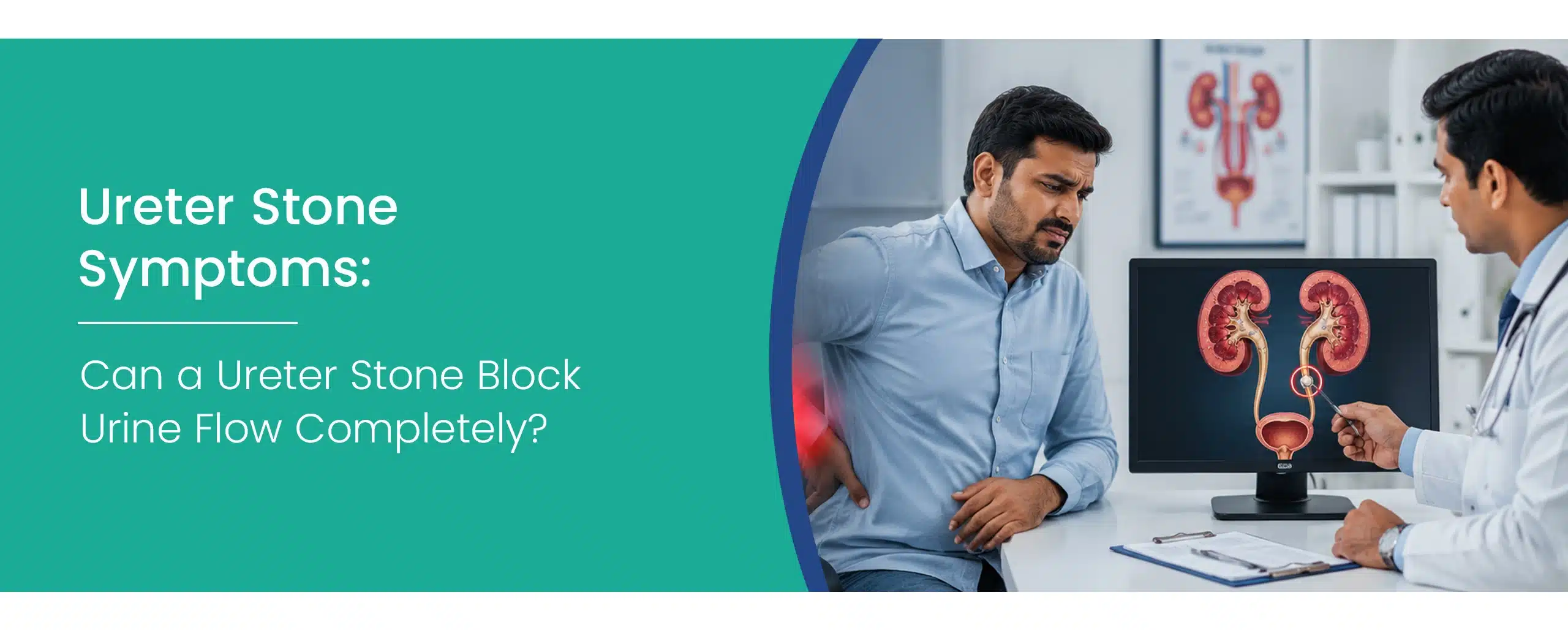
If you have ever dealt with a kidney stone, you know it is an experience you never want to repeat. But the real trouble often begins when that stone decides to leave the kidney and travel down the ureter, the narrow, muscular tube that connects your kidneys to your bladder. Recognizing ureter stone symptoms early can make the difference between a simple procedure and a serious medical emergency.
Because the ureter is incredibly thin (measuring just 3 to 4 millimeters wide), it takes only a small mineral crystal to get firmly wedged along the way. This brings up a critical, time-sensitive medical question: can a ureter stone block urine flow completely? The short answer is a definitive yes. When a stone gets permanently stuck, it turns into an obstructive ureter stone. This acts exactly like a tight plug in a water pipe, completely shutting down your body’s plumbing system and creating a backup that can threaten your entire health.
This guide breaks down exactly what happens if a ureter stone blocks urine, how to spot the ureter stone symptoms, and when to seek advanced ureter stone treatment in Noida. If you are fighting severe pain right now, finding the best urologist in Noida at a leading center like Rama Hospital can clear the path to fast, permanent relief.
The Mechanics of a Ureter Stone Blockage
To understand why this condition escalates so quickly, it helps to look at how your urinary tract handles a physical blockage.
| THE OBSTRUCTIVE PROGRESSION MATRIX | |
| Blockage Level | What Is Actually Happening Inside Your Body |
| Partial Blockage | Urine squeezes past the stone, causing waves of sharp, cramping pain, but urine still exits the body. |
| Complete Blockage | Zero urine can pass the stone; fluid backs up directly into the kidney cavity, causing it to swell up rapidly. |
- The Narrow Chokepoints: The ureter has three natural narrow zones, including the exact junction where it meets the bladder, making it highly prone to catching stones.
- The Muscle Spasm Reaction: When a stone gets stuck, the ureter wall clamps down and rhythmically squeezes to push it out, causing agonizing physical pain.
- The High-Pressure Backup: If the seal is complete, the kidney keeps producing urine blindly, raising internal pressures to dangerous levels within hours.
Recognizing Ureter Stone Symptoms
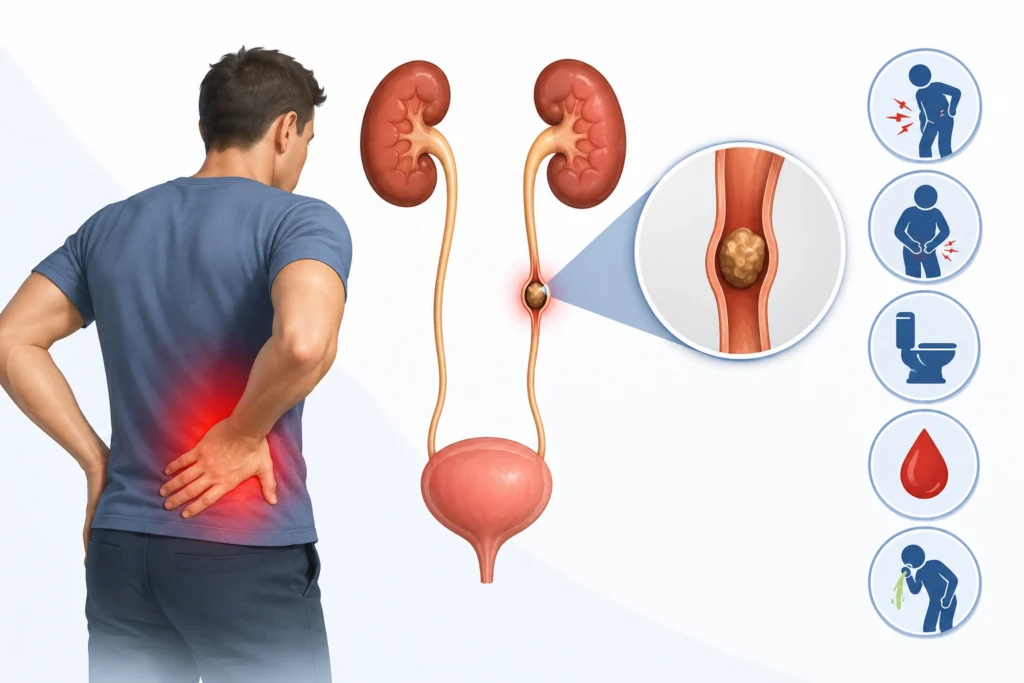
An obstructive ureter stone is virtually impossible to ignore. Your body will trigger a series of intense, unmistakable ureter stone symptoms to alert you that your urinary tract is shut down.
The Pain Profile: How Painful Is a Blocked Ureter Stone?
It is widely considered one of the most severe pains a human can experience, often compared to childbirth or a severe burn.
- Severe flank pain: A sharp, stabbing, and relentless agony centered on one side of your lower back, right below your rib cage.
- Pain radiating to groin: The pain travels downwards over time, shooting into your lower abdomen, pelvis, and deep into your groin area.
- Zero relief positions: Unlike a muscle ache, moving around, stretching, or lying down flat brings absolutely no relief to the throbbing pressure.
Urinary Disruptions
- Difficulty urinating: Feeling a desperate, continuous urge to empty your bladder, but only managing to pass a few tiny drops at a time.
- Reduced urine output: A visible drop in your total daily urine volume, showing that fluid is physically trapped higher up in your body.
- Blood in urine: The jagged, sharp edges of the stone scrape the sensitive inner lining of the tube, turning your urine pink, red, or smoky brown.
- Burning urination: A raw, stinging, or fiery sensation whenever you try to pass urine, mimicking a severe bladder infection.
- Lower abdominal pain: Intense, low-lying cramps that make your entire stomach area feel tight, bruised, and highly sensitive to touch.
Systemic Full-Body Reactions
- Nausea and vomiting: The nerves serving your kidneys are directly linked to your digestive tract, causing sudden waves of sickness and forceful vomiting during a pain attack.
- Fever with kidney stone: Developing a high body temperature, sweating, or severe chills is a major red flag indicating that trapped, stagnant urine has turned into a dangerous bacterial infection.
The Hidden Danger: Can Ureter Blockage Damage Kidneys?
Many patients try to tough out the pain at home, hoping the stone will eventually pass on its own. However, ignoring ureter stone symptoms and delaying treatment opens the door to permanent organ damage. If you are wondering, can ureter blockage damage kidneys? The medical reality is stark:
- Hydronephrosis (Kidney Swelling): The continuous pressure buildup forces the internal chambers of the kidney to stretch and dilate, leading to visible swollen kidney symptoms.
- Filter Compression: The trapped fluid presses heavily against the delicate nephrons, the microscopic blood-filtering units inside your kidney, crushing them against the organ’s outer walls.
- Irreversible Scarring: If a complete blockage is left unmanaged for more than 7 to 14 days, the compressed filtering cells begin to die off, leading to permanent kidney scarring and a lasting drop in overall function.
- Sepsis Threat: Trapped urine acts exactly like a stagnant pool of water, allowing bacteria to multiply rapidly. This can leak into your main bloodstream, creating a life-threatening, full-body infection called urosepsis.
How Urologists Confirm a Ureter Stone Blockage
When you arrive at a clinic with severe ureter stone symptoms, like flank pain, a specialist will use advanced diagnostic tools to map the exact location of the obstruction within minutes.
Severe Flank Pain Attack ➔ Immediate Diagnostic Evaluation
▼
Low-Dose NCCT Kidney Scan ➔ Maps Stone Size, Density, and Location
▼
Check for Kidney Swelling ➔ Identifies Exact Level of Obstruction
- Non-Contrast CT Scan (NCCT): The absolute gold standard for stone tracking. It uses low-dose X-rays to create an ultra-precise 3D map of your abdomen, revealing even microscopic stones hidden behind pelvic bones.
- Kidney Ultrasound: A fast, radiation-free scanning tool that uses sound waves to check for ureter stone symptoms and estimate how much fluid is backing up.
- Urine and Blood Panels: Quick lab tests that check your white blood cell counts for hidden infections and measure serum creatinine to see how well your kidneys are filtering waste under pressure.
Advanced Treatment Options: Clearing the Path
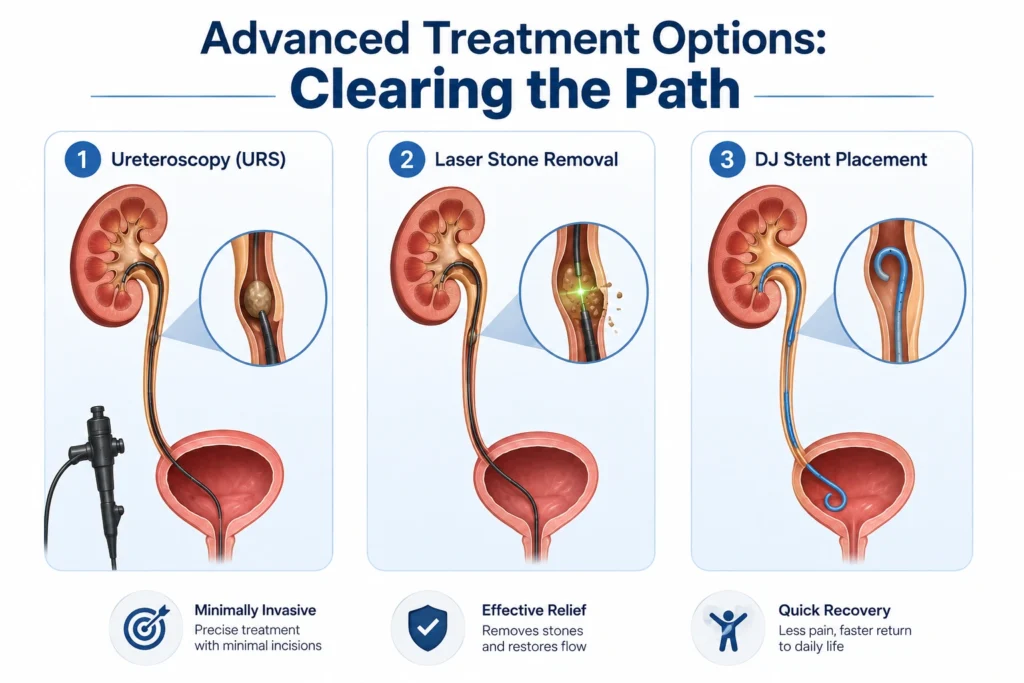
When a stone blocks your urine flow completely, drinking gallons of water or taking oral painkillers will not solve the physical obstruction. Once ureter stone symptoms reach this stage, modern urology offers highly effective, completely incision-free techniques to shatter the stone and restore normal drainage immediately.
1. Ureteroscopy (URS)
- A highly advanced, minimally invasive approach that requires absolutely no surgical cuts or external incisions on your body.
- A specialized, ultra-thin, flexible fiber-optic camera called a ureteroscope is passed gently through your natural urinary opening, traveling up into the bladder and straight to the stuck stone.
2. Laser Stone Removal
- Once the scope gives the urologist a direct view of the stone, a microscopic laser fiber (Holmium or Thulium laser) is threaded through the scope.
- The laser fires high-intensity light pulses directly at the stone, instantly shattering the hard crystal structure into tiny, fine dust particles or small fragments that can be easily washed out.
3. DJ Stent Placement
- After the stone is fully cleared, the inner walls of the ureter can remain swollen and irritated from the blockage.
- To ensure your urine flow stays perfectly clear, the urologist will place a thin, flexible, hollow tube called a double-J (DJ) stent inside the channel.
- The stent remains in place for a couple of weeks to protect the tube from collapsing, allowing the inner tissues to heal smoothly before it is quickly removed in a brief, painless office visit.
World-Class Ureter Stone Treatment
Dealing with a complete urinary blockage is a medical emergency that requires a combination of rapid diagnostic scanning, advanced surgical tools, and highly experienced hands.
| EMERGENCY UROLOGY EVALUATION CHECKLIST | |
| Quality Check | Why It Critical For Your Kidney’s Safety |
| 24/7 Availability | Blockages can strike at midnight and require immediate access to surgical decompression. |
| Laser Capabilities | Advanced holmium laser units break down high-density stones quickly without damaging surrounding tissues. |
| Expert Guidance | An experienced urologist can navigate narrow channels safely, minimizing the risk of ureter scarring. |
If you notice any ureter stone symptoms, consulting the best urologist in Noida ensures you get an instant, highly accurate diagnosis when every hour counts for your kidney health. Seeking your care for advanced ureter stone treatment in Noida at a premier, fully integrated medical facility like Rama Hospital gives you direct access to 24/7 emergency kidney care, state-of-the-art laser technology, and specialized urological surgical teams all under one roof for a fast, safe, and completely pain-free recovery.
Frequently Asked Questions (FAQ)
Can a ureter stone pass on its own if it is already causing severe vomiting?
If ureter stone symptoms like severe, uncontrollable vomiting appear, it is a clear sign that the internal pressure inside your kidney has reached a critical peak, triggering a strong neural distress response across your digestive tract. In these cases, you are highly unlikely to pass the stone safely on your own, and trying to wait it out can lead to severe dehydration and kidney complications.
How long can a kidney survive with a complete ureter stone blockage?
A healthy kidney can handle a complete, sudden blockage for a few days without suffering major, permanent damage. However, if ureter stone symptoms are ignored and the complete obstruction is left untreated for more than 7 to 14 days, the intense fluid pressure will begin to permanently destroy internal filtering nephrons, leading to irreversible kidney damage and a lasting loss of function.
What is the major difference between a kidney stone and a ureter stone?
The primary difference is the physical location of the stone. A kidney stone sits inside the wide, open internal chambers of the kidney itself, where it often remains completely painless and unnoticed for years. A ureter stone is a stone that has rolled out of the kidney and become stuck inside the narrow, 3-millimeter-wide drainage tube, causing sudden, severe ureter stone symptoms like intense pain and blocked urine flow.
Is the placement of a DJ stent permanent after laser stone removal?
No, a DJ stent is entirely temporary and is usually left in place for only 1 to 2 weeks after your procedure. Its only job is to act as a supportive internal splint to keep the ureter channel wide open while post-surgical swelling calms down. Once the tube has healed cleanly and all ureter stone symptoms have completely resolved, the urologist will slide the stent out during a quick, completely painless outpatient visit.
Why do some people form ureter stones repeatedly?
Recurrent stone formation is typically driven by an imbalance in your daily urine chemistry. Common causes include chronic dehydration (not drinking enough water), a diet excessively high in sodium or animal proteins, genetic metabolic disorders, or an overproduction of calcium and oxalate. To avoid experiencing ureter stone symptoms repeatedly, a urologist can perform a detailed 24-hour urine evaluation to build a personalized prevention plan for your lifestyle.
Conclusion: Protect Your Kidneys and Reclaim Comfort
To wrap things up, understanding what happens if a ureter stone blocks urine underscores how vital it is to treat this condition with the urgency it deserves. A stuck stone is far more than an agonizing pain episode; it is a direct physical threat to your long-term kidney function. Waiting for a complete blockage to resolve on its own or relying solely on heavy painkillers can put your health at serious risk.
If you or a family member is experiencing ureter stone symptoms like sharp flank pain, difficulty urinating, or severe morning nausea, taking a proactive approach is the safest choice. Consulting the best urologist in Noida will provide you with an immediate, accurate assessment and a clear roadmap to safety. Never ignore ureter stone symptoms; reach out to the dedicated urological care team at Rama Hospital today to explore advanced options for ureter stone treatment in Noida and take a confident step toward a fast, safe, and fully active recovery.