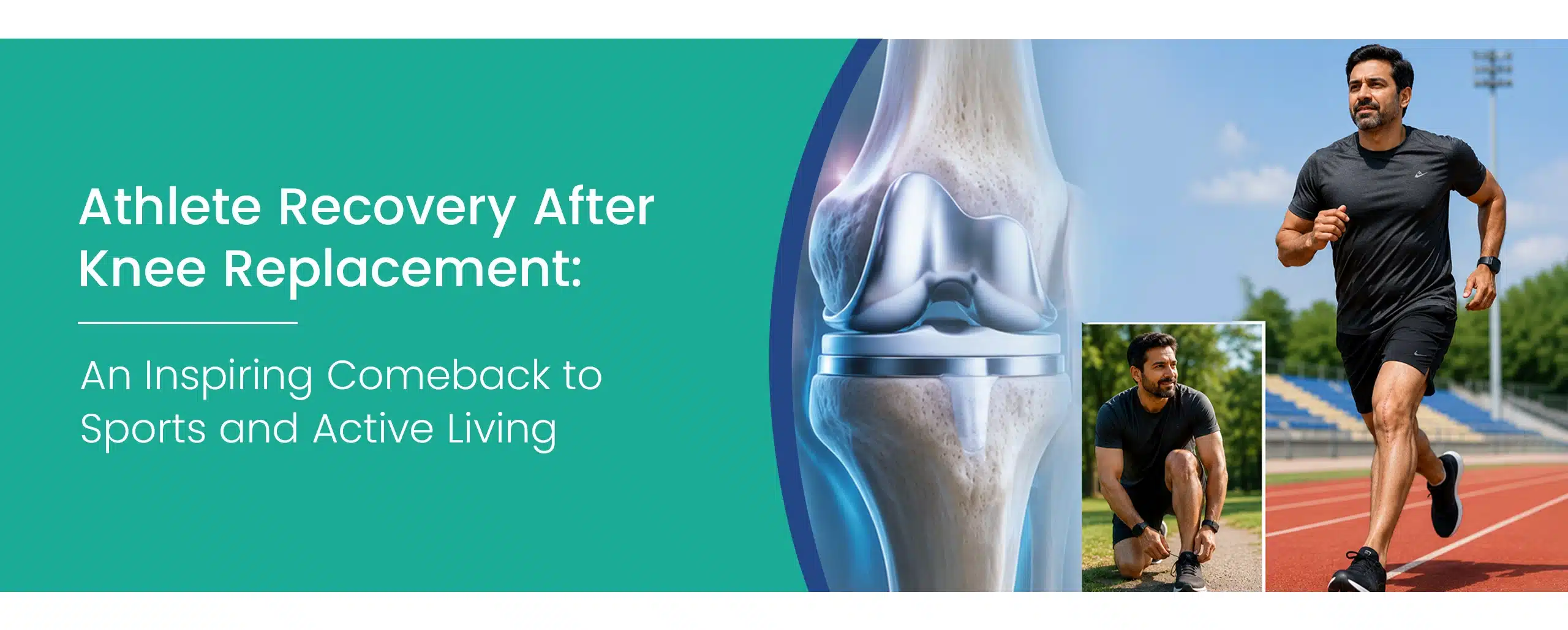
For an athlete, the knee is everything.
It absorbs every landing, powers every sprint, and keeps you stable through every pivot. So when a surgeon says, “You need a knee replacement,” the first question is never just, “Will I be okay?” It’s, “Will I ever compete again?”
The answer, more often than not, is yes.
But how athletes recover after knee replacement is a very different story from how the average patient does. The goals are higher. The demands are harder. The rehabilitation journey is longer, more deliberate, and far more structured.
What happens during knee replacement surgery?
Before diving into recovery, it helps to understand what the surgery actually does.
In a total knee replacement (TKR), the damaged cartilage and bone surfaces of the knee joint are removed and replaced with metal and plastic implants. This relieves pain, corrects deformity, and restores joint function.
For athletes, this is often the last-resort option, chosen after years of cartilage wear, osteoarthritis, or ligament damage that has made normal movement painful and sport impossible. Understanding how athletes recover after knee replacement is an important part of setting realistic expectations for returning to an active lifestyle.
For athletes, this is often the last-resort option, chosen after years of cartilage wear, osteoarthritis, or ligament damage that has made normal movement painful and sport impossible.
The surgery itself takes 1 to 2 hours. Recovery, for athletes determined to return to sport, takes much longer.
Why athletes need a different recovery plan
Standard knee replacement rehabilitation is designed to help patients walk without pain, climb stairs, and manage daily activities. That’s the baseline.
Athletes need more. To understand how athletes recover after knee replacement, it’s important to recognize that they need to run, jump, change direction, manage high loads under fatigue, and perform at speeds that put 5 to 7 times their body weight through the joint with every step.
This is why knee replacement rehabilitation for athletes must be customized from the start.
Key differences in athletic recovery:
- Higher muscle strength targets before return to sport.
- Advanced joint stability and proprioception training.
- Sport-specific movement patterns reintroduced gradually.
- More aggressive physiotherapy timelines with careful load management.
- Psychological readiness assessed alongside physical metrics.
Phase-by-phase recovery roadmap
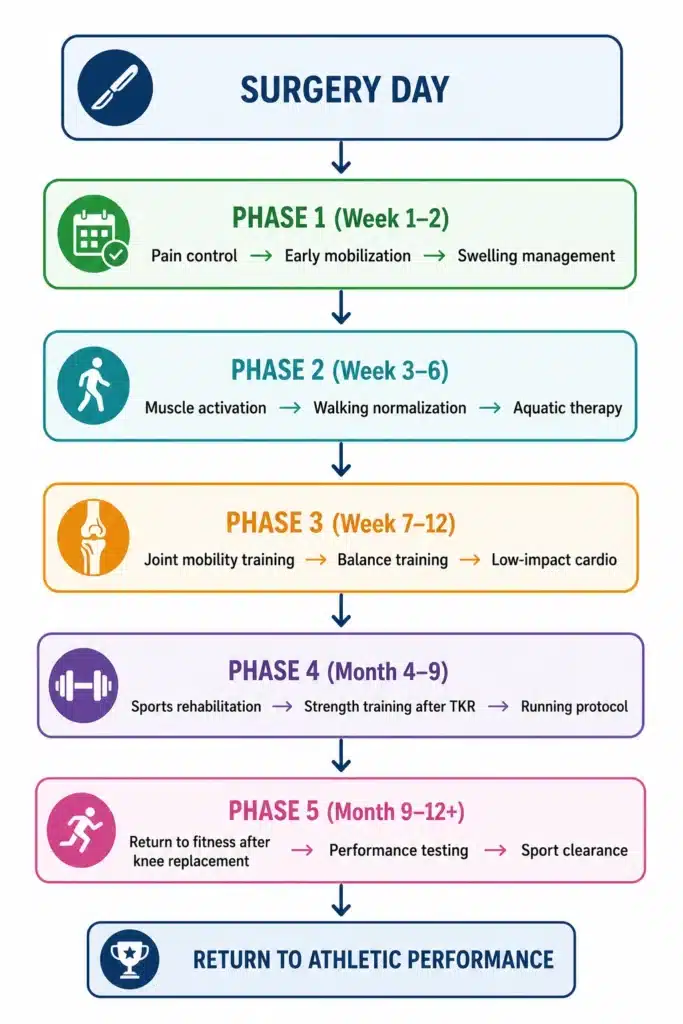
How athletes recover after knee replacement follows a structured, phase-based approach. Each phase has specific goals. Skipping ahead, however tempting, increases the risk of complications, implant stress, and re-injury.
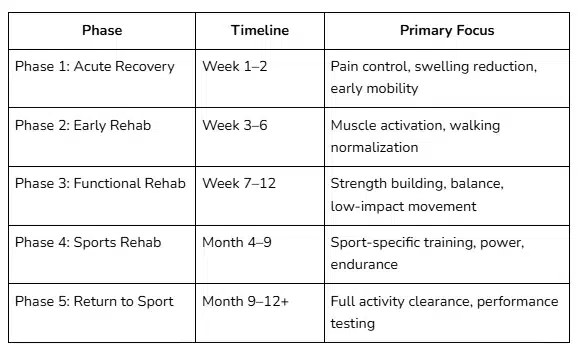
Recovery phases at a glance
Source: https://orthokau.com/knee-specialist-singapore/partial-knee-replacement-recovery-timeline/
Phase 1: The First Two Weeks (Acute Recovery)
For athletes, compliance here is everything. The tendency to push harder or skip rest can actually delay healing at this stage, even as athletes recover after knee replacement and work toward regaining strength, mobility, and performance.
This phase is about survival, controlled, purposeful survival.
- Pain and swelling are managed with ice, elevation, and medication.
- A continuous passive motion (CPM) machine may be used to gently bend and straighten the knee.
- Early mobilization starts within 24 hours; physiotherapists help patients stand and take first steps.
- Ankle pumps, quad sets, and heel slides begin immediately.
- Goal: Achieve 0–90 degrees of knee flexion by end of week 2.
Phase 2: Weeks 3 to 6 (Early Rehabilitation)
Walking patterns normalize. Muscle activation becomes the priority. By the end of week 6, most athletes recover after knee replacement by walking unaided with good alignment and reduced pain.
Key activities include:
- Straight leg raises to rebuild quadriceps strength without joint stress.
- Mini squats and step-ups as range of motion improves.
- Gait training to eliminate limping patterns.
- Pool walking and aquatic therapy begin (excellent for athletes, load-free movement).
- Muscle strengthening after knee surgery focuses on quad, hamstring, and glute activation.
Phase 3: Weeks 7 to 12 (Functional Rehabilitation)
This is where mobility training after knee replacement gets serious. The focus is on restoring quality of movement, not just quantity, helping athletes recover after knee replacement and return to their desired activity levels.
- Full weight-bearing exercises increase progressively.
- Joint mobility training targets full extension and 120+ degrees of flexion.
- Balance and proprioception exercises begin, including single-leg stands and wobble board work.
- Stationary cycling becomes a core tool: low impact, high repetition, and excellent for joint mobility and cardiovascular base.
- Low-impact sports after knee replacement like swimming and cycling can begin here for many patients.
- Flexibility exercises for knee replacement recovery are introduced: hamstring stretches, calf stretches, and hip flexor work.
Phase 4: Months 4 to 9 (Sports Rehabilitation)
This is the heart of sports rehabilitation: how athletes recover after knee replacement and regain strength, mobility, and confidence during recovery.
Strength training after TKR becomes progressive and sport-specific:
- Leg press, lunges, Romanian deadlifts (controlled load).
- Plyometric introduction, low-level jumping, and landing mechanics.
- Agility ladder work and directional changes.
- Running gait assessment: how long before athletes can run after knee replacement depends on strength benchmarks, not just time.
- Most athletes begin jogging between months 5 and 7, pending physiotherapist clearance.
Endurance recovery after surgery is rebuilt methodically. Understanding how athletes recover after knee replacement requires a structured approach, as cardiovascular fitness typically returns faster than muscular strength. Athletic physiotherapy after TKR during this phase often includes:
- Sports-specific movement drills.
- Proprioceptive challenges under fatigue.
- Force plate analysis to detect strength asymmetry between legs.
- Video gait analysis.
Phase 5: Month 9 to 12+ (Return to Sport)
Returning to sports after knee replacement is not a single moment; it’s a gradual, tested process.
Formal return-to-sport criteria include:
- Limb Symmetry Index (LSI) of 90% or above for strength and power.
- Successful completion of sport-specific performance tests.
- Psychological readiness (fear of re-injury assessed and addressed).
- Surgeon clearance based on imaging and functional assessment.
Performance recovery at this stage targets regaining the moment’s performance that is as close to the pre-injury baseline as possible.
For many athletes, especially those who underwent surgery in their 40s and 50s, this stage is genuinely achievable. Many athletes recover after knee replacement and successfully return to high-level recreational sports, masters-level competition, and structured fitness training as part of their long-term recovery journey.
How long before athletes can run after knee replacement?
This is the most common question athletes ask after surgery.
Honest answer: Most athletes begin light jogging between 5 and 7 months post-surgery. Full running is typically cleared between months 9 and 12, provided strength and stability benchmarks are met.
Athletes recover after knee replacement based on both healing and functional readiness, not just time. Running puts 3 to 5 times body weight through the knee. For athletes recovering after knee replacement, attempting to run before the muscles are strong enough to absorb that load can increase implant stress, accelerate wear, and raise the risk of complications.
Key milestones before running clearance:
- Quad strength at 80%+ of the non-operated leg.
- No persistent swelling after activity.
- Full extension and 120+ degrees of flexion.
- Normal walking gait at all speeds.
- Successful completion of progressive walking and fast-walk protocol.
Safe workouts after knee surgery: what to do and what to avoid
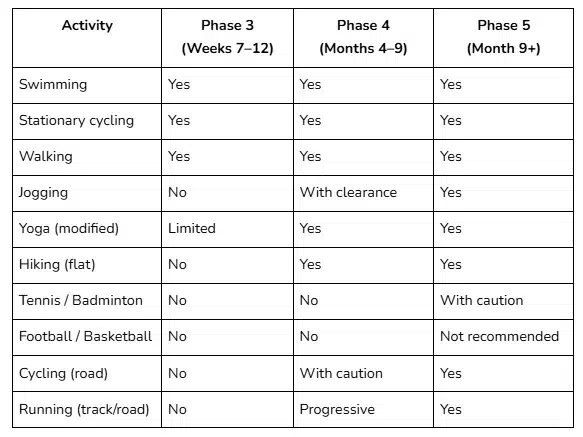
Safe workouts after knee surgery focus on protecting the implant while rebuilding function. High-impact or twisting activities must be avoided until cleared.
Exercise guide by phase
Low-impact sports after knee replacement, swimming, cycling, golf, doubles tennis, yoga, and Pilates are generally recommended as long-term activity choices even after full recovery.
Strength training after TKR: the athletic priority
Strength training after TKR is the single most important variable in helping athletes recover after knee replacement. Without adequate muscle strength, the joint is unprotected, and performance will never return to baseline.
Athletes should aim for bilateral symmetry, with both legs performing within 10% of each other before advancing to high-demand activities.
Core muscle groups to rebuild:
- Quadriceps: primary shock absorbers of the knee.
- Hamstrings: protect the joint against shear forces.
- Glutes and hip abductors: improve alignment and reduce knee load.
- Calf muscles: support the ankle-knee kinetic chain.
Strength training progression:
- Weeks 3–6: Isometric work (no joint movement), straight leg raises.
- Weeks 7–12: Partial squats, leg press, step-ups.
- Months 4–6: Full-range leg press, split squats, Romanian deadlifts.
- Months 7–12: Sport-specific loading, plyometrics, power training.
The recovery flow: visualizing the journey
Athletic physiotherapy after TKR: why it’s different
Athletes should seek physiotherapists experienced in post-surgical sports rehabilitation, not just general orthopedic rehab, to optimize how athletes recover after knee replacement and safely return to peak performance.
Athletic physiotherapy after TKR is not standard physiotherapy with harder exercises. It requires a physiotherapist who understands:
- Force output and load tolerance specific to the sport.
- Movement quality under speed and fatigue.
- Psychological recovery: Many athletes experience fear of re-injury that limits progression even when physically ready.
- Performance benchmarking using objective tools like force plates, hop tests, and video analysis.
In cities like Noida, knee replacement surgery in Noida and post-surgical athletic rehab have grown significantly, with joint replacement specialists in Noida now offering dedicated sports recovery pathways for active patients.
Joint stability after knee replacement: why it matters for athletes
For athletes, the second source is more critical. No implant alone can replicate the stabilizing function of strong, well-coordinated muscles, which is why how athletes recover after knee replacement depends heavily on targeted rehabilitation, muscle strength, and neuromuscular control.
Proprioception training, teaching the body to sense joint position in space, is particularly important. After surgery, proprioceptive feedback from the joint is temporarily disrupted. Rebuilding it through balance and stability exercises is essential for safe return to fitness after knee replacement.
Joint stability after knee replacement comes from two sources:
- The implant itself, designed to replicate natural knee kinematics.
- The surrounding musculature, the true dynamic stabilizers.
Mental recovery: the part no one talks about
Working with a sports psychologist during athletes’ recovery after knee replacement is increasingly recognized as important, especially for competitive athletes and those who define themselves strongly through sports.
Athletic recovery after knee replacement is as much psychological as it is physical.
Common mental barriers athletes face:
- Fear of re-injury when returning to sport.
- Loss of athletic identity during the recovery period.
- Frustration at slower-than-expected progress.
- Comparison with pre-surgery performance levels.
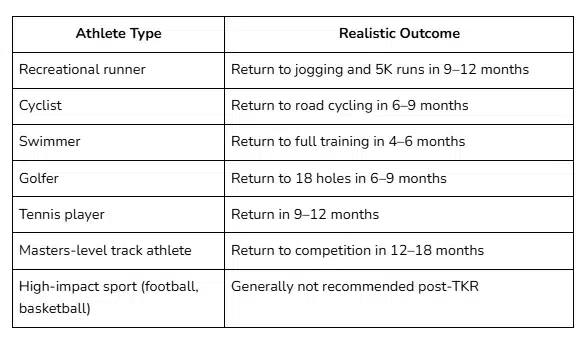
What realistic return to fitness looks like
Return to fitness after knee replacement means different things to different athletes:
Frequently Asked Questions (FAQ)
Q: Will I ever be able to run again after knee replacement?
Yes, most patients can return to jogging and light running, typically between 9 and 12 months after surgery, once strength benchmarks and physio clearance are met. Many athletes recover after knee replacement and gradually resume these activities as part of their rehabilitation journey.
Q: How painful is the recovery after knee replacement?
Pain is significant in the first 2 weeks but is well-managed with medication and physiotherapy. Understanding how athletes recover after knee replacement can provide valuable insight, as by month 3, most patients report far less pain than before surgery and experience significant improvements in mobility and function.
Q: Can I go swimming during recovery?
Yes. Swimming and aquatic therapy are among the safest and most effective safe workouts after knee surgery, especially for athletes recovering after knee replacement, usually starting around weeks 6 to 8.
Q: When can I start going to the gym again?
Light gym work begins around weeks 8 to 12 as athletes recover after knee replacement. Strength training after TKR progresses in a structured way, and your physiotherapist will guide load and exercise selection.
Q: Is cycling safe after knee replacement?
Stationary cycling is encouraged early in recovery, helping athletes recover after knee replacement by improving joint mobility and strength. Road cycling is typically cleared around months 6 to 9.
Q: Will my knee feel normal again?
Most athletes describe significant improvement in pain and function. The knee will feel different from a natural knee, but for active patients, the improvement in quality of life is substantial.
Q: How do I find a good physiotherapist for athletic recovery?
Look for physiotherapists with experience in post-surgical sports rehab. If you had your procedure done with a joint replacement specialist in Noida or another city, ask your surgeon for a referral to a sports-focused physio team.
Q: Is there any sport I can never do again after knee replacement?
High-impact, contact, or pivot-heavy sports like football, basketball, squash, and martial arts are generally not recommended after TKR. The concern is implant wear and risk of dislocation. Low-impact sports, cycling, swimming, golf, and doubles tennis are well-supported.
Q: How do I know if I’m pushing too hard in recovery?
Signs you’re overdoing it: increased swelling, sharp joint pain (not muscle soreness), warmth in the joint, and reduced range of motion the next day. Always communicate these to your physiotherapy team.
Q: Can younger athletes (under 55) have a knee replacement?
Yes, and increasingly so. The decision depends on the degree of joint damage, pain levels, and quality of life. Younger patients may need a revision surgery later in life, but modern implants last 20+ years with proper activity management.
Conclusion
How athletes recover after knee replacement depends enormously on what they bring to the process.
Discipline. Patience. Consistency. A willingness to trust the timeline even when it feels slow.
The athletes who return strongest are not always the ones who pushed hardest, they’re the ones who followed the plan, hit each milestone, and built a foundation strong enough to carry real athletic demands again.
If you are considering knee replacement surgery in Noida or anywhere else in India, find a joint replacement specialist in Noida or in your city who understands not just the procedure but your life beyond it. Ask them about their athletic recovery pathway. Ask about dedicated physiotherapy. Ask about realistic return-to-sport timelines for your specific sport and goals.
The surgery is one day long. The recovery is the work. And for athletes, it is absolutely worth doing right.
Consult your orthopedic surgeon and physiotherapy team before beginning or modifying any exercise program post-surgery. Recovery timelines vary based on individual health, surgery type, and rehabilitation consistency.