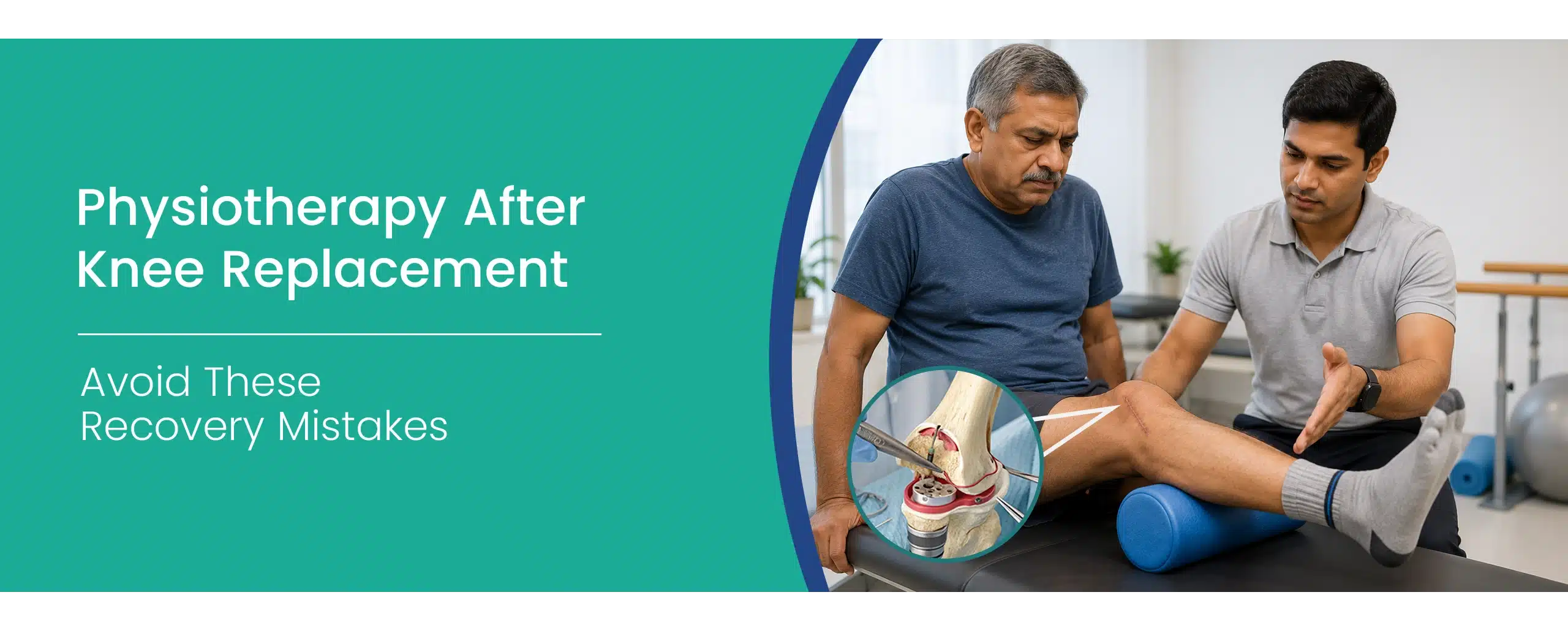
You’ve had your knee replacement. The surgery went well. Now comes the part most patients underestimate, recovery.
The truth is, surgery fixes the joint. But physiotherapy after knee replacement is what actually gives you your life back.
Without it, you risk stiffness, muscle weakness, poor gait, and a much longer recovery. With it, most patients walk unaided within weeks and return to daily life faster than they expected.
Why is physiotherapy after knee replacement non-negotiable?
Many patients think rest equals recovery. That’s one of the most common and costly mistakes.
After knee replacement surgery, your muscles have been cut, moved, and repositioned. The new joint needs to be trained to work properly. Your body doesn’t automatically know how to use it.
Physiotherapy after knee replacement does several critical things:
- Reduces post-surgical swelling and inflammation.
- Rebuilds quadricep and hamstring strength.
- Restores full range of motion in the knee.
- Retrains your balance and coordination.
- Prevents dangerous complications like blood clots (DVT).
- Gets you off the walker and back to walking naturally.
Without structured rehabilitation, patients often develop scar tissue that limits movement permanently. That’s a problem no second surgery can easily fix.
When does physiotherapy start after knee replacement?
This surprises most patients.
Physiotherapy after replacement begins within 24 hours of surgery.
You will not be left in bed to “heal.” Your physiotherapist will visit you in the hospital room, usually the morning after surgery, and begin supervised movement exercises.
The faster and more consistently you follow physiotherapy after replacement, the faster this timeline moves.
Here’s a general timeline:
| Phase | Timeline | Focus Area |
| Phase 1 – Acute | Day 1–3 (In-hospital) | Ankle pumps, leg raises, sitting up, standing with support |
| Phase 2 – Early Recovery | Week 1–3 | Walking with walker, bending the knee, basic strength |
| Phase 3 – Intermediate | Week 4–6 | Stairs, walking without walker, increased range of motion |
| Phase 4 – Functional | Week 7–12 | Strengthening, endurance, return to daily activities |
| Phase 5 – Advanced | Month 3–6 | Full strength, balance training, near-normal function |
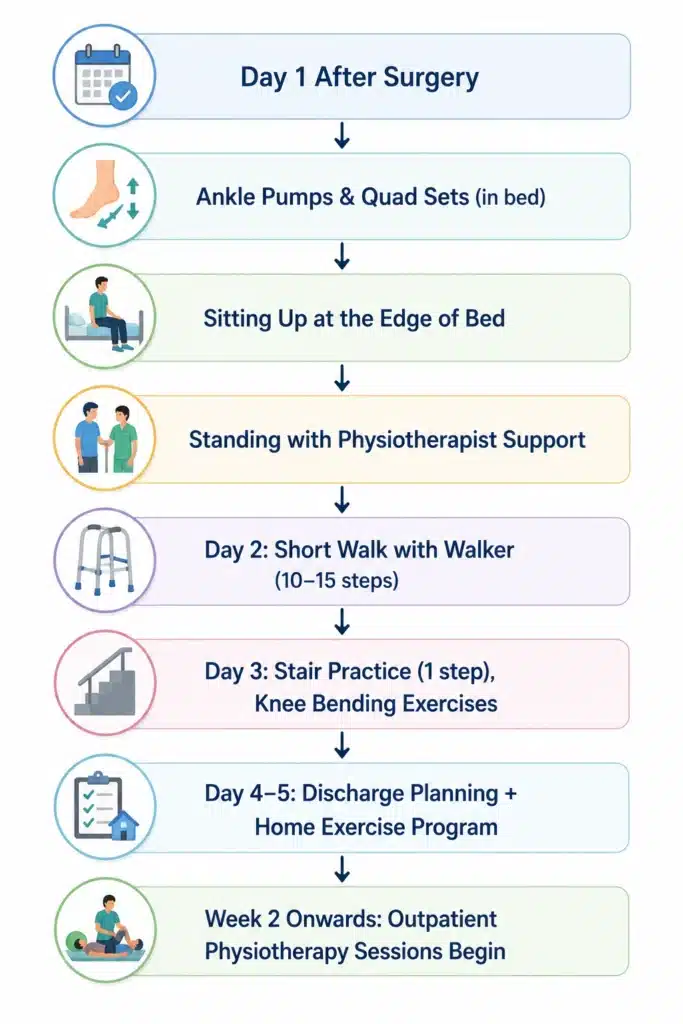
The day-by-day flow: what happens in your first week
Every step in this flow exists for a reason. Skipping any phase slows the entire recovery.
Most patients at hospitals like Rama Hospital in Noida begin joint replacement physiotherapy immediately after surgery. Here’s how it looks:
Core exercises in physiotherapy after knee replacement
The best physiotherapist in Noida will adjust intensity based on your pain, swelling, and progress every session.
Your physiotherapist will customize a plan. But most knee replacement rehabilitation programs include these foundational exercises:
Early stage (Week 1–2)
- Ankle pumps: Prevent blood clots by improving circulation.
- Quad sets: Tighten the thigh muscle without moving the knee.
- Straight leg raises: Rebuild control over the leg.
- Heel slides: Gently increase how far the knee bends.
- Short arc quads: Strengthen without stressing the new joint.
Mid stage (Week 3–6)
- Standing knee bends: Improve flexion with weight through the leg.
- Terminal knee extensions: Train the quad to straighten the knee fully.
- Step-ups: Begin stair training safely.
- Mini squats: Return strength to hip and thigh together.
- Stationary cycling (low resistance): Full-range motion in a safe environment.
Late stage (Month 2–6)
- Full squats and lunges (with guidance).
- Balance training on unstable surfaces.
- Treadmill walking at varied speeds.
- Resistance band strengthening.
- Functional movement drills: Sitting down, getting up, entering a car.
What slows down recovery? red flags patients ignore
Pain after knee replacement is normal for several weeks. Pain is different from damage. Your physiotherapist is trained to know the difference; trust them.
Even with good physiotherapy after knee replacement, some patients slow their own recovery. Here’s what to avoid:
| What Slows Recovery | What Speeds Recovery |
| Skipping physiotherapy sessions | Attending all prescribed sessions |
| Staying in bed all day | Moving every 1–2 hours |
| Not icing the knee | Icing 3–4 times daily for 15–20 mins |
| Ignoring pain and forcing movement | Communicating pain levels to your physio |
| Stopping exercises when pain reduces | Continuing the full program |
| Not elevating the leg | Keeping the leg raised when resting |
| Relying only on pain medication | Using medication alongside therapy |
How does Rama Hospital approach knee replacement rehabilitation?
Rama Hospital, one of the trusted names for knee replacement in Noida, follows an integrated recovery protocol.
Their approach to joint replacement physiotherapy combines:
- Pre-surgery physio (prehabilitation) to strengthen muscles before the operation.
- In-hospital physiotherapy starting Day 1 post-surgery.
- Outpatient rehabilitation programs after discharge.
- Home exercise guidance with printed and digital programs.
- Regular progress assessments at 2 weeks, 6 weeks, and 3 months.
The best hospital in Noida for knee replacement doesn’t just perform the surgery well; it ensures the entire recovery journey is supported.
At Rama Hospital, patients receive physiotherapy after knee replacement from a dedicated orthopedic rehabilitation team working alongside the surgical team. That coordination matters.
Prehabilitation: the physiotherapy that happens before surgery
This is one of the most underused tools in knee replacement rehabilitation.
If your surgery is planned 4–6 weeks away, starting joint replacement physiotherapy before the operation can
- Improve muscle strength so recovery is faster.
- Reduce post-surgery pain levels.
- Decrease time spent in hospital.
- Improve confidence and mental readiness.
- Reduce complication risk.
Studies consistently show that patients who do prehabilitation before knee replacement are walking independently 2–3 weeks earlier than those who don’t.
The best physiotherapist in Noida will design a pre-surgery program that’s low-impact and safe for a damaged knee joint.
Total knee vs. partial knee replacement: Does physiotherapy differ?
Both types of knee replacement surgery require dedicated physiotherapy after knee replacement. The principles are the same; only the pace varies.
Yes, but not as dramatically as patients expect.
| Factor | Total Knee Replacement | Partial Knee Replacement |
| Surgery scope | Full joint replacement | One compartment only |
| Physio start | Day 1 post-surgery | Day 1 post-surgery |
| Intensity of early physio | Slightly more gradual | Can progress a little faster |
| Full recovery timeline | 3–6 months | 2–4 months |
| Long-term physio goal | Full functional independence | Full functional independence |
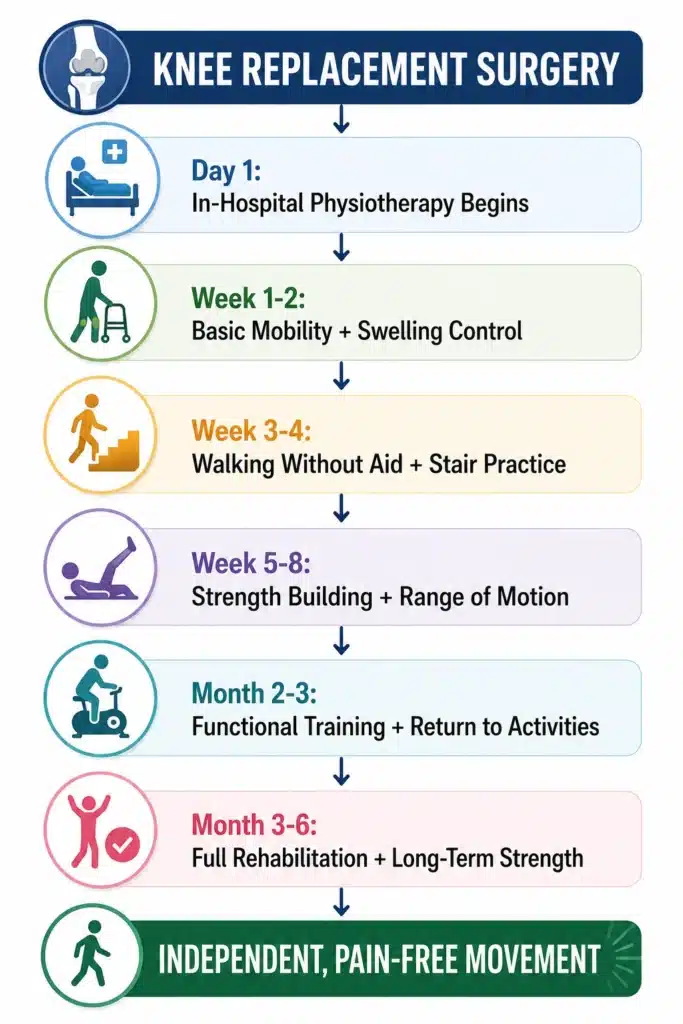
Physiotherapy after knee replacement: A recovery flowchart
Every stage of physiotherapy after knee replacement builds on the previous one. Jumping ahead, or skipping stages, creates gaps that come back as problems later.
Physiotherapy at home vs. clinic: What’s the right balance?
After discharge, most patients do a combination of both.
Home exercises: Done daily. Usually 3–4 times per day in the early weeks. These keep the knee moving between clinic visits.
Clinic sessions: Done 3–5 times per week in the first month. Your physiotherapist monitors progress, adjusts techniques, and uses hands-on therapy and equipment like TENS, ultrasound, and heat.
For patients in Noida, finding the best physiotherapist in Noida for outpatient sessions matters a lot. The quality of knee replacement rehabilitation you receive outside the hospital directly affects your 6-month outcome.
Rama Hospital offers outpatient joint replacement physiotherapy at their facility in Noida, with experienced therapists familiar with every stage of post-surgical recovery.
When can you return to normal life after knee replacement?
Patients asking this during physiotherapy after knee replacement get the same honest answer: it depends on consistency.
General milestones:
- Walking unaided: 4–6 weeks with good knee replacement rehabilitation.
- Driving: Usually 6–8 weeks (left knee earlier than right).
- Stairs independently: 6–10 weeks.
- Light work (desk job): 4–8 weeks.
- Physical work: 3–6 months.
- Low-impact sports (swimming, cycling): 3–4 months.
- Pain-free most days: By month 3 for most patients.
These timelines improve significantly when patients follow structured physiotherapy after knee replacement consistently and attend every session.
Frequently Asked Questions (FAQs)
Q: Is physiotherapy after knee replacement painful?
Yes, there will be discomfort, especially in the first 2–3 weeks. Some pain during movement is expected and normal. Your physiotherapist will work within your pain tolerance and adjust exercises accordingly. The pain gets less every week.
Q: My knee is very swollen. Should I still do physiotherapy?
Yes. Swelling is a normal part of recovery. Your physiotherapist will actually help reduce swelling through specific techniques, elevation, icing, and compression. Stopping physiotherapy because of swelling makes it worse, not better.
Q: How many physiotherapy sessions will I need after knee replacement?
Most patients need 20–40 sessions over 3–6 months. The frequency is high in the first 6 weeks (daily or near-daily) and tapers off as you gain strength and independence.
Q: Can I do physiotherapy at home instead of going to a clinic?
Home exercises are essential, but they don’t replace clinic sessions. A trained physiotherapist can identify problems early, use specialized equipment, and make adjustments you can’t make on your own. Both are needed for the best outcome.
Q: What if I skip some sessions because the pain is less?
This is one of the biggest mistakes patients make. Pain reduction is a sign that therapy is working, not a sign to stop. Stopping early leads to weakness, stiffness, and sometimes the need to start over.
Q: When will I stop needing a walker after knee replacement?
Most patients transition to a walking stick around weeks 3–4 and walk unaided by weeks 5–6 with consistent physiotherapy after knee replacement. Some take a little longer; everyone’s body is different.
Q: Is it normal for my knee to feel hot and tight during recovery?
Yes. Some warmth, tightness, and stiffness are part of the healing process. If redness spreads significantly or you develop fever, contact your surgeon immediately. Otherwise, continue your knee replacement rehabilitation as advised.
Q: Will I ever be 100% normal after knee replacement?
Most patients reach 85–95% of full function with dedicated joint replacement physiotherapy. Many report that their quality of life after recovery is significantly better than the years they spent with a damaged knee.
Why choosing the right hospital matters for knee replacement recovery
The surgery and the rehabilitation are not two separate things. They are one continuous journey.
At Rama Hospital, recognized as the best hospital in Noida for orthopedic care, the surgical team and rehabilitation team work together from day one. Physiotherapy after knee replacement begins before you even leave the operating room area.
For patients looking for knee replacement in Noida, Rama Hospital offers the following:
- Experienced orthopedic surgeons with high-volume knee replacement practice.
- Dedicated joint replacement physiotherapy unit.
- Structured knee replacement rehabilitation protocols.
- Modern physiotherapy equipment and facilities.
- Regular progress monitoring and patient education.
If you or someone in your family is planning knee replacement surgery or has already had one, do not treat physiotherapy as optional. It is the surgery’s partner. It is what makes the surgery worth having.
Conclusion
Physiotherapy after knee replacement is not a supplement to recovery. It is recovery.
Every exercise, every session, every icy pack and resistance band is moving you closer to a life without knee pain. The patients who commit to their knee replacement rehabilitation program are the ones who call it the best decision of their life.
The ones who skip it? They’re usually the ones who come back six months later wondering why their knee still doesn’t feel right.
Start early. Stay consistent. Work with the right team.
If you’re looking for physiotherapy after knee replacement in Noida, reach out to Rama Hospital. The best physiotherapist in Noida is ready to help you get back on your feet literally.