
You are 24. You eat at your desk. You drink more chai than water. And one random Tuesday, you feel a pain so sharp it stops you mid-sentence.
That could be a kidney stone.
Most people think kidney stones are a “middle-aged uncle problem.” But kidney stones in young adults are rising fast, and the lifestyle many young Indians are living right now is one of the biggest reasons why.
This guide breaks it all down: what the warning signs look like, why stones form in the first place, and how you can stop them before they become a serious problem.
Why are kidney stones no longer just an older person’s problem?
Ten years ago, kidney stones in someone under 30 were considered unusual.
Not anymore.
Urologists across India are seeing a clear shift. Young adults, students, IT professionals, gym-goers, and startup founders are showing up with stones that would have previously been associated with people decades older.
The reasons are not mysterious. They are lifestyle-driven, diet-driven, and entirely preventable.
Kidney stones in young adults often go undetected for months because the stones are small and produce no obvious pain until they suddenly move. That is when things get very uncomfortable, very fast.
Warning signs you should not ignore
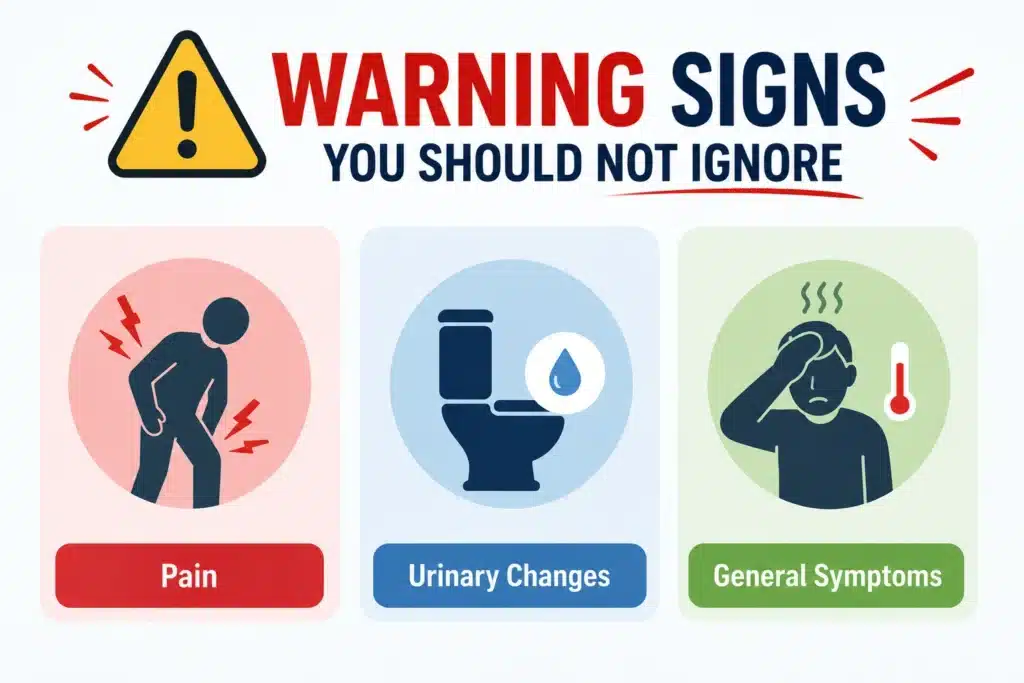
Kidney stones in young adults can range from a dull background ache to pain so severe it mimics a medical emergency.
If you notice any of these symptoms, especially blood in urine or fever alongside pain, do not wait. See a urologist.
Kidney stone symptoms in young adults are frequently mistaken for a muscle pull, a bad period, or a stomach upset. This delay makes things worse.
Pain
- Sudden, intense pain in the lower back, side, or below the ribs.
- Pain that radiates down toward the groin or lower abdomen.
- Pain that comes in waves, eases off, and returns stronger.
- A cramping or stabbing sensation rather than a continuous ache.
Urinary Changes
- Burning or stinging during urination.
- Frequent urge to urinate but passing very little.
- Cloudy, dark, pink, or red-tinged urine.
- Urine that smells unusually strong or foul.
General Symptoms
- Nausea and vomiting, especially during a pain episode.
- Fever and chills (this signals infection; requires immediate attention).
- Restlessness, an inability to find a comfortable position.
What actually causes kidney stones in young adults?
Stones do not form overnight. They build up slowly, often because of daily habits that seem harmless individually but add up over time.
Understanding causes of kidney stones in young adults is the first step toward preventing them.
Lifestyle Causes
Dehydration: The single biggest culprit
Dehydration and kidney stones in young adults are the most direct and well-established connections in urology.
Living in a hot city like Noida makes this even more critical. Sweating reduces your body’s water reserves faster than you realize.
- When you don’t drink enough water, urine becomes concentrated.
- Minerals and salts have nowhere to go; they stick together and crystallize.
- Low water intake stones are the most common type in young people.
- Most Indians drink 1–2 liters of water daily; the recommended minimum is 2.5–3 liters.
Sedentary Lifestyle
Sedentary lifestyle kidney stones in young adults are a growing problem, and no one talks about it enough.
Moving more, even short walks, helps the kidneys function better.
- Sitting for 8–12 hours a day slows metabolism
- Reduced physical movement affects how the kidneys process calcium and oxalate
- A sedentary lifestyle is also linked to obesity, which increases stone risk
- Young professionals, students, and remote workers are particularly at risk
Diet-Related Causes
What you eat has a direct impact on what forms in your kidneys. The current eating habits of young Indians create almost ideal conditions for stone formation.
Junk Food and Fast Food
Junk food kidney stones in young adults and fast food kidney stone risks are real and underestimated.
- Burgers, fries, chips, instant noodles, and packaged snacks are extremely high in sodium.
- High-salt diet kidney stones form because excess sodium causes the kidneys to excrete more calcium into urine.
- That calcium then combines with oxalate to form stones.
- Most young Indians consume 4,000–6,000 mg of sodium daily, nearly double the safe limit.
High Protein Diet
High-protein-diet kidney stones in young adults are increasingly common among gym-goers.
- Excess animal protein (red meat, chicken, and eggs in large quantities) raises uric acid levels.
- It also reduces citrate in urine; citrate is the body’s natural protection against stone formation.
- Protein supplements and crash diets add to this burden significantly.
Oxalate-Rich Foods
Oxalate foods and kidney stones in young adults are a connection many people miss.
- Foods like spinach, tomatoes, nuts, chocolate, and tea are high in oxalate.
- Oxalate binds with calcium in the kidneys and forms calcium oxalate stones, the most common type.
- Eating these foods is not the problem; eating them in excess, without enough water, is.
Sugar and Energy Drinks
- Sugar intake: high fructose from sugary drinks and processed food increases uric acid production.
- Energy drinks: loaded with caffeine, artificial sweeteners, and sugar, all of which dehydrate you and stress the kidneys.
- Drinking two energy drinks a day is more damaging to kidney health than most people realize.
- Packaged juices, sodas, and sports drinks fall into the same risk category.
Medical Causes
Sometimes, medical causes of kidney stones in young adults have a medical root that lifestyle changes alone cannot fix.
High Uric Acid
High uric kidney stones in young adults is a growing concern in urban India.
- A diet heavy in red meat, dal in excess, and alcohol raises uric acid levels in the blood.
- When uric acid is too high, it crystallizes in the kidneys and forms uric acid stones.
- Many young adults discover they have high uric acid only after a stone episode.
- A simple blood test can detect this early.
Metabolic Disorders
Metabolic disorders and kidney stones in young adults are more common than most people realize.
- Conditions like hyperparathyroidism cause the body to release too much calcium into the bloodstream.
- That excess calcium ends up in the kidneys and, eventually, in stones.
- Insulin resistance and type 2 diabetes (increasingly seen in young Indians in their 20s) also raise stone risk.
Calcium Imbalance
Calcium imbalance and kidney stones can be caused by the opposite of what most people expect.
- Not consuming enough calcium from food actually increases stone risk.
- When dietary calcium is low, the body absorbs more oxalate from the gut, which then travels to the kidneys.
- This is why cutting dairy completely, without medical guidance, can backfire.
Urinary Tract Infections
Urinary tract infection stones are a distinct category called struvite stones.
- Repeated or untreated UTIs create an environment where certain bacteria produce ammonia.
- This triggers the formation of struvite stones, which can grow large quickly.
- More common in women; often discovered when a UTI does not respond to treatment as expected.
Can kidney stones be prevented at a young age?
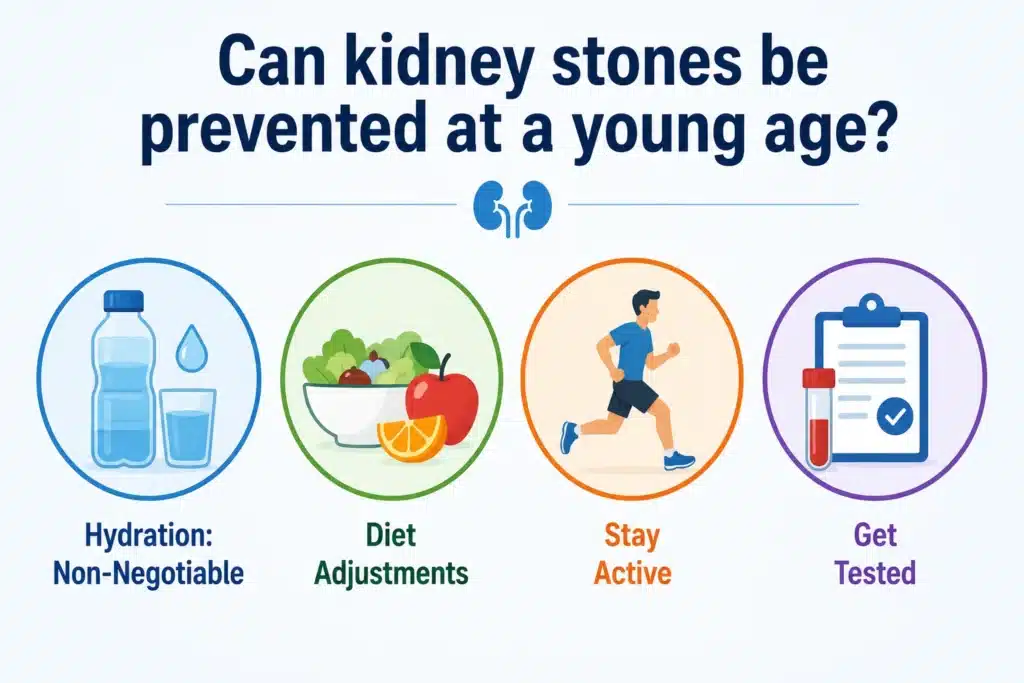
Can kidney stones be prevented at a young age? Absolutely, and the earlier you start, the better.
Prevention does not require dramatic changes. It requires consistent habits.
Hydration: Non-Negotiable
- Drink at least 2.5–3 liters of water every day.
- More on hot days or after exercise.
- Your urine should be pale yellow, not dark.
- Replace energy drinks and sodas with plain water or coconut water.
Diet Adjustments
- Reduce salt in cooking and avoid packaged food as much as possible.
- Eat animal protein in moderation; do not eliminate it, just balance it.
- Do not avoid oxalate foods entirely; pair them with adequate calcium and water.
- Cut down on sugar-sweetened beverages significantly.
Stay Active
- Even 30 minutes of walking daily reduces metabolic stone risk.
- Regular movement prevents calcium from depositing in the kidneys.
- Avoid sitting continuously for more than 2 hours without a break.
Get Tested
- If stones run in your family, get a urine and blood test once a year.
- Check uric acid, calcium, and creatinine levels as part of a basic health check.
- Early detection means early action and no surgery.
When should you see a doctor?
Symptoms of kidney stones in young adults are easy to dismiss until they are not. A urine test and an ultrasound can detect stones before they become a problem.
Do not wait for unbearable pain. See a urologist if:
- You notice blood in your urine even once.
- You have recurring pain in your lower back or side.
- Urination burns or you feel a constant urge.
- You have had a stone before; recurrence is common without treatment.
- You have a family history of kidney stones.
Kidney stone treatment in Noida
If a stone is already forming or has been detected, treatment depends on the size and location.
For reliable kidney stone treatment in Noida, Rama Hospital offers complete urological care, from diagnosis to advanced stone removal procedures, with a focus on minimal intervention and fast recovery.
The best urologist in Noida at Rama Hospital brings experience, precision, and patient-first care to every case. Whether you are dealing with your first stone or a recurring problem, expert guidance makes all the difference.
Small Stones (Under 5mm)
- Usually pass on their own with increased water intake.
- Medications can help relax the ureter and speed up the process.
- Pain management during this phase is important.
Medium Stones (5–10mm)
- May require medication or a minor procedure.
- ESWL (Extracorporeal Shock Wave Lithotripsy) uses sound waves to break stones into smaller pieces.
- Non-invasive and effective for stones in the kidney or upper ureter.
Larger Stones or Stubborn Cases
- Ureteroscopy: A thin scope is passed through the urinary tract to remove or break the stone.
- PCNL (Percutaneous Nephrolithotomy): For very large or complex stones; minimally invasive.
- Recovery is faster than most people expect.
Frequently Asked Questions
I am only 22. Can I really get kidney stones?
Yes, absolutely. Kidney stones in young adults are being diagnosed more frequently than ever before. Age is no longer a protective factor, lifestyle is the main driver, and many 20-somethings have habits that put them directly at risk.
My back hurts sometimes, but it goes away. Could it be a stone?
It could be. Kidney stone symptoms in young adults often come and go, especially if the stone is small and not yet blocking the ureter. An ultrasound or urine test can tell you for sure. Do not wait for it to get worse.
I drink a lot of tea. Does that cause stones?
Tea, especially black tea, is high in oxalate. In moderation, it is fine for most people. But if you are already at risk, drinking 5–6 cups a day without adequate water intake can contribute to oxalate-rich foods and kidney stones. Balance it with water.
I go to the gym and eat a lot of protein. Should I be worried?
It is worth paying attention. High-protein diets are a real risk for people who consume large amounts of animal protein or use protein supplements heavily. Getting your uric acid and kidney function tested once a year is a smart habit.
My urine was slightly pinkish one morning but normal after that. Is that serious?
Pink or reddish urine, even once, should be taken seriously. It can indicate blood in the urine, which is one of the clearest kidney stones in young adults. Get it checked promptly.
Will I need surgery if I have a stone?
Not always. Many small stones pass on their own. Whether surgery is needed depends on the size and location of the stone. A urologist will recommend the least invasive option first. At Rama Hospital, the approach is always to start with conservative treatment before escalating.
How much water should I actually drink to avoid kidney stones?
At least 2.5 to 3 liters per day. More if you exercise, work outdoors, or live in a hot city like Noida. Dehydration and kidney stones in young adults are some of the most preventable causes, and water is genuinely your best defense.
Can I eat spinach and nuts if I have a history of stones?
Yes, but in moderation and always with enough water. Cutting them out completely is not necessary for most people. The real risk comes from eating large amounts regularly without adequate hydration.
Is it genetic? My father had kidney stones.
Family history does increase your risk. If a parent or sibling has had stones, you have a higher chance of developing them too. This makes early screening and prevention even more important for you. Ask your doctor about a baseline kidney function and urine test.
Where can I get treated for kidney stones in Noida?
Rama Hospital in Noida offers comprehensive kidney stone treatment in Noida, from initial diagnosis through advanced procedures. The team of experienced urologists provides personalized care based on your specific case, stone type, and lifestyle.
If you or someone you know is experiencing any of the symptoms described above, do not delay. An early consultation with the best urologist in Noida at Rama Hospital can prevent a small problem from becoming a major one. Book your appointment today.