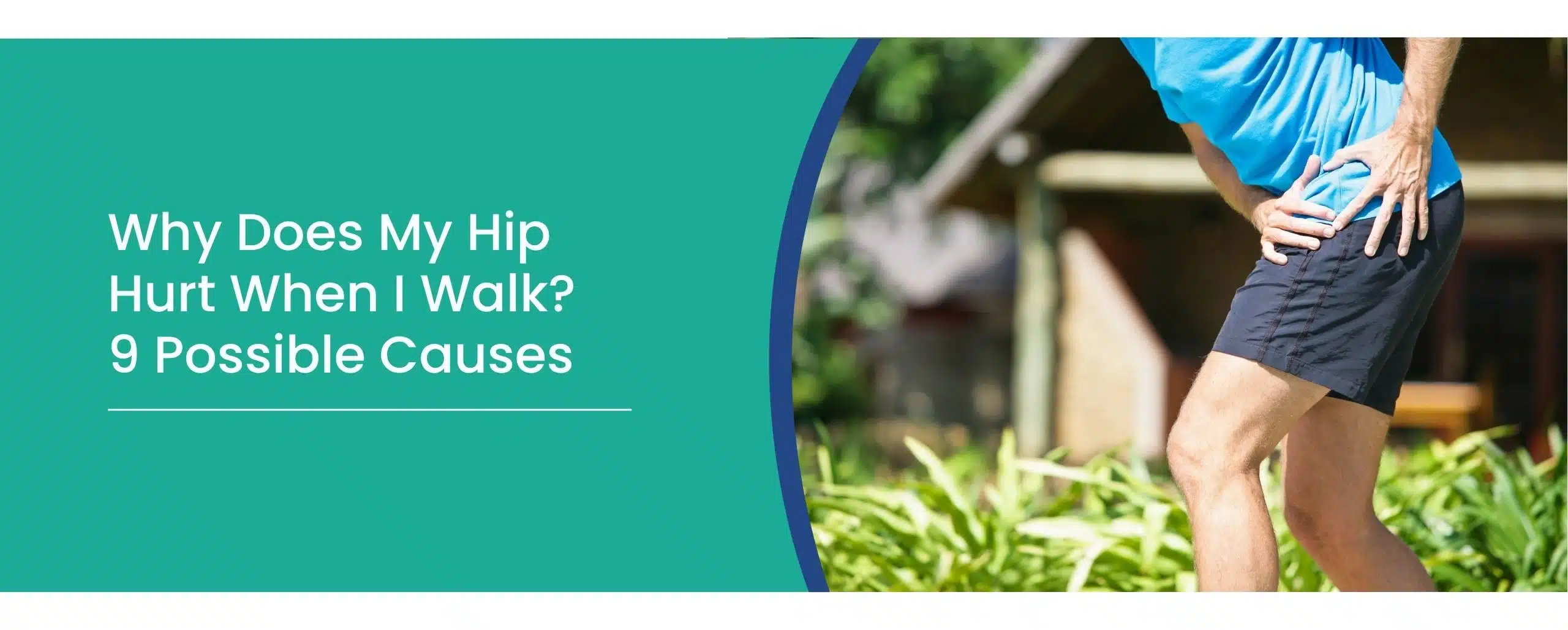
Walking should be one of the simplest movements your body makes. So when every step starts causing pain in your hip, it can quickly become frustrating. You may notice the pain only after walking for a while, when climbing stairs, or even when taking a few steps around the house.
Hip pain when walking doesn’t always mean there is a problem with the hip joint itself. Pain may come from the muscles, tendons, bursae, bones, or even nerves in your lower back. The location of the pain and what makes it better or worse can give doctors important clues about its cause.
Sometimes, the reason is something relatively minor, such as a muscle strain after increased activity. In other cases, persistent pain while walking may be linked to osteoarthritis, a hip injury, or another condition that needs medical evaluation.
So, why does your hip hurt when you walk? Here are nine possible causes.

1. Osteoarthritis of the Hip
Osteoarthritis is one of the most common causes of long-term hip pain. It happens when the protective cartilage inside the joint gradually wears down, allowing the bones to move against each other with less cushioning.
The pain often develops gradually rather than appearing suddenly. You may feel it in the groin, hip, buttock or sometimes the thigh or knee. Walking, standing for long periods, climbing stairs and other weight-bearing activities can make it worse. Stiffness and reduced hip movement are also common.
You may notice:
- Pain that increases with activity
- Stiffness after sitting or resting
- Difficulty walking longer distances
- Reduced hip movement
- A limp as the condition progresses
If hip arthritis starts interfering with everyday activities, an orthopedic evaluation can help determine how advanced the joint changes are and which treatment options may help.
2. Hip Bursitis
Around your hip are small, fluid-filled sacs called bursae. They help reduce friction between bones, muscles and tendons. When one of these sacs becomes irritated, it can cause bursitis.
Hip bursitis often causes pain on the outer side of the hip. The discomfort may become worse when walking, climbing stairs, standing for long periods or lying on the affected side.
It can develop after repetitive activity, an injury or prolonged pressure on the area.
Unlike arthritis, bursitis mainly affects the tissues surrounding the joint rather than the cartilage inside the joint.
3. Muscle or Tendon Strain
Did you recently increase your walking, start exercising, change your workout routine or do something physically demanding?
A strained muscle or irritated tendon could be responsible.
The hip depends on several muscles and tendons to keep the joint stable while you walk. Repetitive activity or a sudden increase in physical demand can irritate these tissues.
You may experience:
- Aching or pulling pain
- Tenderness around the hip
- Pain when moving the leg
- Discomfort that becomes worse with activity
Mild strains may improve with rest and activity modification. However, persistent or worsening pain should not simply be ignored.
4. Hip Labral Tear
The labrum is a ring of cartilage that surrounds the hip socket and helps keep the joint stable. A tear can occur because of an injury, repetitive movement, structural problems in the hip or gradual degeneration.
A labral tear may cause pain in the hip or groin, particularly during walking, sitting or standing for long periods. Some people also notice clicking, catching or locking sensations in the joint.
This type of pain can be difficult to identify based on symptoms alone. Your doctor may recommend imaging such as an MRI if a labral injury is suspected.
5. Femoroacetabular Impingement
Femoroacetabular impingement, or FAI, occurs when the bones of the hip don’t move together as smoothly as they should.
The abnormal contact between the ball and socket can cause pain, particularly with movements that involve bending or rotating the hip. Over time, it may also contribute to damage to the cartilage or labrum.
You may notice pain in the groin or front of the hip when:
- Walking for longer periods
- Sitting for extended periods
- Bending the hip
- Exercising
- Turning or twisting
FAI is more common in active people, but it can affect anyone.
6. Avascular Necrosis of the Hip
Avascular necrosis, also called osteonecrosis, occurs when the blood supply to part of the hip bone is reduced or interrupted. Without enough blood flow, the bone tissue can become damaged.
Early symptoms may be mild, but pain can gradually become more persistent and may occur with weight-bearing activities such as walking. As the condition progresses, pain can also occur at rest.
Because avascular necrosis can eventually lead to collapse of the affected bone, persistent unexplained hip pain deserves medical assessment, particularly when it is progressively worsening.
7. Sciatica or a Pinched Nerve
Not every pain that feels like hip pain actually starts in the hip.
A nerve problem in the lower back can send pain into the buttock, hip or leg. Sciatica, for example, occurs when the sciatic nerve is irritated or compressed and can cause pain that travels from the lower back through the buttock and leg.
Nerve-related pain may feel different from typical joint pain. You might experience:
- Burning or shooting pain
- Tingling
- Numbness
- Pain that travels down the leg
- Weakness in the affected leg
If your “hip pain” is accompanied by back pain or symptoms travelling down the leg, the spine may need to be evaluated as well.
8. Hip Fracture or Other Injury
A fall, accident or sports injury can damage the bones or soft tissues around the hip.
A hip fracture is particularly important to recognise in older adults and people with weakened bones. Severe pain after a fall, difficulty standing or an inability to put weight on the leg requires prompt medical attention. Mayo Clinic recommends immediate medical care when someone cannot bear weight, has severe pain or swelling, or develops a visible deformity after an injury.
Even when you can still walk after an injury, persistent pain should not automatically be dismissed as a simple bruise or strain.
9. Hip Alignment or Structural Problems
The way your hip joint is shaped and how your legs, knees, feet and spine work together can influence how forces travel through the body while you walk.
Structural problems such as hip dysplasia or other alignment issues can contribute to pain and may become more noticeable with activity. Problems elsewhere in the body can also affect your walking pattern and place additional stress on the hip.
This is one reason doctors don’t look at the painful area in isolation. They may assess your walking pattern, range of motion and the movement of your hip, knee and spine.
Where You Feel the Pain Can Give Clues?
The exact location of your pain can sometimes provide useful clues, although it cannot confirm a diagnosis on its own.
| Where you feel the pain | Some possible causes |
| Groin or deep inside the hip | Hip arthritis, labral tear, hip impingement |
| Outer side of the hip | Bursitis, tendon problems, soft-tissue irritation |
| Buttock | Hip problems, muscle problems, referred pain from the lower back |
| Hip and down the leg | Sciatica or another nerve-related problem |
| Hip after a fall or injury | Fracture, strain, dislocation or other injury |
Pain inside the hip or groin often points toward problems within the hip joint, while pain on the outer hip, upper thigh or outer buttock may involve surrounding muscles, tendons or bursae. Pain can also be referred from the lower back.
What Does Your Hip Pain Feel Like?
The pattern of pain matters too. Two people can both say “my hip hurts,” while having completely different underlying problems.
| Pain pattern | What it may suggest |
| Pain mainly during walking or activity | Arthritis, strain, tendon problems or bursitis |
| Pain with stiffness after rest | Arthritis or another joint condition |
| Sharp pain with certain movements | Impingement, labral injury or muscle/tendon problem |
| Burning or shooting pain | Nerve irritation such as sciatica |
| Severe pain after a fall | Possible fracture or significant injury |
| Pain that gradually becomes constant | A condition that may need medical evaluation |
These patterns are only clues. A healthcare professional needs to assess your symptoms, medical history and physical examination before determining the actual cause.
When Should You See a Doctor for Hip Pain?
You don’t necessarily need to panic over every episode of hip pain. A mild ache after unusual exercise may improve with rest and activity modification.
But persistent hip pain when walking deserves attention, especially when it starts interfering with normal activities.
Consider seeing an orthopedic doctor if:
- The pain keeps returning
- Walking or climbing stairs has become difficult
- You are developing a limp
- Your hip feels stiff or has reduced movement
- The pain is getting progressively worse
- Pain continues despite rest
- You have pain after an injury
Seek urgent medical attention if you cannot put weight on the leg, have severe or sudden pain, significant swelling, a visible deformity or severe pain after a fall.
How Is Hip Pain Diagnosed?
Your doctor will first ask about the pain itself.
When did it begin? Did it start after an injury? Does walking make it worse? Where exactly do you feel it? Does it spread toward your thigh, knee or lower back?
A physical examination may include checking your hip’s range of motion, muscle strength, walking pattern and areas of tenderness. Depending on what the doctor finds, imaging may be recommended. X-rays can help identify bone and joint changes, while MRI can provide more detail about soft tissues such as tendons, ligaments and cartilage.
How Is Hip Pain Treated?
Treatment depends on what’s causing the pain.
For a mild muscle or tendon problem, treatment may involve temporarily reducing activities that aggravate the hip, followed by a gradual return to movement. Physical therapy may help improve strength, flexibility and joint stability.
For arthritis, treatment can range from lifestyle changes and physiotherapy to medicines, injections or surgery when symptoms become severe. In some people with advanced hip arthritis, hip replacement may be considered when pain and loss of function significantly affect walking and daily life.
The important point is that there is no single treatment for hip pain. Treating the underlying cause is more useful than simply trying to mask the pain.
Can You Prevent Hip Pain While Walking?
Not every cause of hip pain can be prevented. However, some habits can reduce unnecessary stress on your joints and muscles.
Image
Try to:
- Increase exercise gradually
- Warm up before strenuous activity
- Wear supportive footwear
- Maintain a healthy body weight
- Strengthen the muscles around your hips and legs
- Give your body enough recovery time
- Avoid repeatedly pushing through significant pain
If walking itself consistently causes pain, don’t assume you simply need to “walk through it.” Persistent pain is a reason to find out what’s causing it. Cleveland Clinic similarly recommends modifying activities that aggravate symptoms and seeking evaluation when pain persists or interferes with normal movement.
Conclusion
Hip pain when walking can have many causes, and the location, timing and pattern of the pain can offer important clues. Arthritis, bursitis, muscle or tendon problems, labral tears, hip impingement, nerve problems, injuries and conditions such as avascular necrosis can all cause discomfort with movement.
A mild ache after unusual activity may settle with appropriate rest. But if your pain keeps coming back, is getting worse or is making it harder to walk, it’s worth getting the cause checked rather than simply adapting your life around the pain.
Early evaluation in the best hospital in Noida can help identify the problem and guide the right treatment before pain and reduced mobility begin affecting your everyday life.
Frequently Asked Questions (FAQs)
1. Why does my hip hurt only when I walk?
Pain that appears mainly during walking can occur when weight-bearing stresses an irritated joint, tendon, muscle or surrounding tissue. Arthritis, bursitis, tendon problems and some injuries are common possibilities.
2. Can hip pain go away on its own?
Some mild muscle strains or overuse-related problems may improve with rest and activity modification. If pain persists, returns frequently or affects your ability to walk, a medical evaluation is recommended.
3. How do I know if my hip pain is arthritis?
Hip arthritis often causes pain and stiffness that worsen with movement or weight-bearing activity. Pain may be felt in the groin, hip, buttock or even the knee, and hip movement may gradually become more limited.
4. Should I walk if my hip hurts?
It depends on what’s causing the pain. Gentle movement may be appropriate for some conditions, but continuing activities that clearly worsen significant pain can aggravate an injury or underlying problem.
5. When is hip pain an emergency?
Seek urgent medical attention if you cannot bear weight, have severe or sudden pain, significant swelling, a visible deformity or severe pain following a fall or injury.