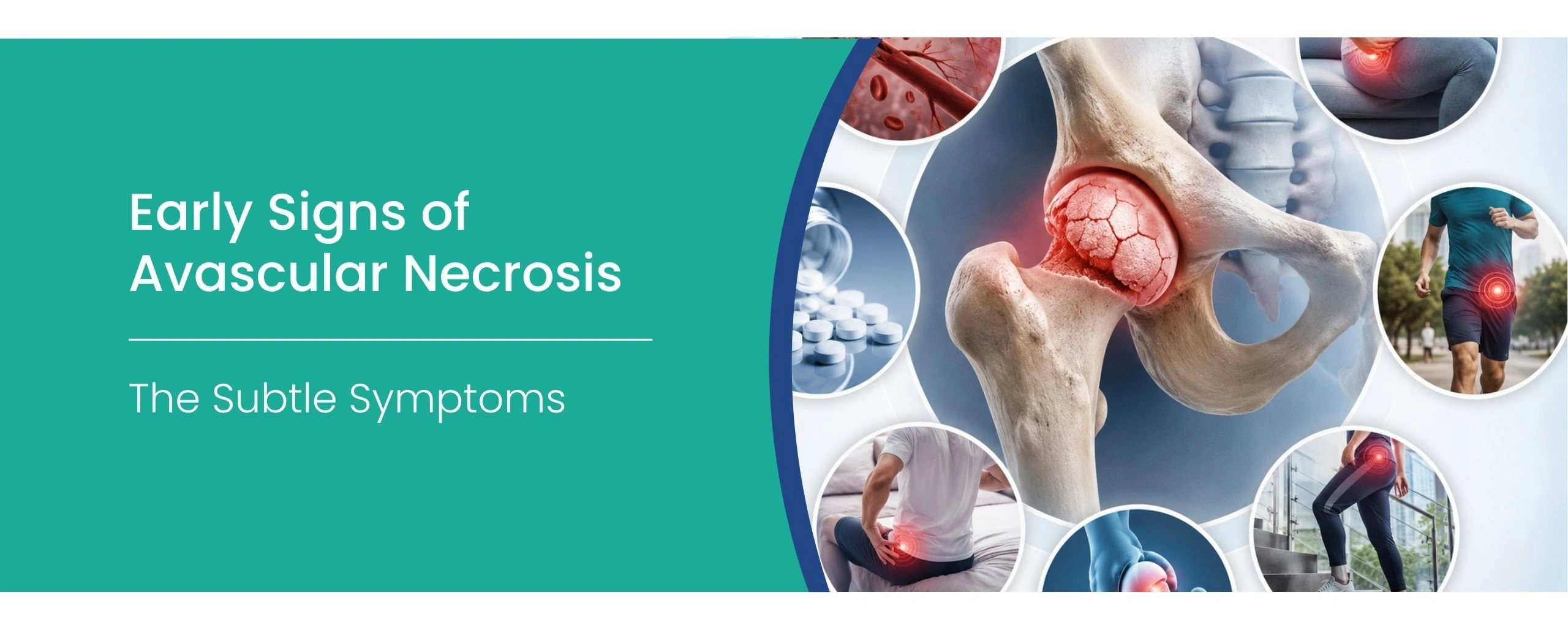
Most people dismiss a dull hip ache as muscle strain. They rest for a few days, maybe apply a pain relief gel, and move on.
But sometimes, that quiet ache is something more serious. Sometimes, it is the first early sign of avascular necrosis, a condition where bone tissue begins to die because blood supply is cut off.
The frightening part? The early signs of avascular necrosis are easy to miss. They feel ordinary. Familiar. Not alarming enough to see a doctor. That is exactly what makes AVN dangerous.
What is avascular necrosis (AVN)?
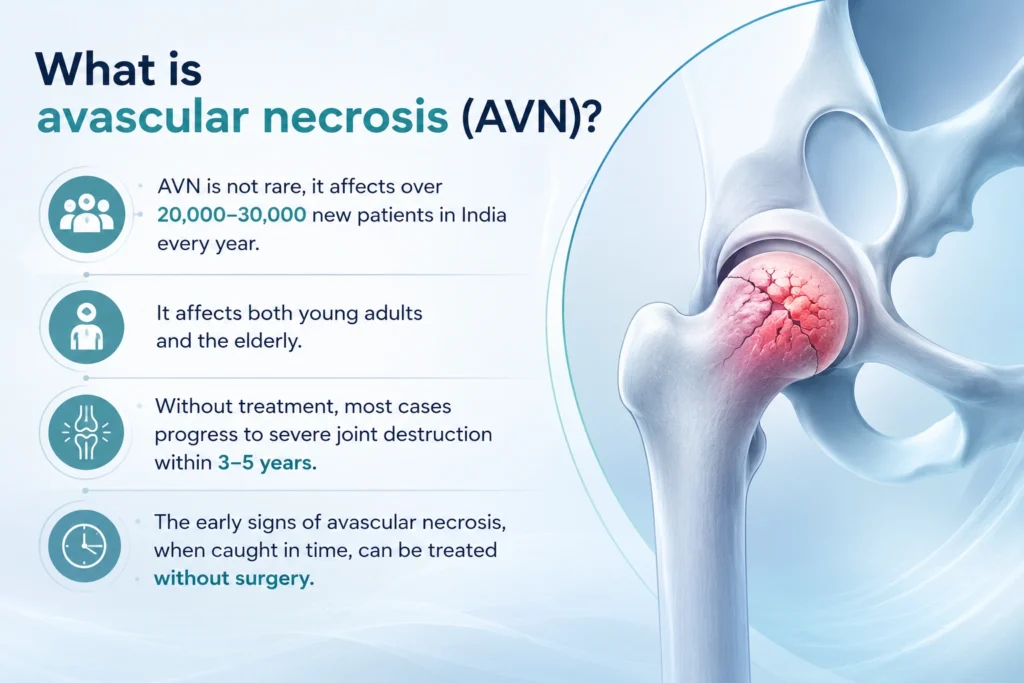
Avascular necrosis (AVN), also called osteonecrosis, is the death of bone tissue due to reduced or blocked blood flow.
Without blood, bone cells cannot survive. Over time, the bone weakens, collapses, and stops functioning normally. The hip joint is the most commonly affected area, though AVN can also affect the knee, shoulder, and ankle.
- AVN is not rare, it affects over 20,000–30,000 new patients in India every year.
- It affects both young adults and the elderly.
- Without treatment, most cases progress to severe joint destruction within 3–5 years.
- The early signs of avascular necrosis, when caught in time, can be treated without surgery.
Why early detection of AVN is important?
Here is the hard truth: most patients with AVN are diagnosed late, often in Stage 3 or 4, when the bone has already collapsed.
Early stage avascular necrosis (Stage 1 or 2) is still reversible in many cases. At this point, the bone structure is intact, and treatments like core decompression or medication can preserve the joint.
Once the bone collapses (Stage 3–4), total hip replacement becomes unavoidable.
That is why knowing the early signs of avascular necrosis is not just medically useful, it is potentially life-changing.
Early signs of avascular necrosis you should not ignore
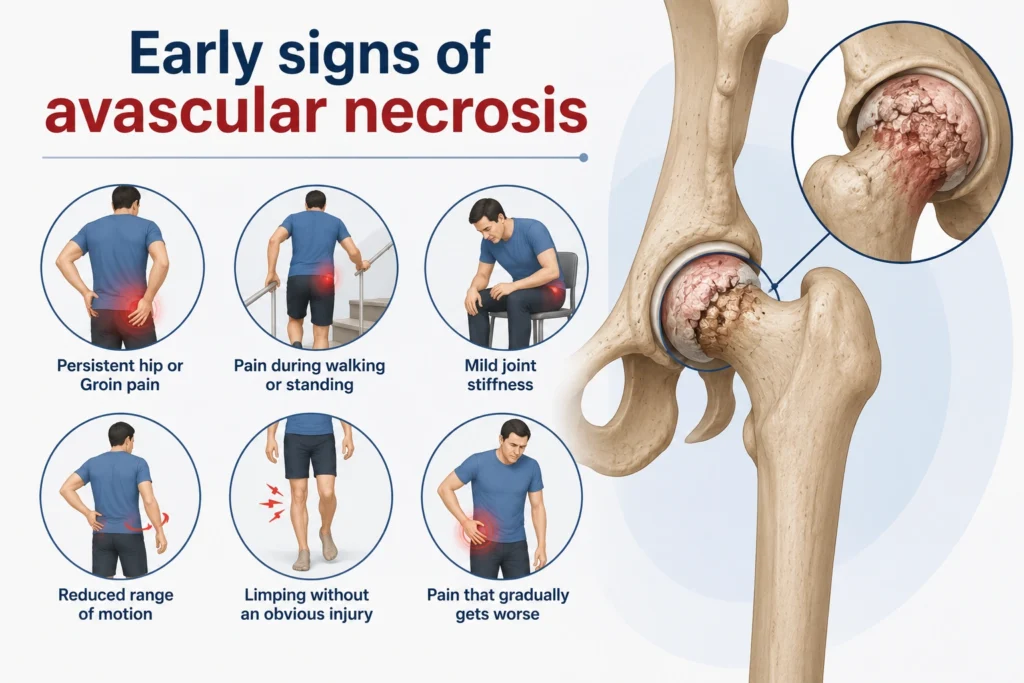
The early signs of avascular necrosis are often subtle. Patients describe them as “nagging,” “background pain,” or “something not quite right.” Here is what to watch for:
Persistent hip or Groin pain
Many patients in Noida describe this groin pain as “something pulling inside”, not sharp, but persistent. That persistence is the warning sign.
This is the most common early sign of avascular necrosis.
- Pain is felt deep in the groin, inner thigh, or buttock area.
- It may feel dull, aching, or pressure-like.
- It does not go away with rest the way ordinary muscle soreness does.
- The pain may come and go initially, making patients delay seeking help.
Pain during walking or standing
One of the clearest early symptoms of AVN is discomfort that increases with weight-bearing.
The early signs of avascular necrosis on weight-bearing happen because the weakened bone structure cannot tolerate load without sending pain signals.
- Walking even short distances causes noticeable hip pain.
- Standing for longer than 10–15 minutes becomes uncomfortable.
- Pain often reduces when you sit or lie down, which misleads people into thinking it is minor.
- Climbing stairs may cause a sharp, shooting sensation in the hip.
Mild joint stiffness
Before pain becomes severe, many patients notice stiffness, especially in the morning or after long periods of sitting.
- The hip feels “locked” or “tight” when you try to move it.
- Stiffness usually improves slightly after movement but returns after rest.
- This is one of the most overlooked AVN warning signs because it mimics arthritis.
- In younger patients (20–40 years), stiffness without any arthritis diagnosis should raise suspicion.
Reduced range of motion
As early stage avascular necrosis progresses, the hip joint’s movement range begins to shrink.
A simple clinical test, called the FABER test, can detect reduced range of motion at an early stage. Your orthopedic doctor can perform this during a consultation.
- Difficulty crossing your legs or sitting cross-legged.
- Trouble bending forward to tie shoelaces.
- Inability to rotate the hip outward comfortably.
- Movements that were effortless a year ago now require effort.
Limping without an obvious injury
This is one of the most telling early signs of avascular necrosis, and one of the most ignored.
If you are limping without knowing why, that is not normal. It is one of the signs of avascular necrosis that should prompt an immediate visit to a specialist.
- You develop a limp, but you have not had a fall or injury.
- People around you may notice it before you do.
- Limping happens because the body subconsciously offloads weight from the affected hip.
- Unexplained limping in adults, especially those between 30–50 years, deserves medical evaluation.
Pain that gradually gets worse
Early stage AVN does not always cause severe pain. But there is a pattern worth watching. Progressive worsening without a clear cause is one of the most reliable early signs of avascular necrosis. Do not wait for the pain to become unbearable.
- Pain that started as occasional becomes more frequent.
- Discomfort that began at a “3 out of 10” slowly climbs to a “6 out of 10”.
- Pain that was only during activity now appears at rest or at night.
- Night pain is a particularly important AVN warning sign, it suggests the disease is progressing.
Who is at higher risk of developing AVN?
Knowing your risk helps you catch the early signs of avascular necrosis before they escalate.
If you fall into any of these categories, you should actively monitor yourself for the early signs of avascular necrosis, even without symptoms.
High-risk groups include:
- Steroid users: Long-term corticosteroid use (for asthma, lupus, RA) is the most common cause in India.
- Heavy alcohol consumers: Alcohol disrupts fat metabolism and can block blood flow to bone.
- Trauma patients: Hip dislocation or femoral neck fractures can cut off blood supply.
- Sickle cell disease patients: Abnormal blood cells block vessels supplying bone.
- HIV/AIDS patients: Especially those on antiretroviral therapy.
- Post-COVID patients: COVID-19 and its steroid-heavy treatment have created a sharp rise in AVN cases in India.
- Deep-sea divers: Decompression sickness can damage bone blood vessels.
- Autoimmune disease patients: Lupus, inflammatory bowel disease, and vasculitis increase risk.
How AVN progresses if left untreated?
Ignoring the early signs of avascular necrosis does not make the problem go away. It makes it worse.
Most patients in India seek help at Stage 3 or 4. By that point, surgery is the only option.
Recognizing avascular necrosis symptoms early means you have more treatment choices and a far better outcome.
| Stage | What Happens | Treatment |
| Stage 1 | MRI detects changes, no visible damage on X-ray | Medication, lifestyle modification |
| Stage 2 | X-ray shows bone density changes | Core decompression, bone grafting |
| Stage 3 | Bone begins to collapse (crescent sign) | Joint preservation surgery |
| Stage 4 | Complete joint collapse, severe arthritis | Total hip replacement |
When should you see an orthopedic specialist?
Do not self-diagnose. Do not assume it is just “muscle pull.” The early signs of avascular necrosis are treatable, but only if you act early.
If you are in Delhi NCR, consult an AVN specialist in Noida as early as possible.
See an AVN specialist immediately if you experience any of the following:
- Unexplained hip or groin pain lasting more than 2–3 weeks
- Pain that worsens when walking or standing
- Morning hip stiffness that is not resolving
- A limp with no history of injury
- Progressive hip pain with a history of steroid use, alcohol, or COVID-19 treatment
- Hip pain in a young adult (20–45 years) with no clear diagnosis
How avascular necrosis is diagnosed?
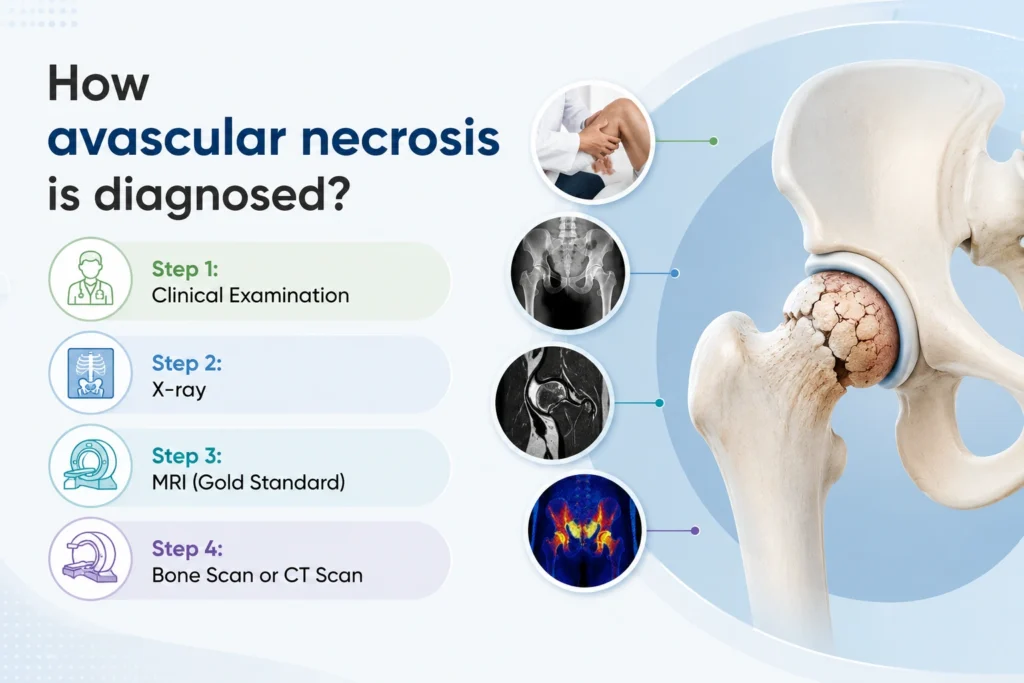
Diagnosing avascular necrosis symptoms in the early stages requires the right tests.
Step 1: Clinical Examination
- Your doctor will assess your hip range of motion, pain points, and gait
Step 2: X-ray
- Often normal in Stage 1–2 AVN. That is why many cases are missed initially
- Useful in Stage 3–4 to confirm bone collapse
Step 3: MRI (Gold Standard)
- MRI can detect early signs of avascular necrosis even before X-rays show changes
- Most sensitive tool, detects AVN in Stage 1 with high accuracy
- Essential for early diagnosis
Step 4: Bone Scan or CT Scan
- Used in specific cases for staging and surgical planning
Key takeaway: If your X-ray is normal but symptoms suggest AVN, insist on an MRI. It is the only way to catch early stage avascular necrosis reliably.
Treatment options for early-stage AVN
The best treatment for early AVN depends on the stage, the extent of damage, and the patient’s overall health.
Non-Surgical Options (Stage 1–2):
- Medications: Bisphosphonates to slow bone loss; statins to improve blood flow.
- Activity modification: Reducing weight-bearing activities temporarily.
- Physiotherapy: Strengthening surrounding muscles to protect the joint.
- Hyperbaric oxygen therapy: Improves oxygen delivery to dying bone tissue.
- Extracorporeal Shock Wave Therapy (ESWT): Stimulates new blood vessel formation.
Surgical Options (Stage 2–3):
- Core decompression: Removes a small core of bone to relieve pressure and stimulate blood supply.
- Bone grafting: Healthy bone is placed in the affected area to support structure.
- Osteotomy: Repositions the bone to shift weight away from the damaged area.
- Vascularized fibular graft: A complex procedure that restores blood supply using a live bone graft.
Stage 4:
- Total hip replacement (THR): The only reliable option once the joint has collapsed completely.
The earlier you identify the early signs of avascular necrosis, the more treatment options remain available.
Can early treatment prevent hip replacement?
The difference between avoiding and needing a hip replacement often comes down to one thing: whether the early signs of avascular necrosis were recognized in time.
If you are looking for AVN treatment in Noida or hip pain treatment in Noida, early specialist consultation gives you the best chance of joint preservation.
- In Stage 1 and early Stage 2, bone-preserving treatments can halt AVN progression in 60–80% of cases.
- Core decompression, when done early, has shown strong outcomes in multiple Indian and international studies.
- Patients who receive treatment before bone collapse rarely need hip replacement.
- Post-COVID AVN patients in their 30s and 40s have particularly benefited from early intervention.
Tips to protect your hip joint health
Even if you are not experiencing symptoms, these habits protect your hip joints and reduce AVN risk.
- Limit alcohol intake: Alcohol is among the top 3 causes of AVN in India.
- Use steroids cautiously: Never take corticosteroids without medical supervision.
- Maintain a healthy weight: Excess weight increases pressure on the femoral head.
- Exercise regularly: Strengthens the muscles around the hip, reducing joint stress.
- Monitor autoimmune conditions: Patients with lupus or RA need periodic bone health checks.
- Avoid smoking: Smoking reduces bone blood circulation.
- Get MRI screening if at risk: If you have risk factors, do not wait for pain to develop.
- Report persistent hip pain early: Do not ignore pain lasting more than 2–3 weeks.
Frequently Asked Questions (FAQs)
Can avascular necrosis start with mild pain?
Yes. In fact, mild or intermittent pain is one of the most common early signs of avascular necrosis. Many patients describe it as “annoying but tolerable” in the early stages. Do not dismiss it because it is not severe.
Is AVN common in young adults?
Increasingly, yes. Post-COVID AVN, steroid use in young patients, and alcohol-related AVN have made it far more common in adults aged 20–45 than it used to be. Young age does not protect you from AVN.
Can AVN be diagnosed on X-ray?
Not always. X-rays are often normal in early stage avascular necrosis. MRI is the gold standard for early diagnosis and can detect avascular necrosis symptoms before any structural damage is visible on X-ray.
What is the best treatment for early AVN?
For Stage 1–2, core decompression combined with medication and physiotherapy gives the best outcomes. The goal is to preserve the natural joint and avoid or delay hip replacement.
Does AVN always require surgery?
No. Early stage avascular necrosis can be managed with medications, physiotherapy, and minimally invasive procedures. Surgery becomes necessary mainly in Stage 2–3 when bone grafting or decompression is needed, and total hip replacement is reserved for Stage 4.
Can physiotherapy help avascular necrosis?
Yes, as part of a comprehensive treatment plan. Physiotherapy strengthens the muscles around the hip, improves mobility, and reduces pain. It does not reverse bone damage, but it plays an important supportive role alongside medical or surgical treatment.
Conclusion
The early signs of avascular necrosis are easy to miss. Hip pain feels common. Stiffness feels like aging. A limp feels temporary.
But these subtle signals, when ignored, can lead to complete joint collapse, and an inevitable hip replacement.
The good news is clear: catch it early, and you have a real chance of preserving your natural joint.
If you or someone in your family has unexplained hip pain, morning stiffness, or a limp without injury, do not wait. See an orthopedic specialist now. The early signs of avascular necrosis are treatable.
If you are experiencing hip pain in Noida or suspect avascular necrosis symptoms, consult the best orthopedic specialists at one of the best hospitals in Noida. Early diagnosis. Better outcomes. Preserved joints.