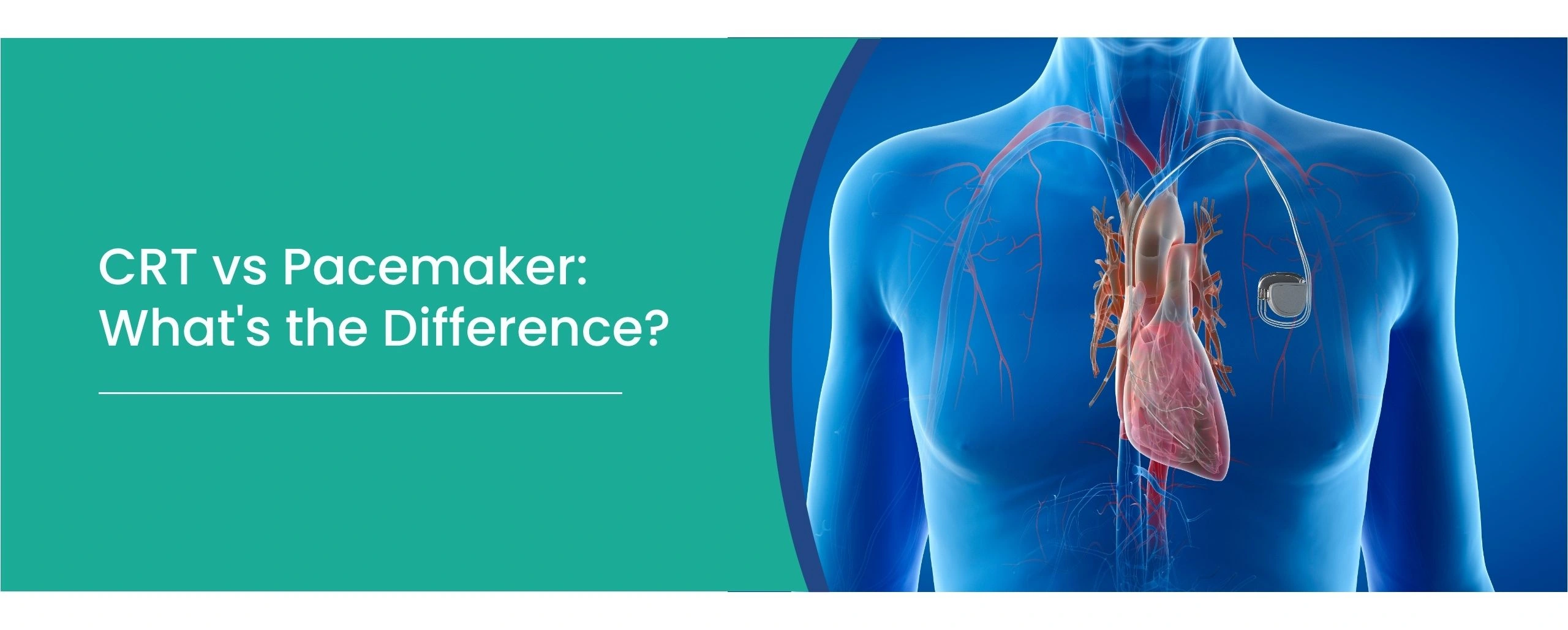
If you’ve been told that you may need a pacemaker, you may already have a lot of questions. But if your doctor has mentioned cardiac resynchronization therapy (CRT), things can get even more confusing.
Is CRT the same as a pacemaker? Why does CRT use more leads? Is one better than the other? And most importantly, which device does your heart actually need?
The short answer is that CRT is a specialized type of pacemaker therapy. A conventional pacemaker is generally used to help control a heartbeat that is too slow or has certain electrical problems. CRT is designed for a more specific problem: helping the lower chambers of the heart beat in better coordination, particularly in some people with heart failure.
Understanding the difference can make the recommendation easier to understand and help you have a more informed conversation with your cardiologist.
What Is a Pacemaker?
A pacemaker is a small electronic device that helps control the heart’s rhythm. It is usually placed under the skin near the collarbone and connected to the heart through one or more thin wires called leads.
Your heart has its own electrical system that tells the heart chambers when to contract. When those electrical signals become too slow, irregular, or blocked, the heart may not beat effectively.
A pacemaker can monitor the heart rhythm and deliver small electrical impulses when needed to help maintain an appropriate heart rate and rhythm. Pacemakers are commonly used for conditions such as certain types of bradycardia (slow heartbeat) and heart block.
Not every pacemaker is the same. Depending on the condition being treated, a device may have one, two, or more leads.
What Is CRT?
Cardiac resynchronization therapy (CRT) is a specialized form of pacing, also called biventricular pacing.
It is mainly used in selected people with heart failure whose ventricles, or lower heart chambers, do not contract in a coordinated way.
Normally, the right and left ventricles work together to pump blood out of the heart. In some people with heart failure and abnormal electrical conduction, the ventricles may contract at different times. This is sometimes called ventricular dyssynchrony.
When the ventricles are out of sync, the heart may pump less efficiently.
CRT uses electrical signals to help coordinate the contractions of the ventricles so they squeeze more closely together. The goal is to improve the heart’s pumping efficiency and, in appropriate patients, reduce symptoms and improve quality of life.
A typical CRT pacemaker, known as CRT-P, generally uses three leads: one associated with the right atrium and leads that stimulate the right and left ventricles. This allows the device to coordinate ventricular contractions.
CRT vs Pacemaker: What’s the Main Difference?
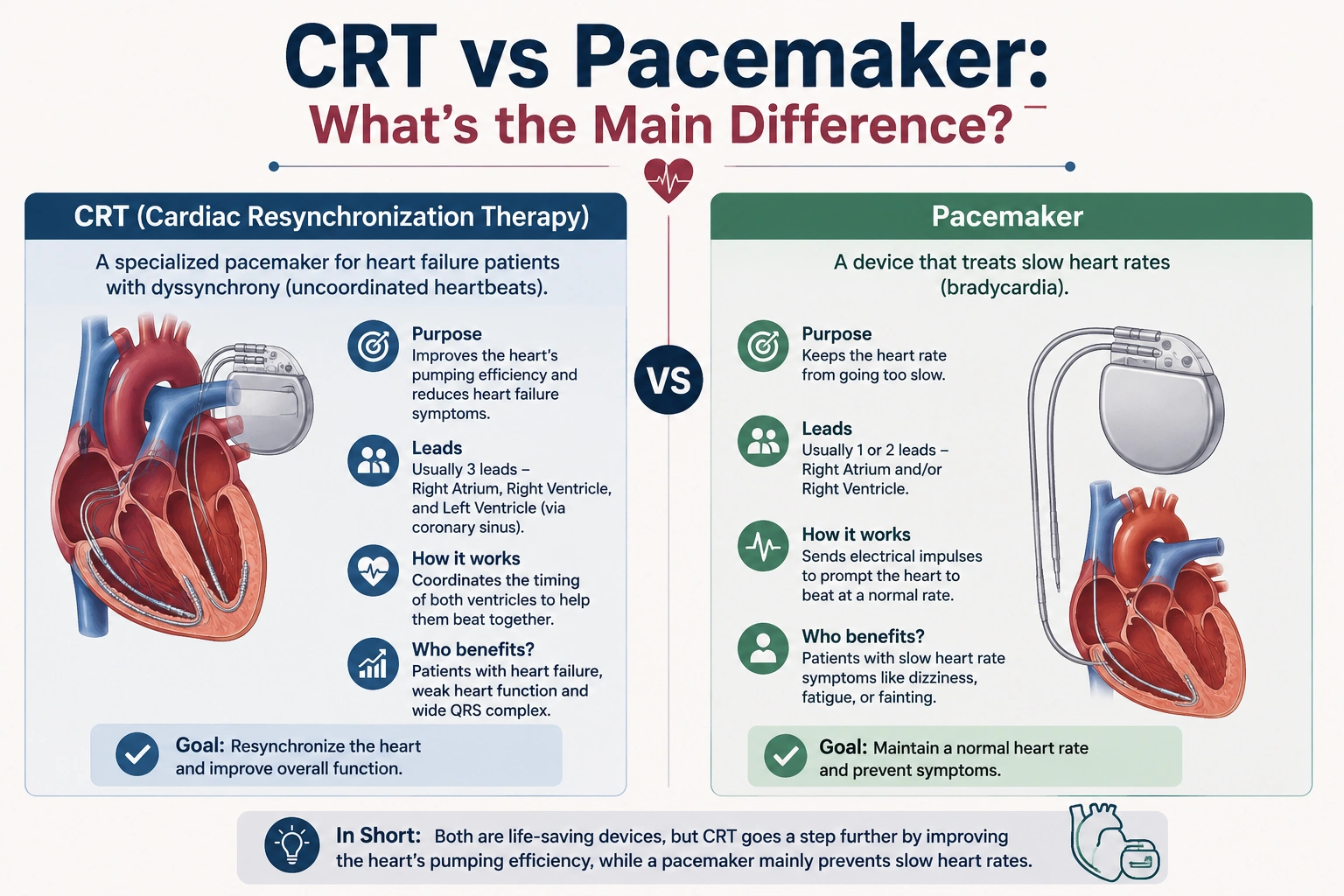
The biggest difference is what problem the device is designed to address.
A conventional pacemaker primarily helps manage problems with the heart’s electrical rhythm, particularly when the heartbeat is too slow or certain signals are blocked.
CRT is more specifically designed to improve the coordination of the heart’s lower chambers in selected people with heart failure and electrical conduction abnormalities.
In simple terms:
A pacemaker helps keep the heartbeat going at the right rate and rhythm.
CRT helps the heart’s lower chambers beat together more effectively.
There can be some overlap. CRT is itself a type of pacemaker therapy, and some people who need CRT may also have a slow heartbeat or other electrical conduction problems.
CRT vs Pacemaker: Quick Comparison
The choice depends on your heart rhythm, heart function, electrical conduction pattern, symptoms, and overall health. There isn’t a single device that is “better” for everyone.
| Feature | Conventional Pacemaker | CRT |
| Main purpose | Helps control an abnormal or slow heart rhythm | Helps coordinate the contractions of the ventricles |
| Common use | Bradycardia, heart block and certain rhythm problems | Selected patients with heart failure and ventricular dyssynchrony |
| Chambers targeted | Depends on the type of pacemaker | Primarily coordinates the right and left ventricles |
| Number of leads | Often one or two, depending on the device | Usually three for a traditional CRT system |
| Main goal | Maintain an appropriate heart rate/rhythm | Improve coordination and pumping efficiency |
| Also called | Cardiac pacemaker | Biventricular pacemaker or cardiac resynchronization therapy |
| Can include defibrillator function? | Some devices can | Yes, as CRT-D |
Why Would Someone Need a Pacemaker?
Your cardiologist may recommend a pacemaker when the heart’s natural electrical system is not maintaining an appropriate heartbeat.
Some common reasons include:
- A persistently slow heartbeat
- Certain types of heart block
- Problems with the heart’s electrical conduction system
- Some rhythm disorders that cause pauses or an abnormally slow rate
Symptoms can vary depending on the underlying problem. Some people may experience dizziness, fainting, tiredness, shortness of breath, or reduced ability to exercise.
A pacemaker doesn’t necessarily mean that your heart is “weak.” In many cases, the main problem is the heart’s electrical system rather than its pumping strength.
Why Would Someone Need CRT?
CRT is generally considered for a more specific group of patients.
It may be recommended for some people who have moderate to severe heart failure, particularly when the ventricles are not contracting in a coordinated way because of an electrical conduction problem.
One example is left bundle branch block (LBBB), although the decision to use CRT depends on several clinical factors.
Doctors may consider factors such as:
- Heart failure severity
- Symptoms despite appropriate medical treatment
- Heart pumping function
- Electrical conduction abnormalities
- Heart rhythm
- Overall health and medical history
CRT is usually not the first treatment for every person with heart failure. Medicines and lifestyle measures are often used first, and CRT is considered when a patient meets appropriate criteria.
How Does CRT Help the Heart?
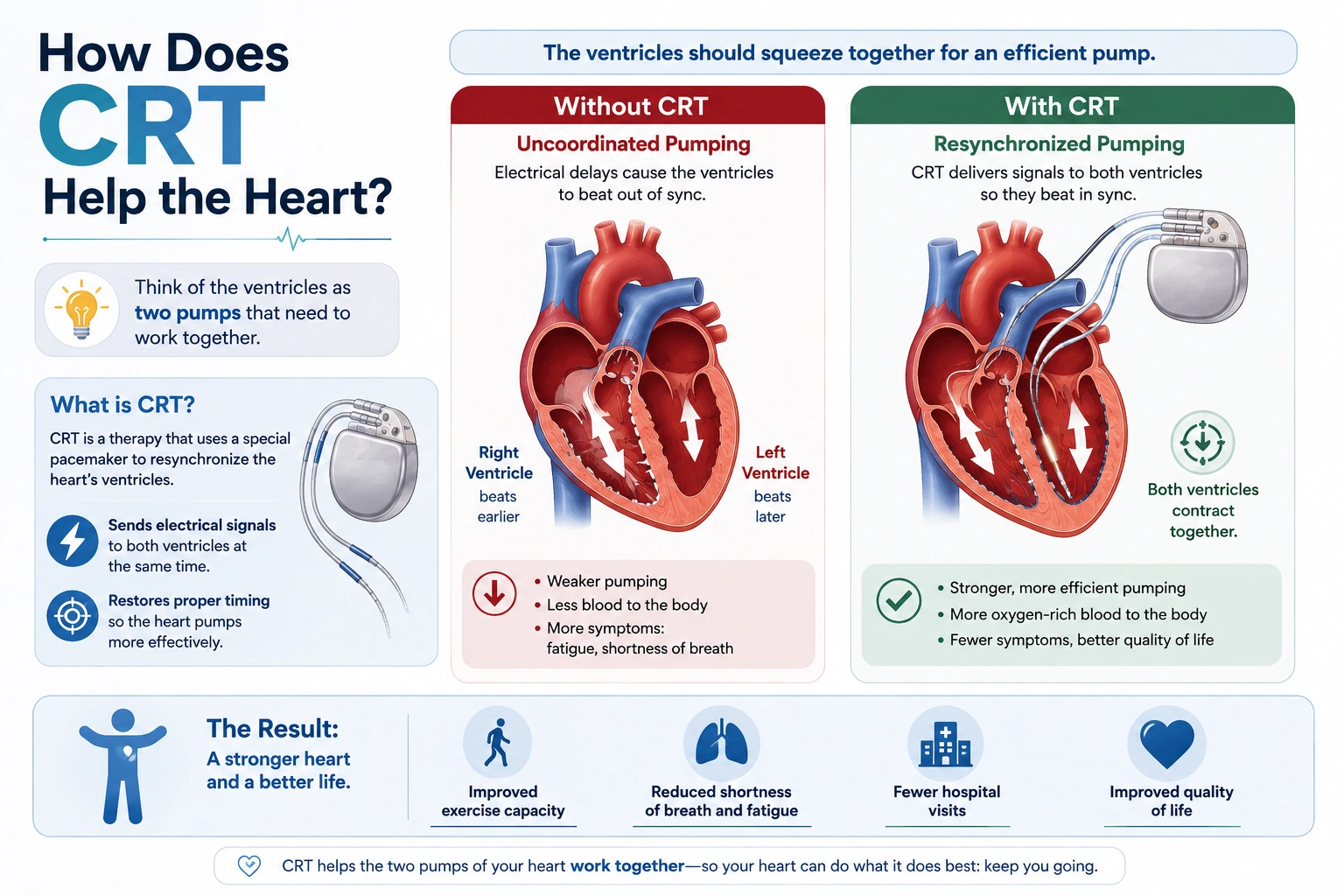
Think of the ventricles as two pumps that need to work together.
When they contract at the same time, blood can be pushed out of the heart more efficiently. But when electrical signals reach one ventricle later than the other, the two sides may contract out of sequence.
CRT sends carefully timed electrical signals to help coordinate the contractions.
For suitable patients, this can improve how efficiently the heart pumps and may help reduce symptoms such as breathlessness. CRT may also improve quality of life and reduce the risk of hospitalization for heart failure in appropriate patients.
However, CRT does not work equally well for everyone. Some people experience a substantial improvement, while others may have a smaller response. Your cardiologist will assess whether your heart is likely to benefit before recommending the therapy.
What Is the Difference Between CRT-P and CRT-D?
This is another point that can cause confusion.
There are two main types of CRT devices:
CRT-P: Cardiac resynchronization therapy with a pacemaker.
CRT-D: Cardiac resynchronization therapy with a defibrillator.
Both can provide resynchronization pacing. The difference is that CRT-D also includes an implantable cardioverter-defibrillator (ICD).
An ICD can detect certain dangerous ventricular rhythms and deliver a shock when necessary. This can be important for people who have a significant risk of life-threatening arrhythmias.
So, CRT-D is not simply a “stronger” CRT device. It is a combination of resynchronization therapy + defibrillator protection for patients who meet the appropriate criteria.
CRT-P vs CRT-D
The choice between CRT-P and CRT-D is made by the cardiology team after considering the patient’s heart function, rhythm history, risk factors, and overall health.
| Feature | CRT-P | CRT-D |
| Resynchronizes the ventricles | Yes | Yes |
| Provides pacing | Yes | Yes |
| Helps coordinate heart contractions | Yes | Yes |
| Includes defibrillator function | No | Yes |
| Can treat certain dangerous ventricular rhythms with a shock | No | |
| Typical consideration | Patients who need CRT without an indication for an ICD | Patients who need CRT and also have an appropriate risk of sudden cardiac death |
Is CRT More Complicated Than a Regular Pacemaker?
CRT implantation is still a device implantation procedure, but the system is generally more involved because it usually requires an additional lead.
A pacemaker procedure involves placing the device under the skin and positioning the necessary leads in the heart.
With CRT, the doctor also needs to position a lead so that the left ventricle can be stimulated. The exact approach depends on the patient’s anatomy and the device being used.
The procedure commonly involves local anesthesia with sedation, although the details can vary. Implantation may take a few hours.
As with other implanted cardiac devices, there are potential risks, including infection, bleeding, lead movement, device malfunction, collapsed lung, or injury to the heart or surrounding structures. The individual risk depends on the patient’s health and the type of procedure.
What Happens After a Pacemaker or CRT Is Implanted?
Getting the device implanted is only one part of treatment.
Your healthcare team will check the device and adjust its settings according to your heart’s needs. Follow-up appointments are important because doctors can assess how well the device is working and make programming changes when necessary.
You may also receive instructions about wound care, physical activity, and when you can return to your normal routine.
For people with CRT, follow-up may also involve assessing whether heart function and symptoms are improving.
A device does not replace the rest of your heart treatment. If you have heart failure, for example, you may still need medicines, lifestyle changes, regular monitoring, and treatment of the underlying heart condition.
Can a Pacemaker Be Used Instead of CRT?
Not necessarily.
A conventional pacemaker and CRT solve different problems, even though CRT is technically a specialized pacing system.
If your primary problem is a slow heartbeat or a conduction block, a conventional pacemaker may be appropriate.
If you have certain types of heart failure along with electrical dyssynchrony, CRT may provide a benefit that conventional pacing alone cannot provide.
Your cardiologist may use tests such as an ECG, echocardiogram, heart rhythm monitoring, and other cardiac assessments to determine which approach is appropriate.
This is why choosing a device should never be based simply on which one sounds more advanced.
Is CRT Better Than a Pacemaker?
There is no simple “better” option.
CRT is not an upgraded version of a regular pacemaker that everyone should choose. It is a specialized treatment intended for patients who meet specific clinical criteria.
For someone with a slow heartbeat, CRT may not be necessary.
For someone with heart failure and poorly coordinated ventricular contractions, CRT may be a more appropriate option.
The right device is the one that addresses the underlying problem safely and effectively.
Conclusion
CRT and a conventional pacemaker are not the same thing, but they are closely related.
A conventional pacemaker primarily helps manage problems with the heart’s electrical rhythm, particularly when the heartbeat is too slow or certain signals are blocked.
CRT is a specialized type of pacemaker therapy designed to help the ventricles contract in better coordination. It is mainly used in selected people with heart failure and electrical conduction abnormalities.
Some patients may need CRT-P, while others may benefit from CRT-D if they also have an appropriate indication for defibrillator protection.
The important question isn’t whether CRT or a pacemaker is “better.” It’s which device is appropriate for your specific heart condition, rhythm, and pumping function.
A cardiologist can assess your ECG, heart function, symptoms, medical history, and other test results to determine whether device therapy is appropriate for you in best hospital in Noida.
Frequently Asked Questions (FAQs)
1. Is CRT the same as a pacemaker?
CRT is a specialized type of pacemaker therapy, also called biventricular pacing. Unlike many conventional pacemakers, CRT is designed to coordinate the contractions of both lower chambers of the heart.
2. Which is better, CRT or a regular pacemaker?
Neither is universally better. A regular pacemaker is often used for slow or blocked heart rhythms, while CRT is intended for selected patients whose heart failure is associated with poorly coordinated ventricular contractions.
3. Does CRT improve heart failure?
For appropriately selected patients, CRT can improve the heart’s pumping coordination, symptoms, quality of life, and may reduce heart-failure-related hospitalizations. However, not everyone responds to CRT in the same way.
4. How many leads does a CRT device have?
A traditional CRT pacemaker usually has three leads: one associated with the right atrium and leads that stimulate the right and left ventricles. Conventional pacemakers may use one or two leads depending on the patient’s condition.
5. Can CRT also act as a defibrillator?
Yes. A device called CRT-D combines cardiac resynchronization therapy with an implantable cardioverter-defibrillator. It can provide pacing and resynchronization while also detecting and treating certain dangerous heart rhythms.