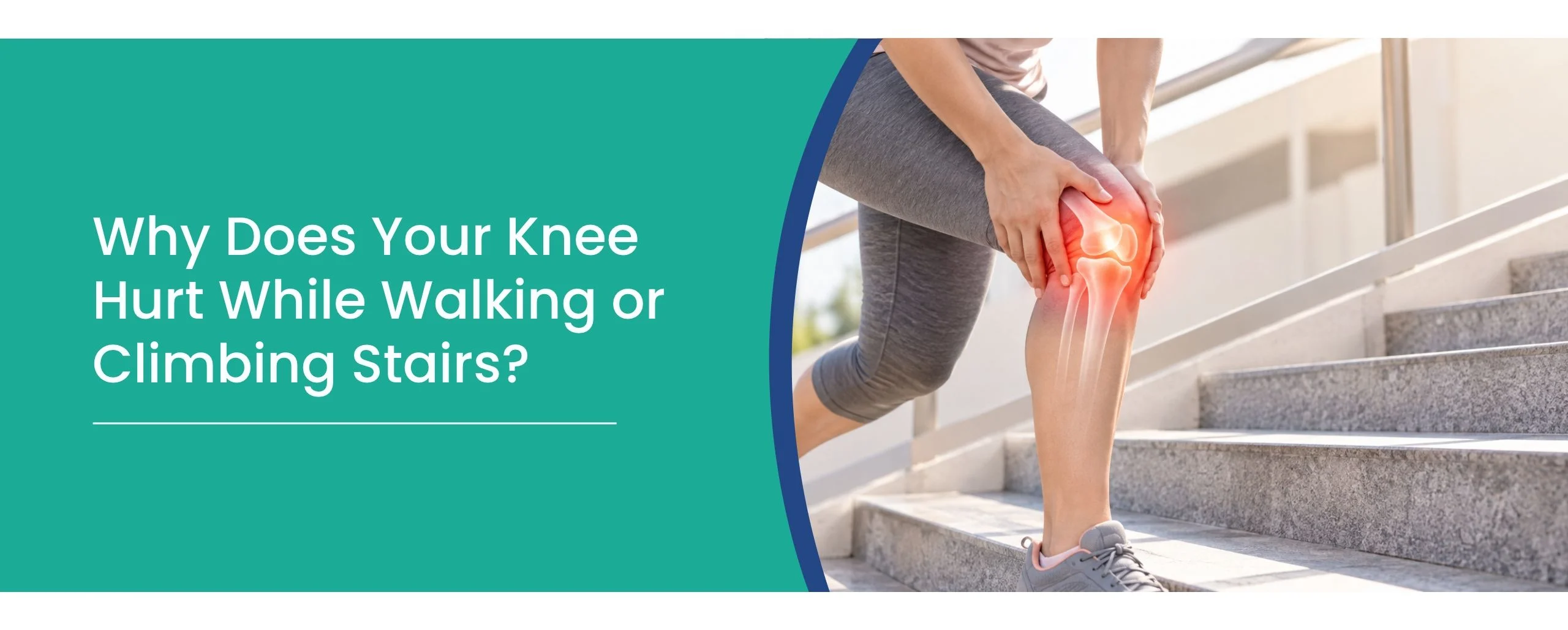
Walking to the market, climbing a flight of stairs, getting out of bed or simply standing up from a chair are movements most people perform without thinking. But when your knees start hurting during these everyday activities, even a short walk can become uncomfortable.
You may notice a dull ache around your kneecap, stiffness after sitting for a while, swelling around the joint or a sharp sensation whenever you put weight on your leg. Sometimes, the discomfort appears only while walking. At other times, climbing stairs, bending your knee or getting up from a seated position makes it worse.
Knee pain while walking is a common complaint, but it does not always have the same cause. It may develop because of muscle weakness, an injury, cartilage damage, inflammation or conditions such as osteoarthritis.
Understanding why your knee hurts is the first step towards finding the right treatment. Ignoring persistent discomfort or continuing activities that aggravate the joint may affect your mobility over time.
Understanding the Knee Joint: Why Is It Important?
The knee is one of the largest and most complex joints in the human body. It connects the thigh bone (femur) to the shin bone (tibia) and includes the kneecap (patella), which helps the joint move smoothly during everyday activities.
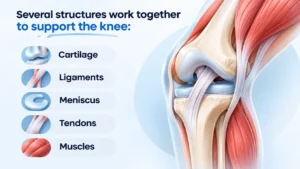
Several structures work together to support the knee:
- Cartilage: Covers the ends of the bones and reduces friction during movement.
- Ligaments: Connect the bones and provide stability.
- Meniscus: Two crescent-shaped pieces of cartilage that help absorb shock between the thigh and shin bones.
- Tendons: Connect muscles to bones and help control knee movement.
- Muscles: Particularly the quadriceps and hamstrings, which support the joint during walking, bending and straightening.
Whenever you walk, climb stairs, squat or stand up, these structures work together to distribute body weight and maintain stability.
When any of them becomes injured, inflamed or damaged, movement can become painful. This is why knee pain while walking may originate from the joint itself or the surrounding muscles, tendons and ligaments.
Why Does Your Knee Hurt While Walking?
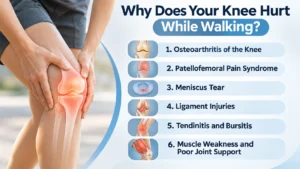
The reason behind knee pain while walking depends on where you experience the discomfort, when it starts and whether other symptoms accompany it.
For some people, the pain develops gradually over several months. Others may experience sudden discomfort following an injury, an awkward movement or excessive physical activity.
Here are some common reasons.
1. Osteoarthritis of the Knee
Osteoarthritis is one of the common causes of persistent knee discomfort, particularly among middle-aged and older adults.
It develops when the protective cartilage covering the ends of the bones gradually deteriorates. As the cartilage becomes thinner, the joint may lose some of its ability to absorb shock and move smoothly.
People with knee osteoarthritis may experience:
- Pain during walking or prolonged standing.
- Stiffness after waking up or sitting for a long time.
- Swelling around the knee.
- A grinding or cracking sensation during movement.
- Difficulty climbing stairs or getting up from a chair.
These are some commonly recognised osteoarthritis symptoms, although their severity varies between individuals.
In the early stages, knee pain while walking may appear only after prolonged activity. As the condition progresses, discomfort may become more frequent and start affecting routine movements.
Osteoarthritis cannot always be reversed, but appropriate treatment, strengthening exercises, weight management and other medical interventions can help manage symptoms and maintain mobility.
2. Patellofemoral Pain Syndrome
Have you ever experienced pain around or behind your kneecap while climbing stairs, squatting or sitting with your knees bent for a long time?
It could be related to patellofemoral pain syndrome, commonly called runner’s knee.
This condition develops when the kneecap and the surrounding structures experience irritation or excessive stress during movement.
Common symptoms include:
- Pain around the front of the knee.
- Discomfort while climbing or descending stairs.
- Pain during squatting or running.
- Stiffness after sitting for extended periods.
- Occasional clicking or popping sensations.
Muscle weakness, changes in activity levels, training-related stress and problems with kneecap movement may contribute to this condition.
The discomfort may become more noticeable when you increase your walking distance or perform activities that repeatedly bend the knee.
3. Meniscus Tear
The meniscus acts as a shock absorber between the thigh bone and shin bone. Each knee contains two menisci that help distribute pressure and stabilise the joint.
A sudden twisting movement, sports injury or gradual age-related degeneration can cause a meniscus tear.
Symptoms may include:
- Pain along the inner or outer side of the knee.
- Swelling that develops after an injury.
- Difficulty bending or straightening the knee.
- A catching or locking sensation.
- A feeling that the knee is giving way.
Depending on the severity and location of the tear, treatment may involve physiotherapy, activity modification or surgery.
If knee pain while walking begins after a twisting injury and is accompanied by swelling or locking, it should be evaluated by an orthopaedic specialist.
4. Ligament Injuries
Ligaments connect bones and help keep the knee stable. An injury to these structures can affect your ability to stand, walk or change direction.
The anterior cruciate ligament (ACL), posterior cruciate ligament (PCL) and collateral ligaments are important for knee stability.
Ligament injuries may occur due to:
- Sudden changes in direction.
- Sports-related injuries.
- Direct impact on the knee.
- Awkward landings after jumping.
- Accidental twisting of the leg.
A ligament injury may cause sudden pain, swelling, instability or difficulty putting weight on the affected leg. Some people also experience a popping sensation at the time of injury.
5. Tendinitis and Bursitis
Tendons connect muscles to bones, while bursae are small fluid-filled sacs that reduce friction between moving structures.
Repeated movements, excessive physical activity or prolonged pressure on the knee can irritate these tissues.
Tendinitis involves inflammation or irritation of a tendon, while bursitis refers to inflammation of a bursa.
Common symptoms include:
- Pain around the kneecap or below it.
- Tenderness when touching the affected area.
- Localised swelling.
- Discomfort during bending or straightening.
- Pain that increases with repetitive movement.
The treatment depends on the affected structure and the severity of inflammation.
6. Muscle Weakness and Poor Joint Support
The muscles around your knee play an important role in controlling movement and supporting the joint. Weak quadriceps, hamstrings and hip muscles may affect how forces are distributed across the knee during everyday activities.
When these muscles are not strong enough to support the joint effectively, certain movements may become uncomfortable.
For some individuals, knee pain while walking may be associated with muscle weakness, reduced flexibility or poor movement patterns. A physiotherapist can assess muscle strength and recommend exercises suited to the underlying problem.
Why Does Your Knee Hurt More When Climbing Stairs?

Walking on a flat surface and climbing stairs may look like similar activities, but they place different demands on your knee joint.
When you climb stairs, your knee bends more deeply, and the muscles around the joint work harder to lift and stabilise your body weight.
This increases the forces acting on the kneecap and surrounding structures.
As a result, knee pain when climbing stairs may become more noticeable in people with certain joint or muscle conditions.
Some common reasons include:
1. Increased Pressure on the Kneecap
The kneecap helps the quadriceps muscle straighten the knee. During stair climbing, the joint experiences greater loading, particularly as the knee bends.
If the cartilage behind the kneecap is irritated or the joint is not moving smoothly, climbing stairs may cause discomfort.
2. Knee Osteoarthritis
When cartilage within the knee becomes damaged, activities that place pressure on the joint may become painful.
This can make stair climbing, squatting and standing up from a chair particularly difficult.
3. Weak Quadriceps Muscles
The quadriceps muscles help control the knee during bending and straightening.
If these muscles are weak, the knee may receive less effective muscular support, making stair climbing more challenging.
4. Patellofemoral Pain Syndrome
Pain around the kneecap often becomes worse when the knee bends under body weight.
This is why people with patellofemoral pain may experience discomfort while climbing stairs, squatting or walking downhill.
An important point: Pain while climbing stairs does not automatically mean you have arthritis. An examination is necessary to identify whether the problem involves cartilage, muscles, tendons or another joint structure.
What Are the Common Knee Swelling Causes?
Swelling is another symptom that may accompany knee discomfort. It can develop suddenly after an injury or gradually due to an underlying joint condition.
Understanding the possible knee swelling causes can help determine whether the problem requires medical attention.
Some common causes include:
| Possible cause | What happens |
| Osteoarthritis | Joint inflammation and fluid accumulation may cause swelling. |
| Meniscus tear | An injured meniscus may trigger pain and swelling. |
| Ligament injury | Damage to a ligament can cause bleeding or fluid accumulation inside the joint. |
| Bursitis | Inflammation of the fluid-filled sacs around the knee causes localised swelling. |
| Gout | Uric acid crystals can trigger sudden joint inflammation. |
| Joint infection | Infection can cause significant swelling, warmth, redness and pain. |
When Should Knee Swelling Be Taken Seriously?
Not all swelling indicates a serious problem, but certain symptoms should never be ignored.
Seek urgent medical evaluation if your knee:
- Becomes suddenly or severely swollen.
- Feels hot and looks red.
- Is accompanied by fever or chills.
- Cannot support your body weight.
- Becomes difficult to bend or straighten.
- Swells significantly after an injury.
A hot, swollen knee with fever may indicate a joint infection, which requires urgent treatment.
What Are the Symptoms You Should Not Ignore?
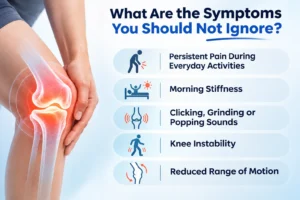
Occasional discomfort after strenuous activity may improve with rest. However, persistent or worsening symptoms deserve attention.
Along with knee pain while walking, you may notice other changes that indicate an underlying problem.
1. Persistent Pain During Everyday Activities
If walking short distances, standing for a few minutes or getting out of a chair regularly causes discomfort, your knee may need medical evaluation.
2. Morning Stiffness
Stiffness after waking up or sitting for a long time can occur in people with osteoarthritis and other joint conditions.
In osteoarthritis, stiffness after inactivity is often relatively short-lived, although individual experiences vary.
3. Clicking, Grinding or Popping Sounds
Some knee sounds are harmless, especially when they are not accompanied by pain.
However, repeated painful clicking, catching or locking may indicate an underlying joint or soft-tissue problem.
4. Knee Instability
Does your knee suddenly feel weak or seem to give way while standing or walking?
This may be related to ligament injuries, muscle weakness or joint degeneration.
5. Reduced Range of Motion
Difficulty bending or straightening the knee may occur because of swelling, pain, stiffness or mechanical problems within the joint.
If knee pain while walking is accompanied by these symptoms, do not rely only on pain-relief measures. Get the joint examined.
How Is the Cause of Knee Pain Diagnosed?
The right treatment begins with identifying what is causing the discomfort.
An orthopaedic specialist will consider your symptoms, medical history, previous injuries and physical examination findings before recommending further investigations.
1. Medical History and Physical Examination
The doctor may ask:
- When did the pain first begin?
- Does it occur while walking, climbing stairs or resting?
- Have you experienced a recent injury?
- Is there swelling or stiffness?
- Does the knee lock or give way?
- Have you had previous knee treatment?
The doctor may also assess your walking pattern, joint movement, muscle strength, tenderness and stability.
2. X-ray
An X-ray helps evaluate the bones and joint alignment.
It may help identify:
- Reduced joint space associated with cartilage loss.
- Bone spurs.
- Fractures.
- Joint deformities.
- Changes associated with osteoarthritis.
Weight-bearing X-rays may be recommended when evaluating knee osteoarthritis.
3. MRI Scan
An MRI provides detailed images of soft tissues and other structures within the knee.
It may be recommended when the doctor suspects:
- Meniscus tears.
- Ligament injuries.
- Cartilage damage.
- Certain bone and soft-tissue conditions.
An MRI is not necessary for every patient with knee discomfort. The decision depends on the clinical findings.
4. Blood Tests or Joint Fluid Examination
If the doctor suspects inflammatory arthritis, gout or infection, blood tests may be recommended.
In selected cases, fluid may be collected from the joint and examined to identify infection, crystals or other abnormalities.
What Are the Treatment Options for Knee Pain?
Treatment depends on the underlying cause, the severity of symptoms, your age, activity levels and overall joint health.
Not everyone with knee pain while walking needs surgery. Many conditions can be managed through non-surgical treatment, rehabilitation and lifestyle changes.
1. Medication
Doctors may recommend suitable pain-relieving or anti-inflammatory medicines depending on the diagnosis and your medical history.
These medicines may help control discomfort and inflammation, but they do not necessarily correct the underlying structural problem.
Avoid taking painkillers regularly without medical advice, particularly if you have kidney, stomach, heart or other health conditions.
2. Physiotherapy
Physiotherapy plays an important role in managing many knee conditions.
A structured rehabilitation programme may include:
- Quadriceps strengthening.
- Hamstring exercises.
- Hip muscle strengthening.
- Flexibility exercises.
- Balance and stability training.
- Gait and movement correction.
The aim is to improve muscular support, joint movement and functional mobility.
Exercises should be selected according to the diagnosis. Activities that increase pain significantly should be reviewed by your treating professional.
3. Weight Management
Excess body weight increases the mechanical load placed on the knee joints. Even during routine activities such as walking and climbing stairs, the knees have to support and move the body.
For people with overweight or obesity, gradual and sustainable weight reduction may help reduce joint stress and improve symptoms.
4. Injections
In selected cases, an orthopaedic specialist may discuss injections for symptom management.
Depending on the condition, these may include:
- Corticosteroid injections.
- Hyaluronic acid injections in selected cases.
- Other treatments based on individual clinical suitability.
The effectiveness of injections varies, and not every treatment is appropriate for every patient.
5. Surgical Treatment
Surgery may be considered when conservative treatment does not provide adequate relief or when there is significant structural damage.
Depending on the diagnosis, surgical options may include arthroscopy for selected conditions, ligament reconstruction, osteotomy or knee replacement.
The decision should be based on symptoms, functional limitations, examination findings and imaging—not simply the patient’s age or X-ray appearance.
How Can You Manage Knee Pain at Home?
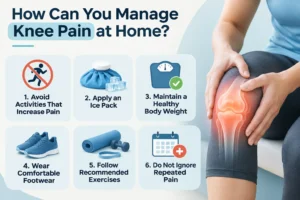
While home care cannot replace medical treatment for an underlying joint condition, certain measures may help manage mild discomfort.
If you experience knee pain while walking, consider the following steps, provided there is no serious injury or warning sign.
1. Avoid Activities That Increase Pain
Temporarily reduce activities that place excessive pressure on the affected knee.
This may include repeated stair climbing, deep squats or high-impact exercises.
However, prolonged complete rest can weaken the surrounding muscles. Try to maintain comfortable movement as advised by your healthcare professional.
2. Apply an Ice Pack
If the knee is swollen or painful, apply a cold pack wrapped in a towel for around 15–20 minutes.
Avoid placing ice directly on the skin.
3. Maintain a Healthy Body Weight
Gradual weight management can reduce the pressure placed on the knee joints and support better mobility.
4. Wear Comfortable Footwear
Choose footwear that provides appropriate support and fits properly. Avoid shoes that make walking uncomfortable or affect your balance.
5. Follow Recommended Exercises
Gentle exercises may help maintain flexibility and strengthen the muscles surrounding the joint.
However, the exercises should match your condition. A physiotherapist can help you understand which movements are appropriate.
6. Do Not Ignore Repeated Pain
If knee pain while walking continues for several days, keeps returning or starts affecting your daily activities, arrange a medical consultation rather than repeatedly relying on home remedies.
When Should You Consult an Orthopaedic Doctor?
Knee discomfort should not be considered a normal part of ageing, especially when it starts affecting your ability to move comfortably.
You should consult an orthopaedic doctor if:
- Pain continues or repeatedly returns.
- You experience difficulty climbing stairs.
- Your knee becomes swollen without a clear reason.
- You notice stiffness or reduced joint movement.
- Your knee feels unstable while standing.
- Walking short distances becomes difficult.
- Pain starts affecting your sleep or routine activities.
Seek urgent medical attention if you cannot bear weight, have severe pain or sudden swelling, or develop a hot, red knee with fever.
An experienced orthopaedic doctor can assess your symptoms, identify the underlying problem and recommend an appropriate treatment plan.
If you are experiencing persistent knee pain while walking, consulting an orthopaedic doctor in Noida can help you understand whether the problem is related to arthritis, an injury, muscle weakness or another joint condition.
Frequently Asked Questions (FAQs)
1. Why does my knee hurt when I walk but not when I sit?
Pain that occurs mainly during walking may be related to conditions that become symptomatic when the knee bears weight. Osteoarthritis, cartilage problems, tendon irritation and muscle weakness are some possible causes. A clinical examination can help identify the reason.
2. Why does my knee hurt more while climbing stairs?
Climbing stairs requires greater muscle effort and increases the load passing through the knee joint. Patellofemoral pain syndrome, osteoarthritis and quadriceps weakness can contribute to discomfort during this activity.
3. Is knee pain while walking always a sign of arthritis?
No. Although arthritis is a common cause, knee discomfort can also result from ligament injuries, meniscus tears, tendinitis, bursitis and patellofemoral pain syndrome. The location and pattern of pain help doctors narrow down the possible cause.
4. Can knee pain go away without surgery?
Yes. Many knee conditions improve with appropriate medication, physiotherapy, activity modification and weight management. Surgery is generally considered when the underlying condition requires it or non-surgical treatments do not provide adequate relief.
5. What are the early symptoms of knee osteoarthritis?
Early symptoms may include pain during movement, stiffness after inactivity, mild swelling, tenderness and difficulty performing activities such as climbing stairs or standing up from a chair. Symptoms usually develop gradually.
6. Is walking good for knee pain?
Gentle walking may help maintain mobility in many people with knee conditions. However, the duration and intensity should be adjusted according to the cause and severity of pain. Avoid pushing through significant discomfort, particularly after an injury.
7. How do I know if I need knee replacement surgery?
Persistent pain, difficulty walking, significant joint stiffness, deformity and limited improvement with appropriate non-surgical treatment may indicate that knee replacement should be discussed. An orthopaedic specialist will evaluate your symptoms and joint condition before recommending surgery.
8. Can excess weight cause knee pain?
Yes. Excess body weight increases the load placed on the knee joints and is an important risk factor for knee osteoarthritis. Weight management may help reduce joint stress and improve mobility.
Conclusion
Your knees support you through thousands of movements every day. From walking and climbing stairs to standing, sitting and maintaining balance, they play an essential role in your independence.
However, when knee pain while walking becomes frequent, even simple activities can start feeling difficult. The discomfort may be associated with osteoarthritis, an injury, muscle weakness or another joint condition.
The important thing is to understand the cause rather than simply getting used to the pain.
Early evaluation, appropriate treatment and guided rehabilitation can help manage many knee problems and support better movement. Even when joint damage is advanced, suitable treatment options are available to improve comfort and quality of life.
At Rama Hospital, Noida, patients looking for an orthopaedic hospital in Noida can seek specialist evaluation for joint pain, knee problems and mobility-related concerns.
If walking, climbing stairs or standing up has become uncomfortable, consult an orthopaedic specialist and take the first step towards healthier movement.