Ligaments are strong bands of tissue that connect bones to each other and help keep joints stable. When a ligament is stretched, partially torn, or completely torn, the joint may become painful, weak, or unstable. In the past, repairing a damaged ligament often required a large open incision, longer hospital stay, more pain, and a slower recovery. Today, many ligament injuries can be treated using a minimally invasive technique called keyhole ligament repair.
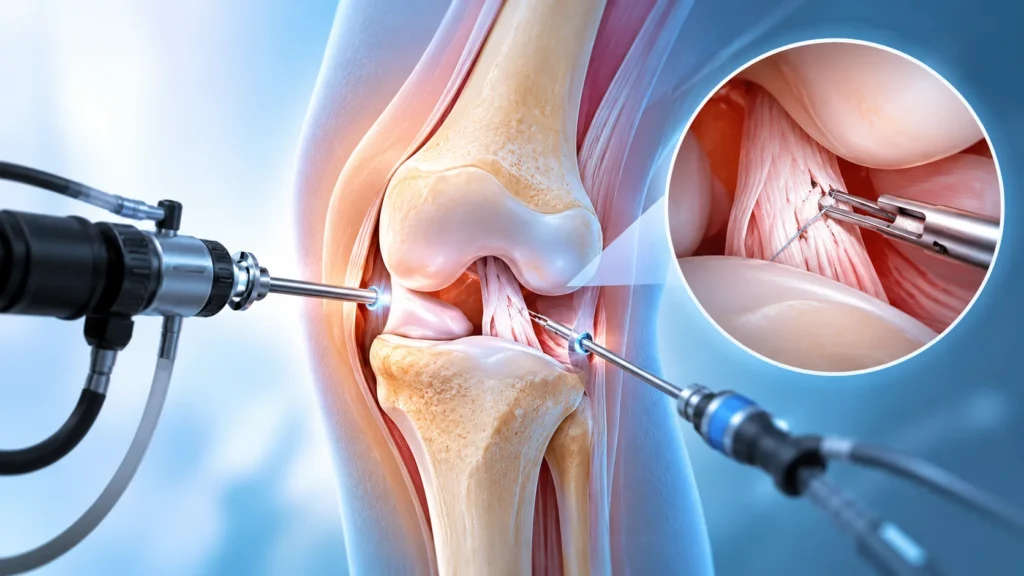
Keyhole ligament repair, also known as arthroscopic ligament repair or reconstruction, is a modern surgical method used to treat damaged ligaments in joints such as the knee, shoulder, ankle, wrist, and hip. Instead of making a large cut, the surgeon makes a few small incisions and uses a tiny camera called an arthroscope along with special instruments to see inside the joint and repair or reconstruct the ligament.
This approach allows the surgeon to treat the injury with less tissue damage, less pain, smaller scars, and often a faster recovery compared with open surgery. It is commonly used for injuries such as ACL tear in the knee, shoulder ligament injuries, ankle ligament tears, and wrist ligament injuries.
What is Keyhole Ligament Repair?
Keyhole ligament repair is a minimally invasive surgical technique used to treat damaged or torn ligaments. The surgeon makes a few small incisions, usually less than one centimeter each, around the joint. Through one incision, a small camera called an arthroscope is inserted. This camera sends images to a screen, allowing the surgeon to see inside the joint clearly. Through the other small incisions, special instruments are inserted to repair, reconstruct, or tighten the damaged ligament.
The word keyhole refers to the small size of the incisions, which are much smaller than those used in traditional open surgery. Because the surgeon does not need to make a large cut, the surrounding muscles, skin, and soft tissues are preserved as much as possible.
Depending on the type and severity of the injury, the surgeon may repair the existing ligament, reconstruct it using a graft, or tighten the joint capsule to restore stability. The goal is to restore normal joint function, reduce pain, and prevent further damage.
How Does Keyhole Ligament Repair Work?
Keyhole ligament repair follows a step-by-step process that allows the surgeon to treat the injury with precision.
Steps involved in the procedure
- The patient is given anesthesia, which may be general or regional depending on the joint and case.
- The joint is cleaned and prepared in a sterile manner.
- Small incisions are made around the joint.
- The arthroscope is inserted to visualize the inside of the joint.
- Fluid is injected to expand the joint and improve visibility.
- The surgeon examines the ligament and surrounding structures.
- The damaged ligament is repaired, reconstructed, or tightened using special instruments.
- If reconstruction is needed, a graft may be used to replace the torn ligament.
- The incisions are closed with small stitches or surgical tape.
- A dressing and sometimes a brace or sling is applied.
What happens during ligament reconstruction
In some cases, the ligament is too damaged to be repaired directly. In such cases, the surgeon may use a graft to replace it.
- The graft may be taken from the patient’s own body, such as hamstring tendon or patellar tendon.
- Sometimes a donor graft may be used.
- The graft is placed in the position of the original ligament.
- It is fixed using screws, buttons, or other fixation devices.
- Over time, the graft heals and becomes strong like a natural ligament.
Conditions Treated with Keyhole Ligament Repair
Keyhole ligament repair can be used to treat many types of ligament injuries in different joints.
Knee ligament injuries
- ACL tear, which is one of the most common reasons for keyhole ligament surgery.
- PCL injury.
- MCL injury in selected cases.
- Multi-ligament knee injuries.
- Meniscus-related instability along with ligament injury.
Shoulder ligament injuries
- Labrum tear or Bankart lesion after shoulder dislocation.
- Shoulder instability.
- SLAP tear.
- Capsular laxity or looseness.
Ankle ligament injuries
- Chronic ankle instability after repeated sprains.
- Lateral ligament tear.
- Deltoid ligament injury in selected cases.
Wrist and hand ligament injuries
- Scapholunate ligament injury.
- Triangular fibrocartilage complex injury.
- Chronic wrist instability.
Hip ligament injuries
- Labral tear with instability.
- Capsular laxity.
- Ligament-related hip pain.
Who Needs Keyhole Ligament Repair?
Not every ligament injury needs surgery. Many mild or partial tears can be treated with rest, physiotherapy, bracing, and medicines. Keyhole ligament repair is usually recommended when conservative treatment does not work or when the injury is severe.
Indications for surgery
- Complete ligament tear.
- Recurrent joint instability.
- Failed conservative treatment.
- Significant pain and swelling that does not improve.
- Inability to return to sports or daily activity.
- Associated injury to cartilage, meniscus, or other structures.
- Young and active patients with high demand on the joint.
- Chronic instability affecting quality of life.
Who may not need surgery
- Mild or partial tears that respond to physiotherapy.
- Elderly patients with low activity demand.
- Patients with severe arthritis or other major joint problems.
- Cases where risk of surgery outweighs benefit.
Benefits of Keyhole Ligament Repair
Keyhole ligament repair offers several advantages over traditional open surgery.
Main benefits
- Smaller incisions and less scarring.
- Less pain after surgery.
- Less blood loss.
- Lower risk of infection.
- Less damage to surrounding muscles and tissues.
- Shorter hospital stay.
- Faster recovery in many cases.
- Better visualization of the joint for the surgeon.
- Ability to treat multiple problems in the same surgery.
- Early return to daily activities.
Why these benefits matter
Because the incisions are small and the surrounding tissues are preserved, the body experiences less trauma. This leads to less pain, less swelling, and faster healing. Patients can often start moving earlier, which helps prevent stiffness and muscle weakness.
Risks and Complications
Like any surgery, keyhole ligament repair has some risks, although serious complications are uncommon.
Possible risks include:
- Infection.
- Bleeding or blood clot.
- Nerve injury.
- Blood vessel injury.
- Stiffness or reduced range of motion.
- Failure of the repair or graft.
- Recurrent instability.
- Pain that persists.
- Reaction to anesthesia.
- Need for revision surgery in some cases.
How risks are reduced
- Careful patient selection.
- Proper surgical technique.
- Sterile environment and infection control.
- Early mobilization as advised.
- Regular follow-up and monitoring.
- Compliance with rehabilitation plan.
Before the Surgery
Proper preparation helps ensure a smooth surgery and recovery.
Pre-surgery evaluation
- Detailed history and physical examination.
- Imaging tests such as MRI or CT scan.
- Blood tests and other routine investigations.
- Review of medicines and allergies.
- Discussion of anesthesia and risks.
- Planning of rehabilitation after surgery.
Patient instructions before surgery
- Stop certain medicines if advised by the doctor.
- Do not eat or drink for the recommended time before surgery.
- Arrange for someone to accompany and help after discharge.
- Keep the surgical area clean.
- Follow all instructions given by the hospital team.
During the Surgery
The surgery is usually done under anesthesia and takes one to three hours depending on the joint and complexity.
What happens during surgery
- Anesthesia is given to keep the patient comfortable and pain-free.
- The joint is cleaned and draped in a sterile manner.
- Small incisions are made around the joint.
- The arthroscope is inserted to see inside.
- The damaged ligament is assessed.
- Repair, reconstruction, or tightening is done as needed.
- The incisions are closed and dressed.
- A brace, sling, or support may be applied.
After the Surgery
Recovery after keyhole ligament repair is usually faster than open surgery, but it still requires time and proper rehabilitation.
Immediate recovery
- Patient may go home the same day or stay overnight depending on the case.
- Pain and swelling are managed with medicines and ice.
- Rest and elevation help reduce swelling.
- Weight bearing or movement restrictions depend on the joint and procedure.
Early recovery phase
- Gentle movement may be started early to prevent stiffness.
- Physiotherapy begins as advised by the surgeon.
- Brace or support may be used for a period of time.
- Follow-up visits are scheduled to monitor healing.
Later recovery phase
- Strengthening exercises are added gradually.
- Balance and proprioception training may be included.
- Return to work or sports depends on progress.
- Full recovery may take several weeks to months.
Rehabilitation After Keyhole Ligament Repair
Rehabilitation is the most important part of recovery after ligament surgery.
Goals of rehabilitation
- Reduce pain and swelling.
- Restore range of motion.
- Rebuild muscle strength.
- Improve balance and coordination.
- Restore joint stability.
- Return to daily activity, work, or sports safely.
Rehabilitation phases
- Early phase focuses on pain control, swelling, and gentle movement.
- Middle phase focuses on strength and flexibility.
- Later phase focuses on balance, coordination, and functional training.
- Final phase focuses on return to sport or work-specific activity.
Importance of physiotherapy
Skipping physiotherapy can lead to stiffness, weakness, and poor outcome. A structured rehabilitation plan helps the patient regain full function and reduces the risk of re-injury.
Recovery Timeline
Recovery time varies depending on the joint, type of injury, and individual factors.
General recovery timeline
- First few days: rest, ice, pain control, and gentle movement.
- First few weeks: physiotherapy and gradual increase in activity.
- Six to twelve weeks: strengthening and functional training.
- Three to six months: return to sports or heavy activity in many cases.
- Full recovery may take six to twelve months for some patients.
Factors affecting recovery
- Age and overall health.
- Type and severity of injury.
- Joint involved.
- Whether graft was used.
- Compliance with rehabilitation.
- Presence of other injuries.
When to Seek Medical Help After Surgery
Some symptoms after surgery need prompt medical attention.
- Severe or increasing pain.
- High fever.
- Redness, warmth, or discharge from the incision.
- Numbness or weakness that is new or worsening.
- Swelling that does not reduce.
- Inability to move the joint.
- Signs of blood clot such as leg swelling or chest pain.
Why Choose Rama Hospital for Keyhole Ligament Repair?
Keyhole ligament repair requires skill, experience, and advanced technology. A hospital with experienced orthopaedic and arthroscopic surgeons can make a major difference in outcomes.
- Expert evaluation by orthopaedic and sports injury specialists.
- Advanced imaging for accurate diagnosis.
- Modern arthroscopic equipment and techniques.
- Experienced surgical team.
- Structured rehabilitation program.
- Long-term follow-up to ensure full recovery.
Frequently Asked Questions (FAQs)
Which joints can be treated with keyhole ligament repair?
It can be used for knee, shoulder, ankle, wrist, and hip ligament injuries. The most common example is ACL reconstruction in the knee.
Is keyhole ligament repair painful?
There is some pain after surgery, but it is usually less than open surgery. Pain is managed with medicines, ice, and rest. Most patients find the recovery more comfortable than traditional surgery.
How long does the surgery take?
The surgery usually takes one to three hours depending on the joint and complexity. More complex cases may take longer.
Will I need to stay in the hospital?
Many patients go home the same day or the next day. Some complex cases may need a longer stay. The decision depends on the joint, procedure, and overall health.
When can I walk after knee ligament surgery?
This depends on the type of surgery and graft used. Some patients start partial weight bearing within days, while others may need a brace and crutches for a few weeks. The surgeon will give specific instructions.
How long does recovery take?
Recovery varies but often takes several weeks to months. Return to sports may take three to six months or longer. Full recovery can take up to a year in some cases.
Can the ligament tear again after repair?
Yes, there is a small risk of re-injury, especially if rehabilitation is not followed or if the patient returns to sports too early. Proper rehabilitation and gradual return to activity reduce this risk.
Is physiotherapy necessary after surgery?
Yes, physiotherapy is essential. It helps restore movement, strength, and stability. Without it, stiffness and weakness can occur, and the outcome may be poor.
Is keyhole ligament repair better than open surgery?
For many ligament injuries, keyhole surgery offers less pain, smaller scars, and faster recovery. However, the best method depends on the type and severity of the injury, and the surgeon will recommend the most suitable option.
Conclusion
Keyhole ligament repair is a modern, minimally invasive surgical technique used to treat damaged ligaments in joints such as the knee, shoulder, ankle, wrist, and hip. It offers several benefits over traditional open surgery, including smaller incisions, less pain, faster recovery, and better cosmetic results.
The success of the surgery depends not only on the skill of the surgeon but also on proper rehabilitation and patient compliance. With the right treatment plan, most patients regain joint stability, reduce pain, and return to normal activity or sports.
Rama Hospital can help evaluate ligament injuries, determine whether keyhole repair is needed, and provide a structured treatment and rehabilitation plan to ensure the best possible outcome.