
Prolonged or severe urinary obstruction can damage the kidneys and, in some cases, lead to kidney failure. But the outcome often depends on where the blockage occurs, whether one or both kidneys are affected, how complete the obstruction is, and how quickly it is treated.
A urinary obstruction means that urine cannot flow normally through part of the urinary system. The blockage may be partial or complete and can occur anywhere from the kidneys and ureters to the bladder outlet or urethra.
When urine cannot drain properly, it may begin to build up behind the blockage. This can increase pressure within the urinary tract, cause swelling of the kidneys (hydronephrosis), and gradually impair kidney function. In severe or prolonged cases, the damage may become permanent.
The good news is that urinary obstruction does not always cause kidney failure. When a significant blockage is identified and treated promptly, kidney function can often improve, particularly when the obstruction is sudden and affects only one kidney.
Can Urinary Obstruction Cause Kidney Failure?
Yes, urinary obstruction can cause kidney failure when a blockage is severe, prolonged, or affects both kidneys. A blockage prevents urine from draining normally, causing urine to back up and pressure to build within the urinary system. Over time, this pressure can impair kidney function and, if the obstruction remains untreated, may result in permanent kidney damage or kidney failure.
Prompt diagnosis and restoration of urine flow can significantly reduce the risk of lasting kidney damage.
However, not every urinary blockage leads to kidney failure. The risk depends on factors such as:
- Whether the obstruction is partial or complete
- Whether one or both kidneys are affected
- How long the blockage remains
- The location of the blockage
- Whether an infection is also present
- Whether the person already has reduced kidney function
What Is Urinary Obstruction?
Urinary obstruction or urinary blockage occurs when something prevents urine from flowing normally through the urinary tract.
Normally, the kidneys produce urine, which travels through the ureters into the bladder. The bladder stores urine until it leaves the body through the urethra. A blockage anywhere along this pathway can interfere with normal urine drainage.
The obstruction may also be acute, developing suddenly, or chronic, developing gradually and continuing for a longer period.
Urinary obstruction can be:
- Partial obstruction: Some urine can still pass through, but the flow is restricted. A person may notice a weak or slow urine stream, difficulty starting urination, or changes in the amount of urine produced.
- Complete obstruction: Urine flow is completely blocked. Depending on the location, this may result in an inability to urinate and can require urgent medical treatment.
- Upper urinary tract obstruction: This involves the kidneys or ureters. Kidney stones are a common example, particularly when a stone becomes lodged in a ureter.
- Lower urinary tract obstruction: This usually involves the bladder outlet or urethra. An enlarged prostate, urethral stricture, bladder stones, or certain tumors can interfere with urine leaving the bladder.
How Does a Urinary Blockage Damage the Kidneys?
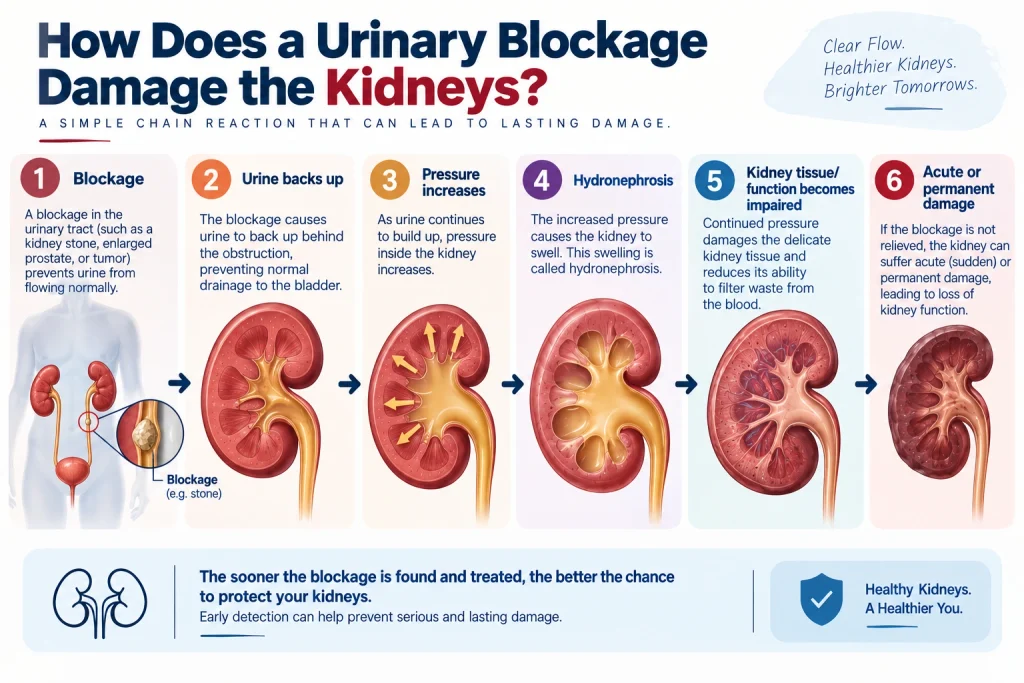
The relationship between urinary obstruction and kidney damage can be understood as a simple progression:
Blockage → urine backs up → pressure increases → hydronephrosis → kidney tissue/function becomes impaired → acute or permanent kidney damage
When urine cannot move forward normally, it can accumulate above the site of obstruction. This increases pressure within the urinary system.
If the obstruction involves the ureter, urine can back up toward the kidney and cause hydronephrosis, which means swelling of one or both kidneys. Persistent or severe hydronephrosis can impair kidney function.
Over time, prolonged pressure can interfere with the kidney’s ability to filter waste and maintain the body’s fluid and electrolyte balance. If the obstruction is not relieved, kidney damage may become permanent.
This is why the duration and severity of the blockage matter. A sudden obstruction that is treated quickly has a different outlook from a blockage that remains unnoticed for weeks, months, or longer.
Can Urinary Obstruction Cause Acute Kidney Injury?
Yes. Urinary obstruction can cause acute kidney injury (AKI) when the blockage suddenly interferes with urine drainage and kidney function.
AKI is a sudden decline in the kidneys’ ability to filter waste from the blood. A urinary blockage is one of the recognised causes of acute kidney injury.
This can happen when:
- Urine flow becomes severely restricted
- Both kidneys are affected
- A blockage occurs in a person with only one functioning kidney
- A severe bladder outlet obstruction prevents adequate urine drainage
The important point is that obstructive AKI can sometimes improve substantially once the obstruction is relieved.
When treatment restores urine flow quickly, kidney function may recover, particularly if significant permanent damage has not yet occurred. However, the longer the obstruction continues, the greater the risk of lasting kidney injury.
When Can Urinary Obstruction Lead to Kidney Failure?
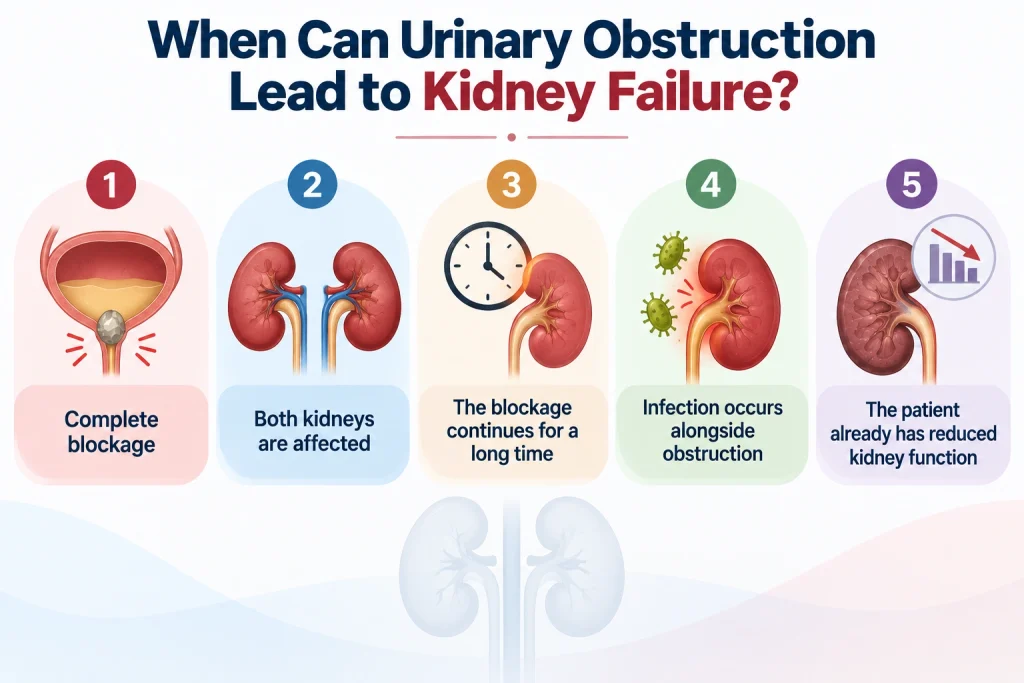
A urinary blockage becomes more concerning when certain risk factors are present.
1. Complete blockage
A complete obstruction can prevent urine from passing altogether. Depending on its location and the patient’s overall kidney function, this can rapidly become a serious problem.
2. Both kidneys are affected
When obstruction affects both kidneys, the body may lose a significant amount of its ability to remove waste and excess fluid.
Bilateral obstruction is therefore more concerning than an obstruction affecting only one normally functioning kidney.
3. The blockage continues for a long time
Duration matters. A blockage that remains untreated for a prolonged period can cause progressive kidney damage. Long-standing obstructive uropathy can result in permanent loss of kidney function.
4. Infection occurs alongside obstruction
A blocked urinary tract can increase the risk of infection because urine becomes trapped and bacteria may multiply. Fever, chills, worsening pain, or other signs of infection in someone with a known obstruction require prompt medical assessment.
5. The patient already has reduced kidney function
People who already have kidney disease or reduced kidney function may have less reserve when a urinary obstruction occurs. In these situations, even a new obstruction can become clinically significant.
The key message: Long-standing obstruction can cause permanent kidney damage, while prompt treatment of sudden obstruction often improves the chance of recovery.
What Causes Urinary Obstruction?
Several conditions can interfere with normal urine flow. The location and cause of the blockage determine the most appropriate treatment.
Kidney and ureter stones can block urine as they move through the urinary tract. An enlarged prostate can narrow the passage through which urine leaves the bladder, while scar tissue can cause a urethral or ureteral stricture. Tumors or surrounding masses may also compress the urinary tract. Nerve or bladder disorders can interfere with the bladder’s ability to empty properly.
| Cause | Where blockage can occur |
| Kidney/ureter stones | Kidney or ureter |
| Enlarged prostate | Bladder outlet/urethra |
| Urethral stricture | Urethra |
| Tumors | Urinary tract or surrounding structures |
| Blood clots | Urinary tract |
| Nerve/bladder disorders | Bladder |
What Are the Symptoms of Urinary Obstruction?
Urinary obstruction symptoms vary depending on the location and severity of the blockage. Some people develop noticeable symptoms quickly, while a slowly developing obstruction may cause fewer obvious warning signs.
Possible symptoms include:
- Reduced urine output
- Difficulty starting urination
- Weak or slow urine stream
- Interrupted urine flow
- Inability to urinate
- Flank or abdominal pain
- Blood in the urine
- Frequent urination
- Nausea or vomiting
- Fever or chills when infection is present
A person with lower urinary tract obstruction may feel that the bladder is full but still be unable to empty it completely. They may also need to urinate frequently or experience a stream that starts and stops.
Pain can be more noticeable when an obstruction affects the upper urinary tract, particularly with a blocked ureter or kidney stone. Hydronephrosis may also cause pain in the side, back or abdomen, although some cases cause few or no symptoms.
Warning Signs That Need Urgent Medical Attention
Some symptoms should not be ignored, particularly when they occur together.
Seek urgent medical attention if you:
- Cannot pass urine at all
- Develop severe or worsening pain
- Have fever or chills with a suspected urinary blockage
- Have repeated vomiting with severe obstruction or pain
- Notice blood in your urine
- Produce very little urine
- Have a known obstruction and your symptoms are getting worse
Complete inability to urinate can represent acute urinary retention, which requires prompt medical attention. Infection occurring alongside urinary obstruction can also become serious and needs timely assessment.
Do not wait for symptoms to become severe if you already know that you have a urinary blockage, hydronephrosis, or another condition that can obstruct urine flow.
Can Urinary Obstruction Cause Hydronephrosis?
Yes. Hydronephrosis due to urinary obstruction occurs when urine cannot drain normally and backs up into one or both kidneys.
As urine accumulates, the affected kidney can become swollen. Hydronephrosis can be caused by an obstruction in the urinary tract and may occur on one side or both sides. It can also be partial or complete and may develop suddenly or gradually.
Hydronephrosis itself is not the underlying cause in every case. Instead, it is often a sign that urine is not draining properly.
If the obstruction is left untreated, persistent pressure and urine backup can impair kidney function. Severe cases can eventually lead to kidney failure, although many people recover when the underlying obstruction is identified and treated appropriately.
That is why finding and treating the cause of the hydronephrosis is more important than simply treating the swelling.
How Is Urinary Obstruction Treated?
Treatment is not simply about removing a blockage. The first priority in significant obstruction is often to restore urine drainage and protect kidney function, while also treating the underlying cause.
Kidney or ureter stone
Depending on the size, location and clinical situation, treatment may include:
- Stone removal
- Ureteroscopy
- Shock wave lithotripsy
- Other stone procedures when appropriate
If a stone has caused significant obstruction, urgent drainage may sometimes be needed before definitive stone treatment.
Enlarged prostate
When an enlarged prostate blocks urine flow, treatment may include medications or procedures depending on the severity of obstruction, symptoms and prostate-related findings.
Urethral stricture
A narrowed urethra caused by scar tissue may require a urological procedure to widen or repair the narrowed area.
Severe obstruction
When urine needs to be drained urgently, doctors may use:
- Urinary catheter to drain the bladder
- Ureteral stent to help urine pass from the kidney to the bladder
- Nephrostomy tube to drain urine directly from the kidney
The choice depends on the location and cause of the obstruction.
Once urine drainage is restored, the underlying cause still needs to be addressed to prevent the blockage from returning.
Can Kidney Function Recover After Urinary Obstruction?
In many cases, kidney function can improve after urinary obstruction is relieved, especially when the blockage is identified and treated early.
Kidney function after urinary obstruction can therefore vary considerably from person to person.
A sudden obstruction treated promptly is generally more likely to have a favourable outcome than long-standing obstruction. If only one kidney is affected and the other kidney is healthy, the risk of permanent overall kidney failure is generally lower.
On the other hand, prolonged obstruction affecting both kidneys can result in permanent kidney damage. In severe cases where kidney function does not recover sufficiently, treatments such as dialysis may become necessary.
So, can kidney damage from obstruction be reversed? Sometimes, but the earlier the obstruction is treated, the better the opportunity to preserve or recover kidney function.
How Can Urinary Obstruction Be Prevented?
Not every urinary blockage can be prevented, but several steps can reduce the risk of complications.
- Treat kidney and ureter stones promptly.
- Do not ignore persistent difficulty urinating.
- Get prostate-related urinary symptoms evaluated.
- Investigate recurrent urinary symptoms rather than repeatedly treating them without finding the cause.
- Follow up on known hydronephrosis.
- Seek medical care if you suddenly cannot urinate.
- Follow your urologist’s recommendations if you have a known urinary tract narrowing or obstruction.
The goal is not only to relieve symptoms but to identify the reason urine flow is being blocked and prevent repeated obstruction.
Partial vs Complete Urinary Obstruction: What’s the Difference?
| Feature | Partial Obstruction | Complete Obstruction |
| Urine flow | Reduced | May stop |
| Symptoms | May be mild | Often more noticeable |
| Kidney pressure | Can increase | Can increase significantly |
| Kidney damage risk | Depends on duration | Higher |
| Urgency | Needs medical evaluation | May require urgent treatment |
A partial obstruction should not automatically be considered harmless. Even reduced urine flow can cause problems if the obstruction persists, particularly when both kidneys are affected or kidney function is already compromised.
Similarly, complete obstruction does not mean kidney failure is inevitable. Rapid treatment can restore urine drainage and may prevent permanent kidney damage.
Frequently Asked Questions (FAQs)
Can urinary obstruction cause kidney failure?
Yes. Severe or prolonged urinary obstruction can cause kidney damage and, in some cases, kidney failure. The risk is higher when the obstruction is complete, affects both kidneys, continues for a long time, or occurs in someone who already has reduced kidney function. Prompt treatment can reduce the risk of permanent damage.
Can a blocked ureter damage the kidney?
Yes. A blocked ureter can prevent urine from draining from the kidney to the bladder. Urine may back up into the kidney, causing hydronephrosis and potentially impairing kidney function if the obstruction is severe or prolonged.
Can kidney function return after urinary obstruction?
Kidney function may improve after the obstruction is relieved, particularly when treatment is provided promptly. Recovery depends on the duration and severity of the obstruction, whether one or both kidneys were affected, and whether permanent damage has already occurred.
What happens if urine is completely blocked?
Complete urinary blockage can prevent urine from leaving the body and may cause severe pain, urinary retention, urine backup and kidney injury. If you cannot urinate at all, particularly with severe pain, you should seek urgent medical attention.
Is urinary obstruction an emergency?
It can be. Inability to urinate, severe pain, very low urine output, or fever and chills associated with a suspected urinary blockage can require urgent assessment. An obstructed urinary tract combined with infection can be particularly serious.
Can kidney stones cause kidney failure?
Kidney stones do not usually cause kidney failure by themselves. However, a stone that significantly blocks urine flow—especially if the obstruction is prolonged, affects both kidneys, or occurs with infection—can cause kidney damage and, in severe cases, kidney failure.
What are the symptoms of obstructive uropathy?
Symptoms can include difficulty urinating, a weak or interrupted urine stream, reduced urine output, inability to empty the bladder, blood in the urine, flank or abdominal pain, nausea, vomiting and fever. Some people with slowly developing obstruction may have few symptoms initially.
Can hydronephrosis cause kidney damage?
Yes. Hydronephrosis occurs when urine backs up and causes one or both kidneys to swell. If the underlying obstruction is severe or remains untreated, hydronephrosis can impair kidney function and, in severe cases, contribute to kidney failure.
Conclusion
A urinary blockage should never be ignored simply because some urine is still passing.
Can urinary obstruction cause kidney failure? Yes, but it does not happen in every case. The greatest concern is a severe or prolonged obstruction, particularly when both kidneys are affected, infection is present, or kidney function is already reduced.
The important thing is to identify the obstruction early, determine what is causing it, restore urine drainage when necessary, and treat the underlying problem in best hospital in Noida.
If you have difficulty urinating, very low urine output, severe flank or abdominal pain, blood in the urine, or fever with urinary symptoms, timely medical evaluation can help prevent a potentially reversible problem from becoming permanent kidney damage.