A normal ECG records the electrical activity of the heart for only a few seconds or minutes. This is useful when an abnormal heart rhythm is present at the time of the test. However, many heart rhythm problems come and go. A person may experience palpitations, dizziness, fainting, skipped beats, chest discomfort, or sudden breathlessness at home, during work, while sleeping, or during exercise—while their clinic ECG appears completely normal.
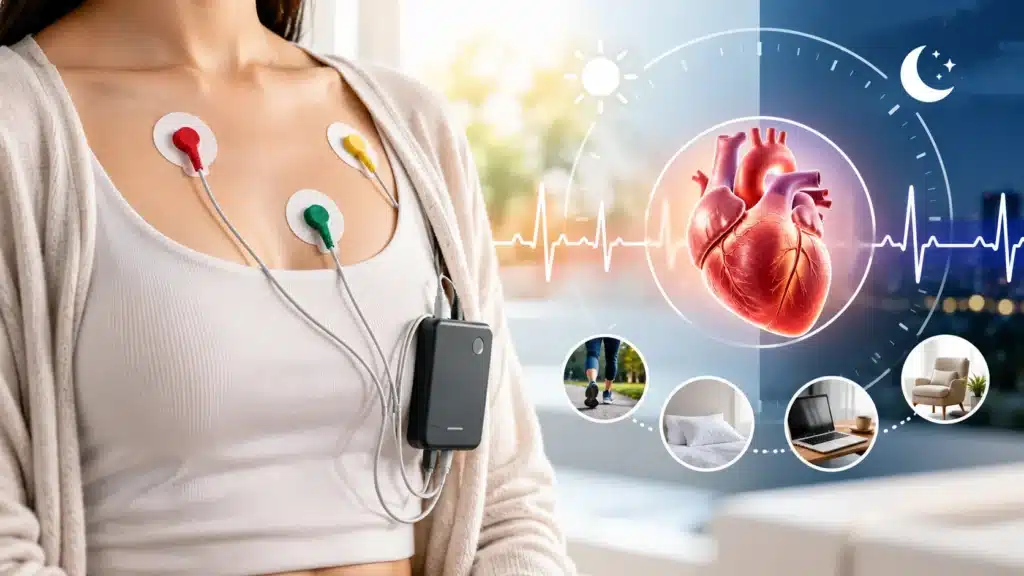
This is where Holter monitoring, also called a 24-hour ECG, becomes useful. A Holter monitor is a small wearable device that records the heart’s electrical activity continuously while the person follows their usual routine. It helps cardiologists understand how the heart behaves over a longer period, including during sleep, walking, work, meals, stress, and symptoms.
Holter monitoring is a type of portable electrocardiogram, or ECG. It records the heart’s electrical activity continuously outside the doctor’s clinic or hospital. Small adhesive electrodes are placed on the chest, and wires connect them to a lightweight recorder that is worn on a belt, strap, pouch, or shoulder harness.
The heart beats through electrical signals that travel in a coordinated pattern. A standard ECG records these signals briefly. A Holter monitor records them over an extended period, usually 24 hours, 48 hours, or longer, depending on the device and the doctor’s clinical question. This makes it easier to detect rhythm abnormalities that may not happen during a short ECG appointment.
Holter monitoring is non-invasive. It does not involve injections, anesthesia, surgery, radiation, or hospital admission in most cases. The device is fitted in a cardiology department or diagnostic centre, and the patient usually goes home and continues normal daily activities with some precautions.
A cardiologist may advise Holter monitoring when symptoms suggest a heart rhythm issue but routine ECG findings are normal or inconclusive. It is especially useful when symptoms happen often enough that they may be captured during the recording period.
Holter monitors help identify irregular heartbeats that are not captured on a standard ECG because they record heart activity continuously during routine daily life.
A Holter monitor does not diagnose every heart condition on its own. However, it can provide important evidence about the heart’s rhythm and electrical activity.
A Holter recording can also show whether symptoms such as palpitations, chest discomfort, breathlessness, or dizziness happened at the same time as an ECG abnormality. That correlation is often one of the most useful parts of the test.
Holter monitoring may be recommended for adults, older people, teenagers, and children when a heart rhythm problem is suspected. The decision depends on symptoms, medical history, physical examination, routine ECG results, and other cardiac risk factors.
People with frequent symptoms, such as daily palpitations, are usually more likely to benefit from a 24-hour Holter monitor. When symptoms happen less often, a cardiologist may recommend a longer event monitor or patch monitor instead.
Some heart rhythm symptoms are easy to recognize, while others are vague. It is still important to mention them clearly during the cardiology consultation.
Not every palpitation is dangerous. Many people have occasional extra beats, especially during stress, caffeine intake, poor sleep, dehydration, or illness. However, recurring symptoms, fainting, chest pain, or breathlessness should be assessed by a doctor.
A standard ECG and a Holter monitor both assess the electrical activity of the heart, but they serve different purposes.
A standard ECG is performed while the patient is resting in a clinic or hospital. It captures a short snapshot of the heartbeat, usually lasting only a few seconds. It can identify many important rhythm, conduction, and heart-attack-related changes if they are present during the test.
A Holter monitor records the heart continuously for an extended time while the patient is moving through normal life. It is useful when the abnormal rhythm comes and goes and may not appear during a short clinic ECG.
A 24-hour ECG records continuously over a relatively short period, typically 24 to 48 hours. An event monitor or longer ambulatory monitor may be worn for days or weeks and is often used when symptoms are less frequent.
Holter monitors continuously record for around 24 to 48 hours, while event monitors can be used for longer periods and may record automatically or when the patient activates them during symptoms.
The procedure is simple and usually takes a short time to set up.
The monitor records the heart’s electrical signals while you go about regular daily activities. You must keep the device on for the full prescribed time, including while sleeping, unless the healthcare team tells you otherwise.
The value of a Holter test comes from recording the heart during normal life. Patients are usually encouraged to continue routine activity unless the doctor gives restrictions.
Your healthcare provider will explain device-specific instructions. In many traditional Holter monitors, the recorder should not get wet.
Traditional Holter monitor leads generally need to remain attached throughout the test, and some services advise patients not to shower while wearing the device. Always follow the instructions provided for your specific device, as newer monitors may differ.
Holter monitoring is painless and non-invasive. The electrodes are attached to the chest with adhesive patches. Some people may feel mild pulling when the patches are removed or mild skin irritation under the adhesive.
Tell the healthcare team if you have sensitive skin or develop significant itching, rash, burning, or blisters. Patients with skin conditions should discuss this before the monitor is fitted.
Holter monitoring is generally safe. The monitor records the heart’s electrical activity; it does not send electricity into the body. There is no radiation exposure, injection, or contrast dye involved.
The main concern is minor skin irritation from the electrode adhesive. The test is also not a substitute for emergency care. If you experience severe chest pain, fainting, severe breathlessness, weakness on one side of the body, or other emergency symptoms while wearing the device, seek immediate medical attention rather than waiting for the monitoring period to end.
After the monitoring period is over, the device is returned to the hospital or diagnostic centre. The recording is downloaded and reviewed by trained cardiac staff and a cardiologist.
The report may include information about:
A Holter report does not always mean that a person has a serious heart problem. Many people have occasional extra beats that are harmless, particularly if the heart is otherwise structurally normal. The cardiologist interprets the report along with your symptoms, age, medical history, routine ECG, echocardiogram, blood tests, and other findings.
A normal Holter result means that no important abnormal rhythm was found during the recording period. It may show a normal variation in heart rate with activity, rest, and sleep.
However, a normal 24-hour ECG does not always completely rule out an intermittent rhythm problem. If symptoms did not happen during the test, or if they occur only once every few weeks, the cardiologist may recommend longer monitoring or another diagnostic approach.
An abnormal report does not automatically mean surgery or hospitalization is required. The next step depends on the type and severity of the finding.
Palpitations are one of the most common reasons for Holter monitoring. They may feel like fluttering, pounding, racing, missed beats, or sudden forceful beats in the chest.
Possible causes of palpitations include:
A Holter monitor can help determine whether the feeling of palpitations corresponds to a normal heart rhythm, harmless extra beats, or a more significant arrhythmia.
Holter monitoring offers several important benefits in cardiac evaluation.
It is a practical way to extend cardiac assessment beyond the short window of a standard ECG.
Holter monitoring is useful, but it has limitations.
If symptoms are infrequent, a longer event recorder, patch monitor, implantable loop recorder, or other test may be more appropriate.
Holter monitoring is an outpatient diagnostic test. It should never delay emergency treatment.
Holter monitoring should be part of a complete cardiac assessment, not just a standalone test. At Rama Hospital, the focus is on understanding the patient’s symptoms, recording the heart rhythm accurately, and ensuring the results are interpreted in the full clinical context.
A routine ECG records only a brief period of heart activity. If palpitations, dizziness, or irregular rhythms come and go, they may not occur during that short test. A Holter monitor records longer and can capture these intermittent changes.
Yes. You should generally keep the monitor on while sleeping because nighttime recordings are an important part of the test. Try to sleep normally while ensuring the wires and electrodes remain attached.
This depends on the device. Many traditional Holter monitors should not get wet, so patients are advised to bathe before fitting and avoid showers during the recording period. Follow the specific instructions given by your cardiac team.
No, Holter monitoring is painless. You may feel mild skin irritation, itchiness, or pulling from the adhesive patches, but there are no needles, injections, or electrical shocks involved.
Record the exact time of symptoms and what you were doing at that moment. Include palpitations, dizziness, chest discomfort, breathlessness, nausea, sweating, medicines, exercise, meals, and sleep-related symptoms, because these can be compared with the ECG recording.
The device must first be returned, downloaded, and reviewed by trained staff and a cardiologist. The exact time varies by hospital and device, but the care team will inform you when and how the report will be discussed.
The cardiologist will assess the type, frequency, severity, and relation to your symptoms. Some findings only need reassurance or lifestyle changes, while others may need medicines, more testing, electrophysiology consultation, or specific heart-rhythm treatment.
Holter monitoring, also known as a 24-hour ECG, is a safe and useful cardiac diagnostic test that records the heart’s electrical activity during everyday life. It is especially helpful for finding intermittent arrhythmias that may not appear during a short ECG in the clinic.
For people with palpitations, dizziness, fainting, unexplained fatigue, irregular heartbeat, or suspected rhythm disorders, a Holter monitor can provide important answers. The test helps cardiologists link symptoms to the heart’s rhythm, assess risk, and choose the most appropriate next step.
If you have recurring palpitations, dizziness, fainting, chest discomfort, or an irregular pulse, do not ignore the symptoms. A cardiology consultation and timely Holter monitoring may help identify the cause early and support safer, more effective heart care.



A Holter monitor is a device you wear that records your heart’s electrical activity for 24 to 48 hours.
No rows found.