Cardiac arrest is one of the most time-sensitive medical emergencies. It happens when the heart suddenly stops pumping blood effectively. Within seconds, the brain and other vital organs stop receiving oxygen-rich blood. Without immediate action, a person can lose consciousness, stop breathing, and die within minutes.
CPR, or cardiopulmonary resuscitation, and defibrillation are the two most important emergency interventions in cardiac arrest. CPR keeps blood moving to the brain and heart through chest compressions. Defibrillation uses an electric shock to reset a dangerously abnormal heart rhythm. When both are started quickly, the chances of survival improve significantly.
What is Cardiac Arrest?
Cardiac arrest is a sudden loss of heart function. The heart stops pumping blood effectively, so oxygen-rich blood no longer reaches the brain, lungs, and other organs. A person in cardiac arrest becomes unresponsive and stops breathing normally.
Cardiac arrest is different from a heart attack. A heart attack happens when blood flow to part of the heart muscle is blocked. A person may remain conscious and breathing during a heart attack. In cardiac arrest, the heart’s pumping action stops, and the person collapses. A heart attack can sometimes lead to cardiac arrest, but they are not the same condition.
Key features of cardiac arrest
- Sudden collapse.
- No normal breathing or only gasping.
- No response when called or shaken.
- No pulse in many cases.
- Loss of consciousness.
- Possible seizure-like movements at the start.
Why time matters
Every minute without CPR and defibrillation reduces the chance of survival. The brain is extremely sensitive to lack of oxygen. Early action can keep blood flowing until emergency medical help arrives.
What is CPR?
CPR stands for cardiopulmonary resuscitation. It is an emergency procedure used when someone’s heart has stopped or they are not breathing normally. CPR uses chest compressions, and sometimes rescue breaths, to keep oxygenated blood moving to vital organs until advanced medical care is available.
The main goal of CPR is not to restart the heart by itself. Its main goal is to maintain circulation and oxygen delivery. This buys time until a defibrillator or emergency team can restore a normal heart rhythm.
Why CPR is important
- Keeps blood flowing to the brain and heart.
- Delays brain damage during cardiac arrest.
- Improves the chance of successful defibrillation.
- Supports survival until emergency services arrive.
- Can be started by any bystander with basic knowledge.
Types of CPR
- Hands-only CPR, which uses continuous chest compressions without rescue breaths.
- Full CPR, which includes chest compressions and rescue breaths.
- Infant and child CPR, which uses different compression depth and technique.
- Advanced CPR, which is performed by trained medical teams with medicines and advanced airway support.
What is Defibrillation?
Defibrillation is the delivery of an electric shock to the heart to stop a dangerously fast or chaotic rhythm. The goal is to allow the heart’s natural electrical system to reset and resume a normal rhythm.
Defibrillation is used for specific abnormal rhythms such as ventricular fibrillation or pulseless ventricular tachycardia. These rhythms prevent the heart from pumping blood effectively. A shock can interrupt the abnormal electrical activity and give the heart a chance to restart in a more organized rhythm.
How defibrillation works
- The device delivers a controlled electric shock through pads placed on the chest.
- The shock briefly stops all electrical activity in the heart.
- The heart’s natural pacemaker then has a chance to restart a normal rhythm.
- If the rhythm is shockable, defibrillation can restore circulation.
Types of defibrillators
- Automated external defibrillator, or AED, which is designed for public and bystander use.
- Manual defibrillator, which is used by trained healthcare professionals.
- Implantable cardioverter defibrillator, or ICD, which is placed inside the body for people at high risk of dangerous rhythms.
What is an AED?
An automated external defibrillator, or AED, is a portable device that can analyze the heart rhythm and deliver a shock if needed. It is designed to be used by bystanders as well as healthcare professionals. The device gives clear voice instructions and will only shock if it detects a shockable rhythm.
AEDs are commonly found in airports, malls, offices, schools, gyms, stadiums, and hospitals. They are safe to use because the device will not deliver a shock unless it detects a rhythm that needs one.
Key features of an AED
- Voice prompts that guide the user step by step.
- Sticky pads that are placed on the chest.
- Automatic rhythm analysis.
- Shock delivery only when needed.
- Simple design for public use.
- Clear visual and audio instructions.
When are CPR and Defibrillation Needed?
CPR and defibrillation are needed when a person is unresponsive and not breathing normally. This may happen due to cardiac arrest, drowning, choking, trauma, drug overdose, or severe electrical injury.
Signs that CPR may be needed
- Person is unresponsive.
- No normal breathing.
- Only gasping breaths.
- No pulse or uncertain pulse.
- Sudden collapse.
- No movement or response to voice or touch.
When to use an AED
- As soon as an AED is available.
- When the person is unresponsive and not breathing normally.
- When the device prompts that a shock is advised.
- Alongside CPR, not instead of it.
Emergency Steps for Cardiac Arrest
The most important thing is to act quickly and call for emergency help. The following steps reflect general adult basic life support guidance.
Step 1: Check response and breathing
- Tap the person’s shoulders and ask loudly if they are okay.
- Look for chest movement and normal breathing.
- Gasping is not normal breathing.
- If there is no response and no normal breathing, treat it as cardiac arrest.
Step 2: Call for emergency help
- Call the local emergency number immediately.
- Ask someone nearby to call and bring an AED.
- If alone, call emergency services first, then start CPR.
- Put the phone on speaker if possible so instructions can be followed.
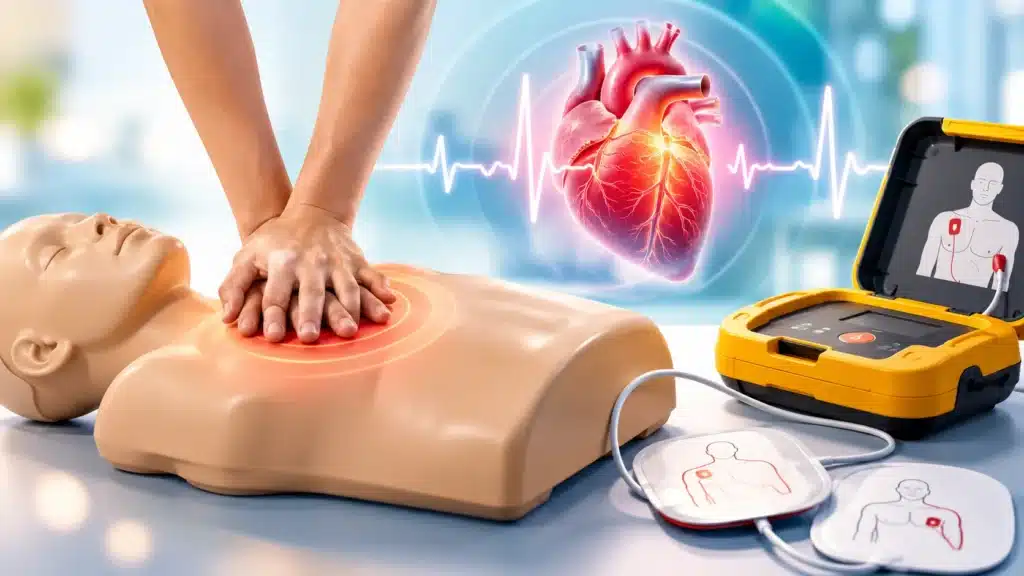
Step 3: Start chest compressions
- Place the person on a firm, flat surface.
- Put the heel of one hand on the center of the chest.
- Place the other hand on top and interlock fingers.
- Keep arms straight and shoulders directly above hands.
- Push hard and fast in the center of the chest.
- Allow the chest to rise fully between compressions.
Step 4: Use an AED as soon as available
- Turn on the AED.
- Attach the pads to the bare chest as shown in the diagrams.
- Let the device analyze the rhythm.
- Do not touch the person during analysis or shock.
- Deliver the shock if the device advises it.
- Resume CPR immediately after the shock.
Step 5: Continue until help arrives
- Continue CPR until emergency services take over.
- Continue until the person starts breathing normally.
- Continue until an AED instructs to stop.
- Do not stop just because the person does not respond immediately.
CPR Technique: Key Points
Good CPR technique matters. The quality of compressions can affect survival.
Chest compression points
- Push hard and fast.
- Compress at least two inches, or about five centimeters, in adults.
- Avoid compressing too deeply.
- Aim for a rate of about 100 to 120 compressions per minute.
- Allow full chest recoil between compressions.
- Minimize interruptions in compressions.
Rescue breaths
- If trained and confident, give two rescue breaths after every 30 compressions.
- If not trained, hands-only CPR is still effective and better than doing nothing.
- Ensure the airway is open before giving breaths.
- Watch for chest rise with each breath.
Special situations
- Children need gentler compressions with one or two hands depending on size.
- Infants need two fingers or two thumbs for compressions.
- Drowning victims may benefit from early rescue breaths.
- Choking victims may need airway clearance before CPR.
What Happens in a Hospital?
When a person reaches the hospital after cardiac arrest, the medical team continues advanced care. The goal is to restore circulation, protect the brain, treat the cause, and prevent complications.
Hospital emergency care may include
- Advanced airway management.
- Mechanical ventilation if needed.
- Medicines to support heart rhythm and blood pressure.
- Continued defibrillation if dangerous rhythms return.
- ECG and blood tests to identify the cause.
- Coronary angiography if a heart attack is suspected.
- Cooling therapy in selected patients to protect the brain.
- Intensive care monitoring.
- Treatment of complications such as brain injury or organ failure.
Why hospital care matters
Even after CPR and defibrillation, the body may need support to recover. Hospital teams monitor brain function, heart function, kidney function, and breathing. Early treatment of the underlying cause improves the chance of a better recovery.
Recovery After Cardiac Arrest
Recovery depends on how quickly CPR and defibrillation were started, the cause of arrest, and the amount of brain injury.
Early recovery
- Some people wake up within hours or days.
- Others may need days or weeks in intensive care.
- Breathing support may be needed initially.
- Neurological monitoring is important.
Long-term recovery
- Physical therapy for weakness or mobility issues.
- Speech therapy if speech or swallowing is affected.
- Cognitive rehabilitation for memory or concentration problems.
- Psychological support for anxiety, depression, or trauma.
- Cardiac rehabilitation to improve heart health and fitness.
- Regular follow-up to prevent another cardiac arrest.
Family support
Families play an important role in recovery. They may need guidance on medicines, follow-up visits, lifestyle changes, and warning signs. Emotional support is also important because cardiac arrest can be frightening for both patient and family.
Possible Complications
Cardiac arrest and resuscitation can lead to complications, especially if treatment is delayed.
Possible complications
- Brain injury due to lack of oxygen.
- Memory or concentration problems.
- Weakness or paralysis.
- Speech or swallowing difficulty.
- Kidney or liver dysfunction.
- Lung complications.
- Infection.
- Abnormal heart rhythms.
- Repeat cardiac arrest.
- Emotional or psychological effects.
Why complications happen
When the heart stops, organs do not receive oxygen. The longer this continues, the higher the risk of damage. Even after the heart is restarted, the body may need time and support to recover fully.
Prevention of Cardiac Arrest
Not all cardiac arrests can be prevented, but risk can be reduced with good heart health and early treatment of underlying conditions.
Prevention pointers
- Control high blood pressure.
- Manage diabetes.
- Keep cholesterol in check.
- Quit smoking.
- Limit alcohol.
- Maintain a healthy weight.
- Exercise regularly as advised.
- Manage stress.
- Treat heart disease early.
- Follow up regularly if you have a heart condition.
For people at high risk
- Regular cardiac check-ups.
- ECG and echocardiogram when advised.
- Medicine compliance.
- Family screening if there is a history of sudden cardiac death.
- Discussion about implantable defibrillators in selected high-risk patients.
Why Choose Rama Hospital for Emergency Cardiac Care?
Cardiac arrest requires immediate, coordinated, and expert care. A hospital with emergency medicine, cardiology, critical care, and neurology support can make a major difference in outcomes.
- Rapid emergency response.
- Advanced life support and defibrillation.
- Intensive care monitoring.
- Cardiac evaluation and treatment.
- Brain protection and neurological care.
- Rehabilitation and long-term follow-up.
Frequently Asked Questions (FAQs)
What is an AED?
An AED is an automated external defibrillator. It is a portable device that analyzes the heart rhythm and delivers a shock only if needed. It gives voice instructions and can be used by bystanders as well as medical staff.
When should CPR be started?
CPR should be started when a person is unresponsive and not breathing normally. Gasping is not normal breathing. Early CPR improves the chance of survival.
Can CPR restart the heart by itself?
Sometimes CPR can help restore circulation, but it does not always restart the heart. Its main role is to keep blood flowing until defibrillation or advanced medical care can restore a normal rhythm.
Is it safe to use an AED?
Yes, AEDs are designed to be safe. The device only delivers a shock if it detects a rhythm that needs one. It gives clear instructions and will not shock if the rhythm is not shockable.
What should I do if I am alone and see someone collapse?
Call emergency services first, then start CPR. If an AED is nearby, use it as soon as possible. Do not delay calling for help.
Can a person survive cardiac arrest?
Yes, survival is possible, especially when CPR and defibrillation are started quickly. Early action can prevent brain damage and improve the chance of recovery. The faster treatment begins, the better the outcome.
Conclusion
Cardiac arrest is a life-threatening emergency where every second matters. CPR and defibrillation are the two most important interventions that can save a life. CPR keeps blood flowing to the brain and heart, while defibrillation can reset a dangerous heart rhythm and restore normal function.
The most important steps are early recognition, immediate emergency call, prompt CPR, and use of an AED as soon as it is available. Even after resuscitation, hospital care is essential to protect the brain, treat the cause, and support recovery. With the right emergency response and follow-up care, many people can survive cardiac arrest and return to meaningful lives.
Rama Hospital can provide emergency cardiac care, advanced resuscitation, intensive monitoring, and long-term recovery support for patients who experience cardiac arrest or serious heart rhythm problems.