Most people use the terms “kidney stone” and “ureter stone” like they mean the same thing.
They don’t.
Yes, they’re related. But where the stone is sitting inside your body changes everything, the pain you feel, the symptoms you experience, and the treatment your doctor recommends. Understanding a ureter stone vs kidney stone properly can help you make faster, smarter decisions about your health.
What is a kidney stone?
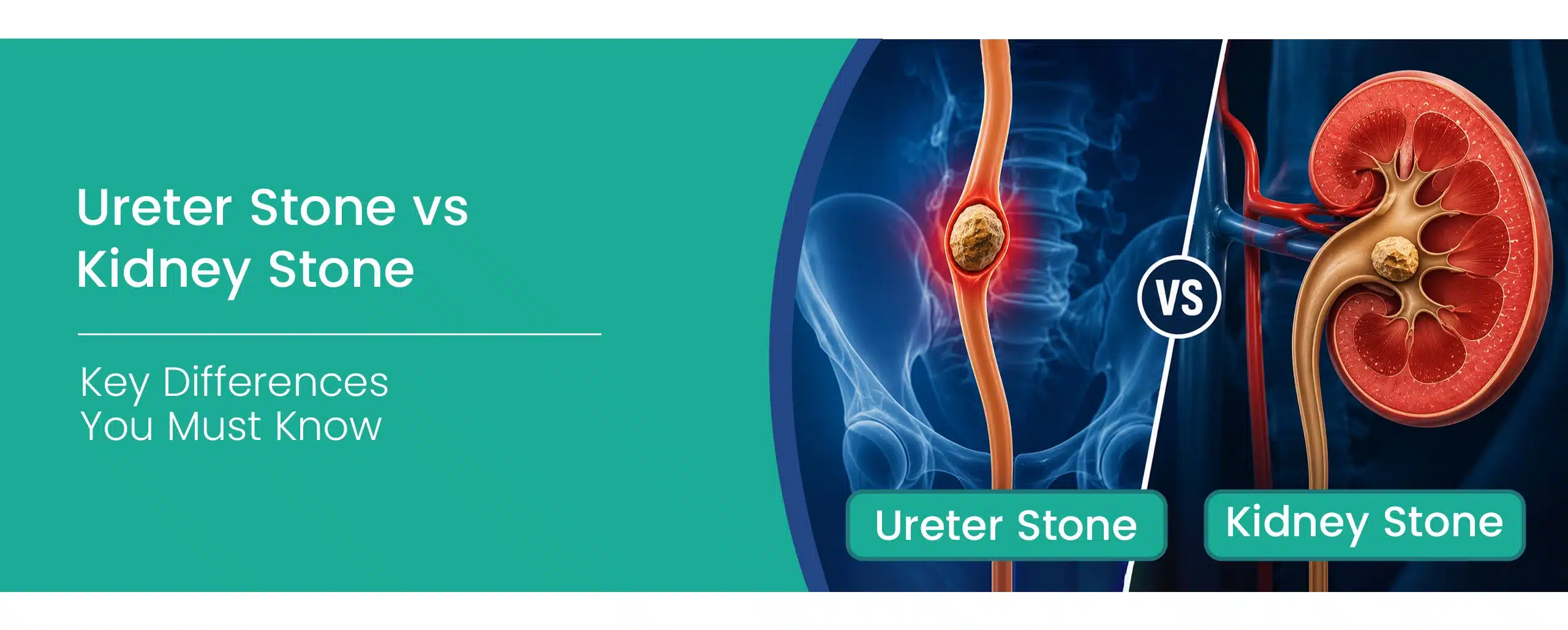
A kidney stone forms inside the kidney. It starts when certain minerals and salts, like calcium, oxalate, or uric acid, build up in your urine and crystallize over time.
Small kidney stones often sit quietly inside the kidney. You may not feel a thing. They get discovered accidentally during an ultrasound or CT scan done for a completely different reason. This is actually very common in Indian patients, especially those who don’t drink enough water or follow high-protein diets.
Quick facts about kidney stones:
- Forms inside the kidney (renal pelvis or calyx).
- Can be as small as a grain of sand or as large as a golf ball.
- May stay silent for months or even years.
- Starts causing pain only when it begins to move or blocks urine flow.
- More common in men than women.
- Extremely common in North India, especially in the “stone belt” (UP, Rajasthan, MP).
What is a ureter stone?
A ureter stone is a kidney stone that has moved. It has left the kidney and is now stuck inside the ureter, the thin tube that connects your kidney to your bladder.
This is where things get painful. Fast.
The ureter is narrow. Very narrow. When a stone gets lodged there, it blocks urine from flowing down. Pressure builds up inside the kidney. And that pressure creates one of the most intense pains a human being can experience.
The difference in ureter stone vs kidney stone becomes most obvious here: ureter stones cause sudden, severe, unmistakable pain. Kidney stones, while still sitting in the kidney, are often silent.
Quick facts about ureter stones:
- A kidney stone that has migrated into the ureter.
- Most commonly gets stuck at three narrowing points in the ureter.
- Causes sudden, severe pain called renal colic.
- Considered a urological emergency in many cases.
- Requires faster medical attention than a stationary kidney stone.
Ureter stone vs kidney stone: side-by-side comparison
| Feature | Kidney Stone | Ureter Stone |
| Location | Inside the kidney | Inside the ureter (tube from kidney to bladder) |
| Pain type | Dull ache or no pain | Sudden, severe, cramping pain (renal colic) |
| Pain location | Flank (back/side, below ribs) | Flank, radiating to lower abdomen and groin |
| Nausea/vomiting | Mild or absent | Common and intense |
| Blood in urine | Possible | Very common |
| Urinary symptoms | Rare unless blocking | Frequent urge to urinate, burning sensation |
| Urgency | Monitor with a doctor. | Often needs urgent treatment |
| Passes on its own | Often yes (small stones) | Depends on size and location |
| Commonly detected by | Ultrasound, CT scan | Ultrasound, CT urogram |
| Typical treatment | Medication, lifestyle changes, ESWL | ESWL, ureteroscopy, medication |
Understanding this table is key when comparing ureter stones vs. kidney stone for your own situation.
Ureter stone causes and symptoms: What patients need to know
What causes a ureter stone?
Ureter stone causes and symptoms are closely linked to underlying kidney stone formation. The stone doesn’t originate in the ureter; it forms in the kidney first.
Primary causes:
- Dehydration, the number one cause in Indian patients.
- High-salt diet (think pickles, papads, processed snacks).
- High-oxalate foods (spinach, tomatoes, nuts, tea in excess).
- High-protein diet (popular with gym-goers).
- Family history of kidney or ureter stones.
- Recurrent urinary tract infections (UTIs).
- Certain medications (diuretics, calcium supplements in excess).
- Metabolic conditions like hyperparathyroidism or gout.
In Delhi NCR and Noida, ureter stone causes and symptoms are frequently tied to a combination of hard water consumption, low water intake, and sedentary urban lifestyles.
Symptoms of a ureter stone
If you’re experiencing these, don’t wait. Seek care immediately from a kidney stone specialist in Noida or your nearest urologist.
Symptoms:
- Sudden, severe pain in the side and back (flank pain).
- Pain that moves to the lower abdomen and groin; this is the hallmark of ureter stone vs kidney stone.
- Intense waves of pain that come and go (renal colic).
- Nausea and vomiting during pain episodes.
- Blood in urine (pink, red, or brown-colored urine).
- Burning sensation while urinating.
- Urgent, frequent need to urinate even when the bladder is not full.
- Fever and chills (if infection is also present, this is a medical emergency).
How the pain feels: ureter stone vs kidney stone
Pain is the most obvious difference patients notice.
Kidney stone pain (while still in the kidney):
- Often absent or just a dull, chronic ache.
- Felt in the back or side, below the ribcage.
- Many patients mistake it for a backache or muscle pain.
Ureter stone pain:
- Sudden onset, can wake you up from sleep.
- Described by patients as worse than childbirth or a bone fracture.
- Comes in waves lasting 20–60 minutes.
- Travels from the back/flank down toward the groin and inner thigh.
- Accompanied by nausea, restlessness, and inability to sit still.
This pain pattern, moving from back to groin, is a strong indicator that a stone has entered the ureter. If this is what you’re experiencing, seeing the best urologist in Delhi NCR immediately is the right call.
How is each type diagnosed?
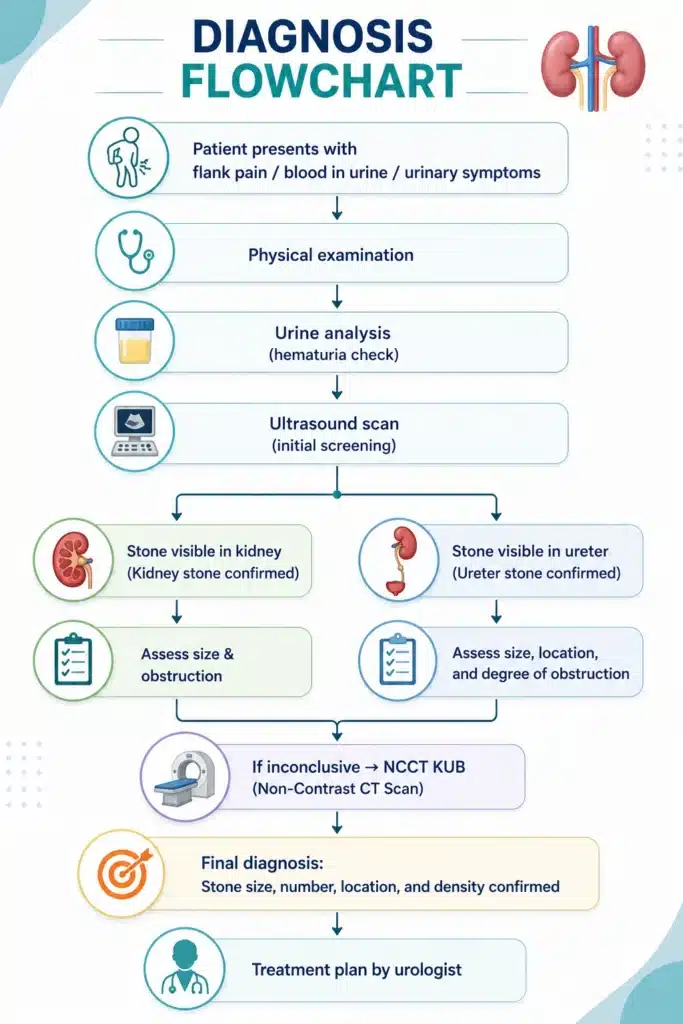
The NCCT KUB (CT scan of the kidney, ureter, and bladder) is the gold standard for both ureter stone vs kidney stone diagnosis. It gives your doctor a precise picture of exactly where the stone is, how big it is, and whether it is causing a blockage.
Ureter stone treatment in Noida: What are your options?
Treatment depends on three things: stone size, stone location, and how much trouble it’s causing.
For small stones (less than 5mm)
- Often pass on their own with high fluid intake.
- Alpha-blockers (like tamsulosin) help relax the ureter muscles to let the stone pass.
- Pain management with anti-inflammatory medications.
- Regular monitoring with ultrasound.
For medium to large stones (5mm and above)
Medical intervention is usually needed. Options available for ureter stone treatment in Noida include:
1. ESWL (Extracorporeal Shock Wave Lithotripsy)
- Uses sound waves from outside the body to break the stone into small pieces.
- Non-invasive, no cuts, no anesthesia.
- Works best for stones in the upper ureter and kidney.
- Fragments pass through urine over days to weeks.
2. Ureteroscopy (URS) with Laser Lithotripsy
- A thin scope is passed through the urethra and bladder into the ureter.
- Laser breaks the stone into tiny pieces, which are removed or pass naturally.
- Most effective procedure for ureter stones.
- Daycare procedure: most patients go home the same day.
3. PCNL (Percutaneous Nephrolithotomy)
- For very large kidney stones (above 2 cm).
- A small incision is made in the back to access the kidney directly.
- Highly effective for complex or staghorn stones.
At Rama Hospital, all these procedures for ureter stone treatment in Noida are available with experienced urologists and modern surgical infrastructure.
Why Noida patients choose Rama Hospital
When it comes to ureter stone vs kidney stone treatment, the quality of care matters enormously.
Rama Hospital stands out for several reasons:
- Experienced team of urologists with specialization in stone disease management.
- Advanced diagnostic equipment, including high-resolution CT urogram and real-time ultrasound.
- Full range of urological procedures under one roof: ESWL, URS, PCNL, and laser lithotripsy.
- Transparent consultation process: Doctors explain your diagnosis and all treatment choices.
- Affordable packages with insurance support.
- Located conveniently in Noida, serving patients from across Delhi NCR, Ghaziabad, Greater Noida, and beyond.
As the best hospital in Noida for urology and stone disease, Rama Hospital has helped thousands of patients, from simple ureter stone cases to complex bilateral kidney stones, get back to their normal lives without unnecessary delay.
Whether you’re looking for the best urologist in Delhi NCR or a trusted kidney stone specialist in Noida, the team at Rama Hospital brings both clinical expertise and patient-first care to every case.
When is it an emergency? Don’t ignore these signs
Not every stone needs emergency care. But some situations absolutely do.
Go to the hospital immediately if you have:
- Fever above 101°F (38.3°C) along with flank pain; this suggests a kidney infection with obstruction, which is dangerous.
- Severe, uncontrolled vomiting; you can’t keep fluids down.
- Complete inability to urinate, a sign of total blockage.
- Excruciating pain that isn’t responding to painkillers.
- Only one functioning kidney (any blockage here is urgent).
A blocked, infected kidney can become life-threatening within hours. Don’t try to manage this at home. The best hospital in Noida for emergencies like this is equipped to handle these situations around the clock.
Preventing ureter and kidney stones: simple habits that work
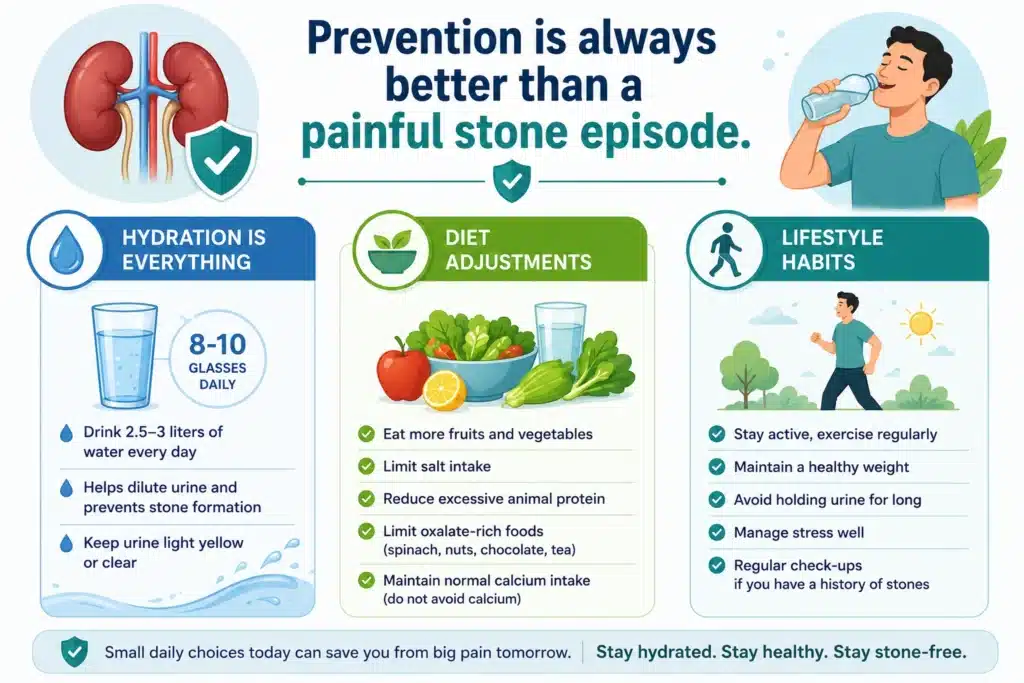
Prevention is always better than a painful stone episode.
Hydration is everything:
- Drink at least 2.5 to 3 liters of water daily.
- Urine should be pale yellow; if it’s dark, you’re not drinking enough.
- Increase intake in summers, during exercise, and while traveling.
Diet adjustments:
- Reduce sodium; limit salt, processed snacks, pickles, and papads.
- Limit oxalate-rich foods if you’ve had calcium oxalate stones (spinach, tea, and nuts in excess).
- Don’t cut calcium from your diet; dietary calcium actually protects against stone formation.
- Limit animal protein if you’ve had uric acid stones.
- Add lemon juice to water; citrate in lemon inhibits stone formation.
Lifestyle habits:
- Stay active; a sedentary lifestyle increases stone risk.
- Don’t hold urine for too long.
- Follow up with a kidney stone specialist in Noida even after your stone passes; first-time stone formers have a 50% chance of recurrence within 5 years.
Frequently Asked Questions (FAQs)
Q1. How do I know if the stone has moved from my kidney to the ureter?
The most common signal is a change in the nature of your pain. If you’ve been told you have a kidney stone and suddenly experience intense cramping pain that travels to your groin, the stone has likely moved into the ureter. A repeat ultrasound or CT scan will confirm this.
Q2. Can a ureter stone pass on its own without surgery?
Yes, if it’s smaller than 5mm. Approximately 70–80% of small ureter stones pass naturally with plenty of fluids and medication. Stones larger than 7–8mm rarely pass without intervention.
Q3. How long does a ureter stone take to pass?
Small stones (less than 5mm) typically pass within 1 to 4 weeks. Larger stones need treatment. Waiting too long with a blocked ureter can damage the kidney permanently, so don’t delay if the pain is severe or you develop a fever.
Q4. Is the treatment for ureter stones painful? Will I need surgery?
Most ureter stone treatments today are minimally invasive. Ureteroscopy with laser is done under short anesthesia; most patients are back home the same day. ESWL is entirely non-invasive. Open surgery is rarely needed for stone disease anymore.
Q5. I’ve had a stone removed. Will it come back?
Unfortunately, yes, the recurrence rate for kidney and ureter stones is around 50% within 5 years if lifestyle changes are not made. Dietary modification, hydration, and periodic follow-up with a kidney stone specialist in Noida significantly reduce your chances of a repeat episode.
Q6. Where is the best place for ureter stone treatment in Noida?
Rama Hospital in Noida is a trusted name for urology and stone disease management. The hospital offers full diagnostic and surgical facilities, experienced urologists, and affordable treatment packages. Patients from across Delhi NCR visit Rama Hospital for both routine stone management and complex urological care.
Conclusion
The debate of ureter stone vs kidney stone isn’t just academic; it directly affects how you feel, how urgently you need care, and which treatment your doctor will recommend.
If you’re experiencing any of the symptoms described in this blog, don’t wait. Connect with the best urologist in Delhi NCR at Rama Hospital, one of the best hospitals in Noida for urology and stone disease, and get the right diagnosis before the situation worsens.
Your kidneys work 24/7. Give them the attention they deserve.
For appointments and consultations related to ureter stone or kidney stone treatment, visit Rama Hospital, Noida. Our team of experienced urologists and kidney stone specialists is available to guide you through diagnosis, treatment, and long-term prevention.