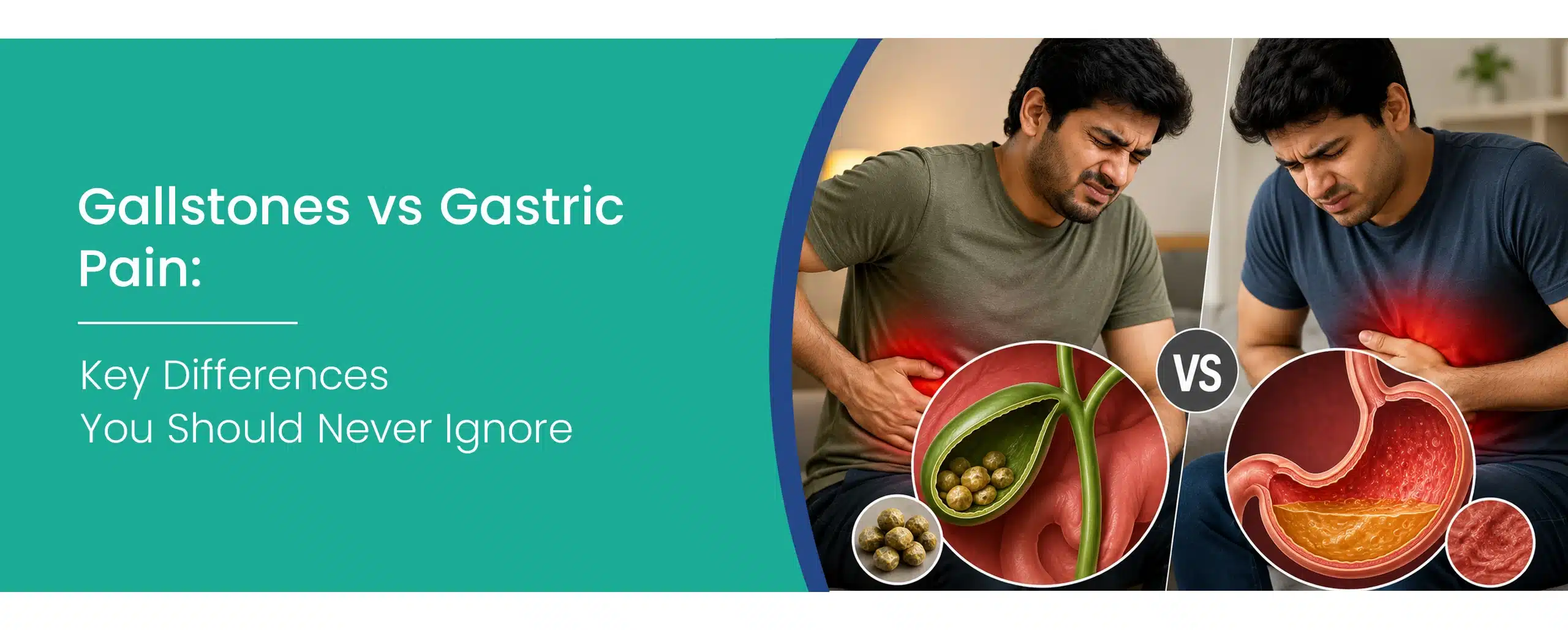
That sharp pain in your upper abdomen after a heavy meal, is it gas, acidity, or something more serious?
Most people assume it’s gastric. They pop an antacid, wait it out, and move on. But sometimes, what feels like routine stomach trouble is actually your gallbladder sending out an SOS.
Gallstones vs gastric pain is one of the most commonly confused medical situations in India. The symptoms overlap, the triggers feel similar, and both can appear after eating. But the causes are completely different, and so is the treatment.
Why do people confuse gallstones with gastric pain?
Both conditions affect the upper abdomen. Both can flare up after eating. Both cause discomfort that most people try to manage at home.
But that’s where the similarity ends.
Gallstones (cholelithiasis) and gastric pain differ in their cause, pain pattern, severity, and long-term risks. Mistaking cholelithiasis for simple gas or indigestion, or ignoring symptoms in the hope that they will go away on their own, can delay diagnosis and increase the risk of serious complications such as gallbladder infection, jaundice, or pancreatitis.
The problem is that antacids and home remedies work for gas. They do absolutely nothing for gallstones.
Here’s why confusion happens:
- Both cause upper-abdominal discomfort.
- Both can follow a meal.
- Both may involve nausea.
- Neither always presents dramatically at first.
- Most patients self-medicate before seeing a doctor.
What are gallstones? A quick overview
The gallbladder is a small, pear-shaped organ sitting just below your liver on the right side of your abdomen. Its job is to store bile, a digestive fluid produced by the liver that helps break down fats.
Gallstones form when substances in bile (usually cholesterol or bilirubin) harden into stone-like deposits. They can be as small as a grain of sand or as large as a golf ball.
Many people have gallstones for years without any symptoms. The problem starts when a stone blocks the bile duct; that’s when the pain begins.
Common risk factors for gallstones:
- Being female (women are 2–3x more likely to develop gallstones).
- Age above 40.
- Obesity or rapid weight loss.
- High-fat, low-fiber diet.
- Diabetes and metabolic conditions.
- Family history of gallstones.
- Prolonged fasting or skipping meals.
Gallstone symptoms: what does a gallstone attack actually feel like?
Gallstone symptoms are distinct once you know what to look for. The classic presentation is called biliary colic, a specific type of pain that has a very recognizable pattern.
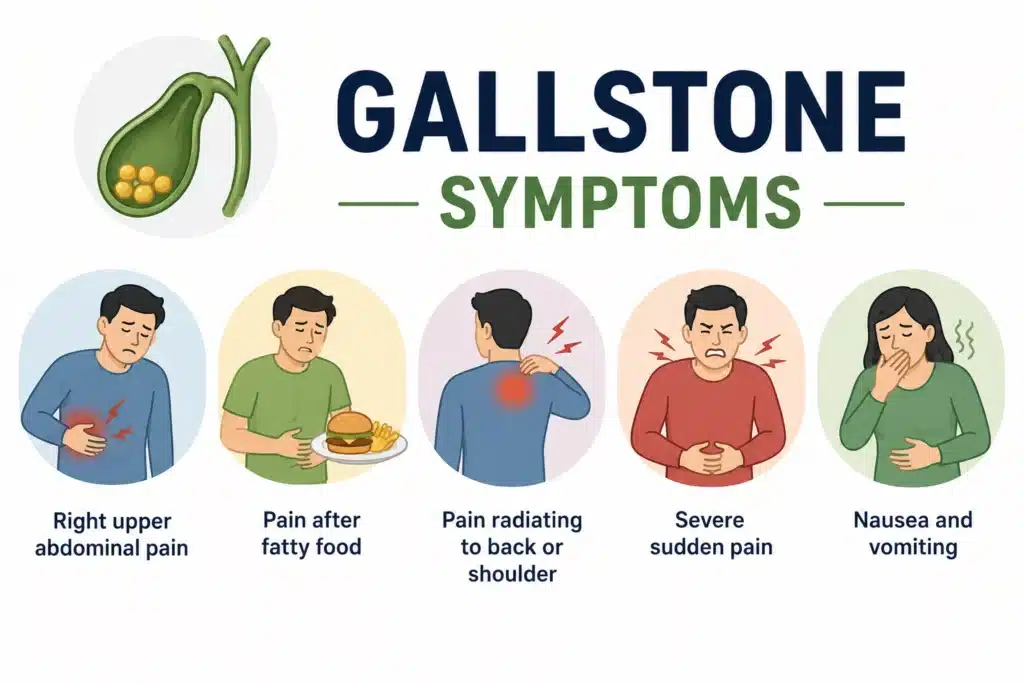
Right upper abdominal pain
- The most telling sign of gallstones.
- Located specifically in the upper right portion of the abdomen.
- Pain can be dull and constant or sharp and cramping.
- Often described as a pressure or squeezing sensation.
- Does NOT move around like gas pain does.
Pain after fatty food
- Triggered specifically by high-fat meals, fried foods, ghee, full-fat dairy, and non-vegetarian dishes.
- Usually begins 30 minutes to 2 hours after eating.
- This is because fatty food stimulates the gallbladder to contract and release bile.
- When a stone blocks the duct during contraction, pain begins.
Pain radiating to back or shoulder
- A hallmark feature that distinguishes gallstones from gas.
- Pain travels from the right abdomen to the right shoulder blade or upper back.
- Some patients feel it between the shoulder blades.
- This referred pain pattern is almost never seen in simple gastric problems.
Severe sudden pain
- Gallstone attacks can go from mild discomfort to severe pain within minutes.
- Pain typically peaks and lasts 1–5 hours before easing.
- Can be so intense that patients cannot sit still or find a comfortable position.
- Often occurs at night or in the early hours of the morning.
Nausea and vomiting
- Almost always present during a gallstone attack.
- Nausea often precedes or accompanies the pain.
- Vomiting usually does not relieve the pain (unlike in some gastric conditions)
Other gallstone symptoms to watch for:
- Fever with chills (suggests infection, needs immediate attention).
- Yellowing of skin or eyes (jaundice, bile duct is blocked).
- Dark urine or pale/clay-colored stools.
- Indigestion and bloating that keeps recurring.
Gastric/acidity symptoms: What does gastric pain actually feel like?
Gastric problems, including acidity, GERD, gastritis, and functional dyspepsia, are extremely common in India. Irregular eating habits, spicy food, stress, and overuse of pain medications all contribute.
Burning sensation in chest
- Classic symptom of acid reflux or GERD.
- Felt in the chest, throat, or behind the breastbone.
- Worsens after lying down or bending forward.
- Often described as heartburn.
- Rarely seen in gallstone attacks.
Bloating and gas
- Feeling of fullness, tightness, or swelling in the abdomen.
- Excessive gas production.
- Audible gurgling or rumbling sounds.
- Common after spicy, fried, or gas-producing foods like dal and rajma.
Relief after burping
- One of the clearest signs of a gastric issue.
- Burping or passing gas provides noticeable relief.
- In gallstone attacks, burping does not help at all.
- This one difference alone can help you distinguish the two.
Stomach fullness
- Feeling uncomfortably full even after a small meal.
- A heavy or bloated sensation in the upper or central abdomen.
- Common in gastritis and slow gastric emptying.
Mild cramping pain
- Gastric pain is usually diffuse; it moves around.
- Cramping is often relieved by passing gas or having a bowel movement.
- Less severe than gallstone pain.
- Rarely radiates to the back or shoulder.
Other gastric/acidity symptoms:
- Sour taste in the mouth.
- Frequent belching.
- Loss of appetite.
- Mild headache alongside stomach discomfort.
- Nausea without severe pain.
Gallstones vs Gastric pain: the complete comparison table
This table makes the cholelithiasis (gallstones) vs gastric pain comparison much easier to understand. If your symptoms match the cholelithiasis column, especially right upper abdominal pain, pain after fatty foods, and pain that radiates to the back or right shoulder, don’t assume it’s just acidity. Early evaluation can help identify cholelithiasis before it leads to complications.
| Feature | Gallstones | Gastric / Acidity |
| Pain Location | Right upper abdomen | Central or upper abdomen, chest |
| Pain Type | Severe, constant, squeezing | Burning, cramping, diffuse |
| Pain After Fatty Food | Yes, very consistent trigger | Sometimes, but not specific to fat |
| Pain Radiating to Back or Shoulder | Yes, right shoulder/back | Rarely |
| Relief After Burping | No | Yes |
| Nausea and Vomiting | Common, vomiting doesn’t help | Sometimes, relief after vomiting |
| Fever or Jaundice | Possible in complicated cases | Not associated |
| Triggered by Spicy Food | Rarely | Very commonly |
| Response to Antacids | No improvement | Often provides relief |
| Duration of Pain | 1–5 hours per episode | Minutes to hours, often variable |
| Time of Attack | Often at night | Often after meals |
| Bloating and Gas | Mild | Prominent |
Can gallstones be confused with acidity? Yes, here’s why it happens
Can gallstones be confused with acidity? Absolutely. It happens every day.
Several factors make this mix-up so common:
- Both worsen after eating: Fatty meals trigger gallbladder contractions. Spicy or heavy meals trigger acid production. Both lead to post-meal discomfort that feels similar from the outside.
- Both cause nausea: Nausea is present in both conditions. Without knowing where exactly the pain is and how it behaves, it’s easy to attribute nausea to “something I ate.”
- Antacids sometimes mask gallstone discomfort temporarily: Not because they treat the cause, but because any placebo or time-based relief can make patients think the antacid worked. The gallstone hasn’t gone anywhere.
- Patients avoid hospital visits: In India especially, many patients try home remedies for days or weeks before seeking care. By the time they visit a doctor, symptoms have sometimes settled, creating a false sense of resolution.
- Overlapping risk populations: Middle-aged adults, especially women, are prone to both conditions simultaneously. Someone can have both acidity AND gallstones. This layering makes diagnosis harder without proper investigation.
The key distinguisher: If antacids consistently fail to provide relief, if pain is specifically in the right upper abdomen, and if pain goes to the back or right shoulder, it is not simple acidity. Get an ultrasound done.
What is gastritis, and how is it different?
Gastritis is inflammation of the stomach lining. It’s often confused with both gallstones and simple acidity, but it has its own distinct features.
Gastritis symptoms include the following:
- Gnawing or burning pain in the upper central abdomen
- Pain that may improve or worsen with eating
- Nausea, sometimes with vomiting
- Loss of appetite
- Feeling of fullness after small amounts of food
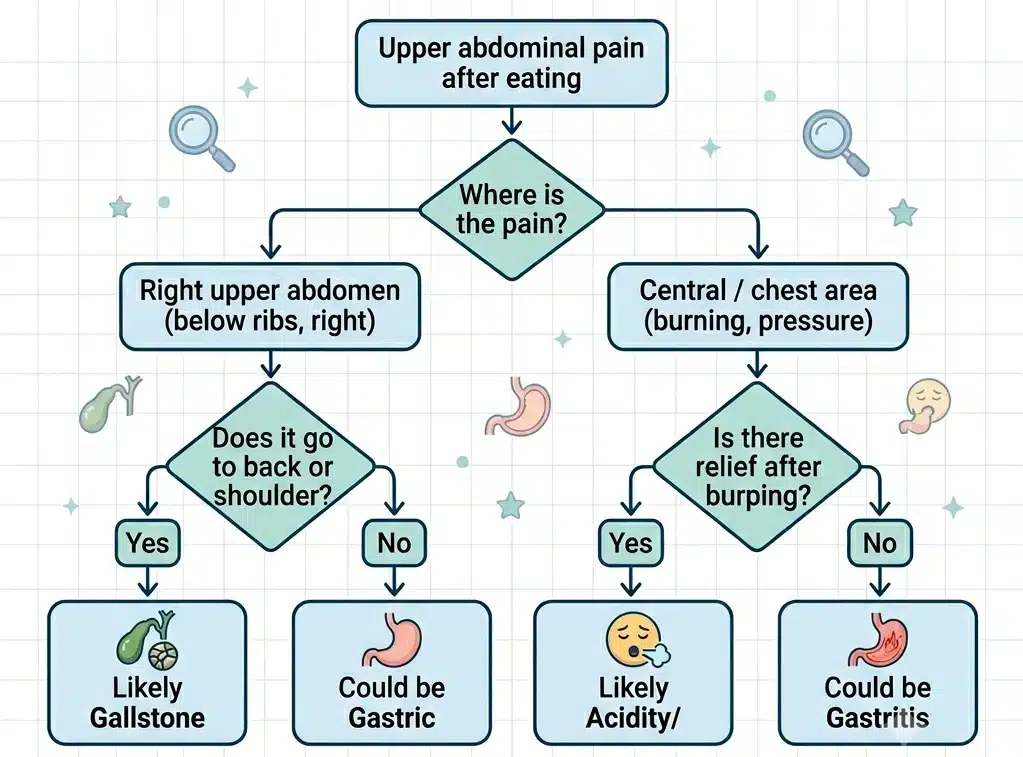
How the pain travels: a flowchart of symptoms
This simple flow helps you understand gallstones vs gastric pain without needing a medical degree. The moment pain travels to the back or shoulder and antacids don’t work, see a doctor.
When should you go to the doctor immediately?
Some symptoms demand urgent medical attention. Do not wait; do not try home remedies; do not assume it will pass.
These signs point to complications like acute cholecystitis (inflamed gallbladder), cholangitis (infected bile duct), or gallstone pancreatitis, all of which are medical emergencies in gallstones vs gastric pain.
Go to emergency if you have:
- Severe, unbearable right upper abdominal pain lasting more than 2 hours.
- Fever above 38.5°C with abdominal pain.
- Yellow eyes or skin (jaundice).
- Dark brown or cola-colored urine.
- Pale, grey, or clay-colored stools.
- Vomiting blood or vomiting that won’t stop.
- Rapid heart rate alongside abdominal pain.
Diagnosis: how doctors tell them apart
The most important message: do not self-diagnose based on symptoms alone. An ultrasound is inexpensive, widely available, and gives a definitive answer for gallstones vs gastric pain. Doctors use a combination of your history, physical examination, and investigations.
For Gallstones:
- Ultrasound of the abdomen: First and most effective test. Can detect stones as small as 2–3mm with high accuracy.
- Blood tests: Liver function tests, bilirubin, WBC count.
- MRCP (MRI of bile ducts): Used when stones in the bile duct are suspected.
- CT scan: For complicated cases or when ultrasound is inconclusive.
For Gastric / Acidity Problems:
- Upper GI endoscopy: Examines the esophagus, stomach, and duodenum directly.
- H. pylori test: Breath test or stool antigen test.
- Blood tests: Rule out anemia or infection.
- pH monitoring: For GERD assessment.
Gallbladder stone treatment in Noida
If gallstones are confirmed, the treatment depends on the type, size, and whether symptoms are present.
For patients in Noida looking for gallbladder stone treatment in Noida, experienced surgical teams at specialized hospitals can perform laparoscopic cholecystectomy safely with minimal recovery time.
Treatment options:
1. Watchful waiting (asymptomatic stones)
- If stones are detected incidentally and you have no symptoms, doctors may monitor without immediate intervention.
- Lifestyle modifications recommended.
2. Laparoscopic Cholecystectomy (keyhole surgery)
- The gold standard treatment for symptomatic gallstones.
- Removal of the gallbladder through 3–4 small incisions.
- Minimally invasive, safe, and highly effective.
- Most patients go home within 24–48 hours.
- Recovery time: 5–7 days in most cases.
- Life after surgery is completely normal; the liver continues producing bile.
3. Medication (UDCA: Ursodeoxycholic acid)
- Only effective for small cholesterol stones.
- Takes months to years to dissolve stones.
- Stones often recur after stopping medication.
- Rarely recommended as primary treatment.
4. ERCP (Endoscopic Retrograde Cholangiopancreatography)
- Used when stones are lodged in the common bile duct.
- A non-surgical procedure done under sedation.
- Often combined with laparoscopic surgery for complete management.
Gastric problem treatment
When it comes to gallstones vs gastric pain, persistent or recurring symptoms should never be ignored. Consulting a specialist in Noida can help ensure an accurate diagnosis and a targeted treatment plan rather than relying on repeated antacid use.
Managing gastric and acidity-related conditions is largely about consistency and lifestyle.
Medical treatment:
- Proton pump inhibitors (PPIs): Omeprazole, Pantoprazole for acid reduction.
- H₂ blockers: Ranitidine (now limited use), famotidine.
- Antacids: For immediate symptom relief.
- Antibiotics: If H. pylori infection is confirmed.
- Prokinetics: For slow gastric emptying or bloating.
Lifestyle changes that actually work:
- Eat smaller, more frequent meals.
- Avoid lying down within 2–3 hours of eating.
- Reduce spicy, fried, and processed foods.
- Limit tea, coffee, carbonated drinks, and alcohol.
- Manage stress; the gut-brain connection is very real.
- Do not skip meals; irregular eating worsens acidity.
Diet Tips: What to Eat and Avoid for Both Conditions
| Eat More | Avoid |
| High-fibre vegetables and fruits | Fried and deep-fried foods |
| Whole grains: oats, brown rice | Full-fat dairy: cream, paneer, cheese |
| Lean proteins: dal, lentils, fish | Red meat and processed meats |
| Olive oil in small amounts | Fast food and packaged snacks |
| Water, a minimum of 2.5–3 litres daily | Very large, heavy single meals |
| Nuts in moderation | Refined carbohydrates: maida, white rice in excess |
If You Have Gastric Problems / Acidity:
| Eat More | Avoid |
| Coconut water and buttermilk | Spicy curries and pickles |
| Bananas, melons, and cooling fruits | Tomatoes, citrus fruits in excess |
| Oats and plain khichdi | Tea and coffee on an empty stomach |
| Curd (if tolerated) | Carbonated drinks and alcohol |
| Small frequent meals | Large, heavy meals |
| Ginger in moderation | Onion and garlic in excess |
Gallbladder stone treatment in Noida
Rama Hospital is a trusted name for digestive health care in Noida and the NCR region. With experienced specialists in gastroenterology and minimally invasive surgery, the team handles everything from complex gallbladder conditions to chronic gastric disorders.
Whether you need expert evaluation for gallstones vs gastric pain, advanced gallbladder stone treatment in Noida, or consultation with a gastric problem specialist in Noida, Rama Hospital offers comprehensive diagnosis, personalized treatment, and compassionate care under one roof.
Do not wait for symptoms to escalate. Early diagnosis saves you from emergency surgery and unnecessary complications.
Frequently Asked Questions (FAQs)
Q1. My pain goes away on its own after a few hours. Should I still see a doctor?
Yes, gallstone attacks can sometimes settle on their own when a stone temporarily moves away from the blockage. However, the stone remains present, and future attacks may be more severe. When considering gallstones vs gastric pain, recurring pain, especially after eating fatty foods, is more suggestive of gallstones and should not be ignored. Repeated episodes can lead to complications such as infection, inflammation, or jaundice, making an ultrasound evaluation essential.
Q2. I’ve been taking antacids for months, but the pain keeps coming back. What should I do?
Persistent pain despite taking antacids may indicate that the issue isn’t acidity at all. Understanding the difference between gallstones vs gastric pain is crucial, as an ultrasound can quickly determine whether gallstones are responsible for your symptoms.
Q3. Can I have both gallstones and acidity at the same time?
Yes, it is possible to experience both conditions at the same time. Gallstones vs gastric pain are separate medical issues, and having one does not rule out the other. In fact, many middle-aged adults with dietary irregularities may develop symptoms of both simultaneously. When evaluating gallstones vs gastric pain, a thorough clinical assessment and ultrasound can help determine the exact cause of each symptom and guide appropriate treatment.
Q4. Is gallbladder removal surgery risky? Will I be able to live normally after it?
Laparoscopic cholecystectomy is one of the safest and most commonly performed surgeries for patients whose symptoms are clearly linked to gallstones rather than gastric issues. Understanding the difference between gallstones vs gastric pain is important, as the gallbladder is not an essential organ. After its removal, the liver continues to produce bile, which flows directly into the small intestine. Most patients recover quickly, returning to normal activities within 7–10 days and resuming a regular diet within a few weeks.
Q5. My doctor found gallstones on ultrasound, but I have no pain. Do I need surgery now?
Gallstones vs gastric pain can sometimes be confusing, but not all gallstones require immediate treatment. Silent gallstones often cause no symptoms and may only need monitoring. When evaluating gallstones vs gastric pain, doctors consider factors such as stone size, age, symptoms, and overall health before recommending treatment. Regular follow-up is important because silent gallstones can eventually become symptomatic.
Q6. What foods should I completely avoid if I have gallstones?
In cases of gallstones vs gastric pain, fried foods, full-fat dairy products, red meat, and heavy meals can often worsen symptoms. These foods may cause the gallbladder to contract forcefully, triggering pain when gallstones are present. Choosing smaller, balanced meals rich in fiber and lean proteins can help reduce discomfort and support digestive health.
Q7. How do I know if my stomach pain is an emergency?
When comparing gallstones vs gastric pain, severe abdominal pain that does not improve within two hours, fever, jaundice, or dark-colored urine should never be ignored. These warning signs may suggest a gallstone complication or infection and require immediate medical attention.
Q8. Is gastritis the same as an ulcer?
No. When comparing gallstones vs gastric pain, it is important to understand that gastritis and ulcers are different conditions. Gastritis is inflammation of the stomach lining, whereas an ulcer is a deeper sore that develops in the stomach or duodenum. While both can cause symptoms similar to gastric pain, ulcers are typically more serious and often require endoscopic evaluation for diagnosis. In discussions of gallstones vs gastric pain, proper medical assessment is essential, as neither condition should be managed with antacids alone.
Q9. I’m scared of surgery. Are there non-surgical options for gallstones?
When discussing gallstones vs gastric pain, treatment options differ significantly. While medication can help dissolve small cholesterol gallstones, it is effective only in select cases, may take years to work, and carries a high risk of stone recurrence. For most patients with symptomatic gallstones, laparoscopic gallbladder surgery remains the most effective and long-lasting treatment. This minimally invasive procedure offers a permanent solution with a relatively quick recovery period.
Q10. Where can I get gallstones diagnosed and treated in Noida?
Rama Hospital, Noida, provides comprehensive evaluation and treatment for conditions such as gallstones vs gastric pain. The hospital offers advanced diagnostic services, including ultrasound, blood tests, and endoscopy, along with personalized surgical and non-surgical treatment plans tailored to each patient’s condition. Patients can consult experienced specialists to accurately identify whether their symptoms are caused by gallstones vs gastric pain and receive appropriate care.