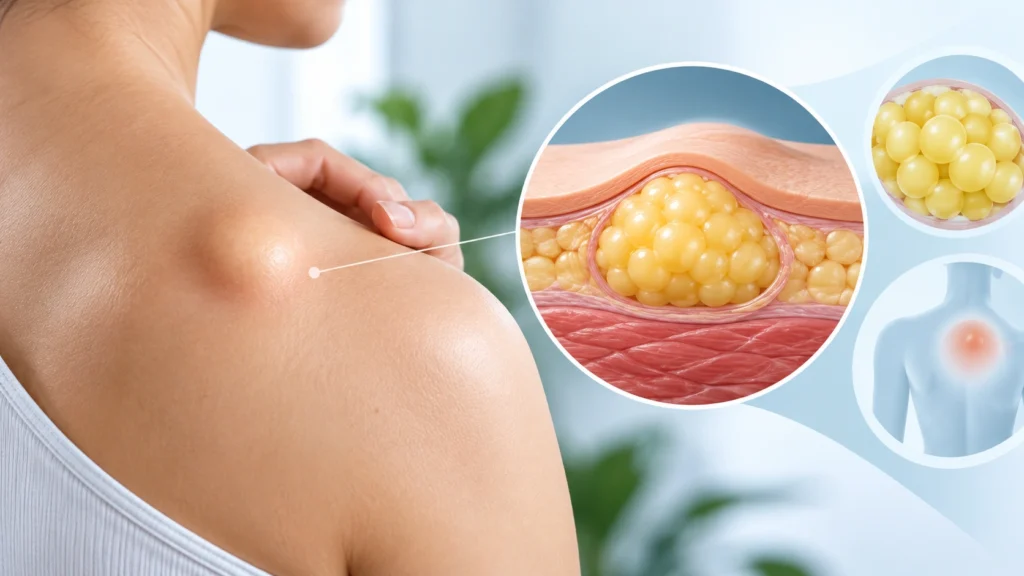
A lipoma is a common, usually harmless lump that forms under the skin. It is made up of fat cells and feels soft, rubbery, and movable when touched. Most lipomas grow slowly and do not cause pain or serious health problems. Many people notice them on the arms, shoulders, back, neck, or thighs, but they can appear almost anywhere on the body where fat tissue is present.
Although these lesions are generally benign, they can be worrying for patients who are unsure whether the lump is something serious. Some people seek medical advice because the lump is growing, causing discomfort, affecting appearance, or pressing on nearby structures. In rare cases, a deep or large lesion may need more detailed evaluation to rule out other conditions.
What is a Lipoma?
A lipoma is a benign growth of fat cells that develops just under the skin. It is not cancer and does not spread to other parts of the body. Most lesions are small, slow-growing, and painless. They are usually easy to move under the skin when pressed gently.
They can occur at any age, but they are most common in adults between thirty and sixty years. Some people may have a single lesion, while others may develop multiple lesions over time. In most cases, a this does not affect overall health, but it can be bothersome if it is in a visible area, causes discomfort, or keeps increasing in size.
Types of Lipoma
These can be classified based on their location, depth, and tissue composition.
Based on location
- Subcutaneous lipoma, which lies just under the skin and is the most common type.
- Deep lipoma, which is located deeper in the muscle or near internal structures.
- Intramuscular lipoma, which grows within a muscle and may cause discomfort during movement.
- Spinal or internal lipoma, which occurs near the spine or internal organs and is less common.
Based on features
- Simple lipoma, which is made mostly of mature fat cells.
- Angiolipoma, which contains fat cells and small blood vessels and may be tender.
- Fibrolipoma, which has more fibrous tissue along with fat.
- Multiple lipomas, where a person has several lesion in different areas.
- Giant lipoma, which is unusually large and may require more detailed evaluation.
Based on number
- Solitary lipoma, where only one lump is present.
- Multiple lipomas, where several lumps appear over time, sometimes with a family tendency.
Causes of Lipoma
The exact cause of lesions is not always clear. Most lesion develop without a known trigger. They are not caused by injury, infection, or lifestyle habits in most cases.
Possible contributing factors
- Genetic tendency or family history of lipomas.
- Age, as these are more common in middle-aged adults.
- Minor trauma in some cases, although this is not proven in all patients.
- Certain rare genetic conditions that cause multiple lesion.
- Natural variation in how fat cells grow in some people.
What does not cause lipoma?
- These are not caused by obesity or weight gain.
- They are not caused by eating fatty food.
- They are not a sign of cancer in typical cases.
- They are not infectious and cannot spread from person to person.
Risk Factors for Lipoma
Some people are more likely to develop lesion than others.
Higher-risk groups
- Adults between thirty and sixty years of age.
- People with a family history of lesions.
- Individuals with certain genetic conditions.
- People who have had a lesion before.
- Those with multiple soft tissue lumps without other symptoms.
Why risk increases in these groups
- Genetic factors can make fat cells more likely to form lumps.
- Age-related changes may affect how fat tissue behaves.
- Some syndromes are associated with multiple lesions.
- Previous lesion may indicate a tendency to form more.
Symptoms of Lipoma
Most lesions cause very few or no symptoms. They are often noticed by chance when a person feels a lump under the skin.
Common features of a typical lipoma
- Soft, rubbery lump under the skin.
- Easily movable when pressed gently.
- Usually painless.
- Slow growth over months or years.
- Most often found on the arms, shoulders, back, neck, or thighs.
- Skin over the lump looks normal.
Symptoms that may need more evaluation
- Rapid increase in size.
- Firm or hard texture instead of soft.
- Lump that is fixed and does not move easily.
- Pain, tenderness, or discomfort.
- Lump deeper in the muscle or near joints.
- Lump in an unusual location such as the breast, abdomen, or near major nerves.
- Skin changes over the lump such as redness or ulceration.
Lipoma in Different Age Groups
Lipomas can affect people of different ages, but the pattern may vary.
In children and teenagers
- These are less common but can still occur.
- Often noticed as a painless lump by parents or during routine examination.
- Usually benign and slow-growing.
In adults
- Most common age group for lipoma.
- Often found on the trunk, arms, or neck.
- May be single or multiple.
In older adults
- Lesion may coexist with other soft tissue lumps.
- Deeper or larger lumps may need more careful evaluation.
- Overall health and other conditions may influence treatment decisions.
How is Lipoma Diagnosed?
Diagnosis is usually based on physical examination and, if needed, imaging tests. Most typical lesions can be identified by an experienced doctor during a clinical exam.
Diagnostic steps
- Detailed history of when the lump was first noticed.
- Assessment of growth pattern and any symptoms.
- Physical examination to check size, texture, mobility, and location.
- Evaluation for multiple lumps or family history.
- Decision on whether imaging or further tests are needed.
Common tests that may be done
- Ultrasound to confirm that the lump is made of fat and is benign in appearance.
- MRI for deep, large, or atypical lesions to assess exact location and structure.
- CT scan in selected cases for internal or complex lumps.
- Biopsy or removal for histopathology if the diagnosis is uncertain or features are atypical.
When tests are more likely
- Lump is large or growing quickly.
- Lump is firm, fixed, or painful.
- Lump is deep inside muscle or near important structures.
- Diagnosis is not clear on examination alone.
- Patient or doctor wants to rule out other conditions with certainty.
Treatment for Lipoma
Many lesion do not need treatment. The decision to treat depends on symptoms, location, size, growth, and patient preference.
When treatment is recommended
- Lump is painful or tender.
- Lump is growing or changing.
- Lump is causing discomfort or limiting movement.
- Lump is in a visible or cosmetically sensitive area.
- Diagnosis is uncertain and removal is needed for confirmation.
- Patient is worried and prefers removal after discussion.
1. Observation and monitoring
For small, typical, and symptom-free lesions, observation may be the best option.
- Regular self-check for changes in size or symptoms.
- Medical review if the lump grows or becomes painful.
- No active treatment unless needed.
2. Surgical removal
Surgical removal is the most common and effective treatment for lipoma.
- Done under local anesthesia for most small and superficial lesions.
- Small incision is made over or near the lump.
- The lipoma is carefully separated from surrounding tissue and removed.
- The wound is closed with stitches or adhesive strips.
- The removed tissue may be sent for laboratory testing to confirm diagnosis.
3. Liposuction-assisted removal
In some cases, liposuction may be used, especially for larger or multiple lesions.
- Small incision is made.
- A thin tube is used to remove fatty tissue.
- May leave a smaller scar in some cases.
- Not suitable for all types of lipoma.
4. Minimal access or keyhole techniques
For selected lesions, minimal access techniques may be used.
- Smaller incisions.
- Faster recovery in some cases.
- Suitable for certain locations and sizes.
5. Supportive care
After removal, basic wound care is important.
- Keep the area clean and dry.
- Follow instructions for dressing and bathing.
- Take prescribed pain relief if needed.
- Attend follow-up for stitch removal or wound check.
Recovery After Lipoma Removal
Recovery is usually quick for simple lipoma removal.
Expected recovery pattern
- Mild pain or discomfort for a few days.
- Small scar that fades over time.
- Return to normal activities within a few days for small procedures.
- Avoid heavy strain on the area until the wound heals.
Wound care
- Keep the dressing clean and dry.
- Do not scratch or pick at the wound.
- Watch for signs of infection such as increasing redness, swelling, pus, or fever.
- Follow advice on bathing and activity.
Scar care
- Scars are usually small and fade over months.
- Sun protection can help reduce darkening.
- Scar gels or creams may be suggested in some cases.
Possible Complications of Lipoma
These are themselves usually harmless, but there can be issues related to the lump or its removal.
Issues related to the lipoma
- Gradual increase in size.
- Discomfort or pressure on nearby structures.
- Cosmetic concern.
- Rarely, deep lesions may press on nerves or muscles.
Issues related to removal
- Bleeding or bruising around the wound.
- Infection, though uncommon.
- Fluid collection under the skin.
- Scar formation.
- Rare recurrence if some lesions tissue remains.
Why complications are usually mild: Most of procedures are minor and done under local anesthesia. With proper technique and wound care, serious complications are rare.
When Should You See a Doctor?
Medical evaluation is important for any new or changing lump.
- A new lump under the skin.
- A lump that is growing.
- A lump that is painful or tender.
- A lump that is firm, hard, or fixed.
- Multiple lumps appearing over time.
- A lump in an unusual location.
- Uncertainty about whether the lump is a lipoma.
Prevention of Lipoma
There is no proven way to prevent lipoma completely, as the exact cause is often unclear.
- Maintain a healthy lifestyle.
- Monitor any new lumps and seek early evaluation.
- Follow up if you have a tendency to form multiple lesions.
- Keep regular health check-ups.
For people with multiple lipomas
- Discuss family history with a doctor.
- Consider evaluation if lumps are increasing in number or size.
- Plan removal of bothersome lumps in a staged manner if needed.
Why Choose Rama Hospital for Lipoma Treatment?
Lesions removal is usually a minor procedure, but it still requires proper diagnosis, safe technique, and good wound care. A hospital setting ensures that atypical lumps are evaluated correctly and that procedures are done under sterile conditions with appropriate follow-up.
- Accurate diagnosis by experienced doctors.
- Safe removal under proper anesthesia and sterility.
- Ability to send tissue for laboratory testing.
- Management of deeper or complex lesions.
- Clear wound care instructions and follow-up.
Frequently Asked Questions (FAQs)
Is lipoma dangerous?
In most cases, these are not dangerous. It is a benign condition that rarely causes serious problems. However, any new or changing lump should be examined by a doctor to confirm the diagnosis.
Can lipoma turn into cancer?
Typical lesions do not turn into cancer. Very rarely, a lump that looks like a lesions may be a different type of tumor, which is why atypical or rapidly growing lumps need proper evaluation.
Does lipoma need surgery?
Not every lesion needs surgery. Many can be safely observed. Surgery is considered if the lump is painful, growing, cosmetically bothersome, or if the diagnosis is uncertain.
Is lipoma removal painful?
The removal is usually done under local anesthesia, so the procedure itself is not painful. There may be mild discomfort for a few days after, which can be managed with simple pain relief.
Can lipoma come back after removal?
Recurrence is uncommon if the lipoma is completely removed. In some cases, a new lesions may form in the same or a different area, especially in people who tend to develop multiple lesions.
How long does the procedure take?
Most simple lesion removals take about fifteen to thirty minutes. Larger or deeper lesions may take longer. Patients can usually go home the same day.
Will there be a scar after removal?
Yes, there will be a small scar where the incision is made. In most cases, the scar is thin and fades over time. Proper wound care and sun protection can help improve scar appearance.
Conclusion
A lipoma is a common, usually harmless fatty lump that forms under the skin. Most lesions are soft, movable, and painless, and they do not affect overall health. However, any new or changing lump should be evaluated by a doctor to confirm the diagnosis and rule out other conditions.
The most important steps are proper examination, appropriate imaging when needed, and a clear plan for observation or removal. For patients with a growing, painful, or bothersome lesion, simple surgical removal can provide relief and peace of mind. With proper care, recovery is usually quick and complications are rare.
Rama Hospital can help evaluate lesion, confirm the diagnosis, and provide safe and effective removal when needed, along with clear guidance on wound care and follow-up.