You got your varicose veins treated. The swelling reduced. The pain was gone. Life felt normal again.
And then, a few months or years later, those twisted, bulging veins started showing up again.
If this sounds familiar, you are not alone. Varicose vein recurrence is one of the most frustrating, and most common, issues patients face after treatment. Understanding why this happens and what you can actually do about it is the first step toward lasting relief.
What is varicose vein recurrence?
Varicose vein recurrence simply means the return of varicose veins after a treatment procedure. In medical terms, it is also called recurrent variceal veins after treatment, or REVAS (Recurrent Varices after Surgery).
This is not a treatment failure, necessarily. It is a biological reality. Veins are living tissue, and the underlying factors that caused them to fail the first time do not disappear just because the affected vein was removed or sealed.
Varicose vein relapse can occur weeks, months, or even years after a procedure. Some patients see it within a year. Others notice new veins forming after five to ten years.
How common is varicose vein recurrence?
These figures vary based on the type of procedure, the severity of the original condition, and lifestyle factors post-treatment. Varicose vein recurrence is not rare. It needs to be planned for, not ignored.
The numbers are surprisingly high.
| Time After Treatment | Estimated Recurrence Rate |
| Within 1 year | 10–15% |
| Within 3 years | 20–30% |
| Within 5 years | Up to 40% |
| Within 10 years | 50–65% |
Why do varicose veins come back? The real causes
- New Vein Growth (Neovascularization) – New veins can form after treatment and later become varicose.
- Incomplete Treatment – Some damaged veins may remain untreated and cause recurrence.
- Underlying Venous Insufficiency – Faulty vein valves continue to increase pressure inside the veins
- Genetic Predisposition – A family history of varicose veins increases the risk of recurrence.
- Prolonged Standing – Standing for long hours puts constant pressure on leg veins.
- Sedentary Lifestyle – Lack of movement reduces healthy blood circulation in the legs.
- Obesity – Excess body weight places additional strain on the veins.
- Pregnancy – Hormonal changes and increased vein pressure can trigger new varicose veins.
- Hormonal Medications – Certain hormonal treatments may weaken vein function over time.
- Choice of Treatment – Older procedures have higher recurrence rates compared to modern minimally invasive treatments.
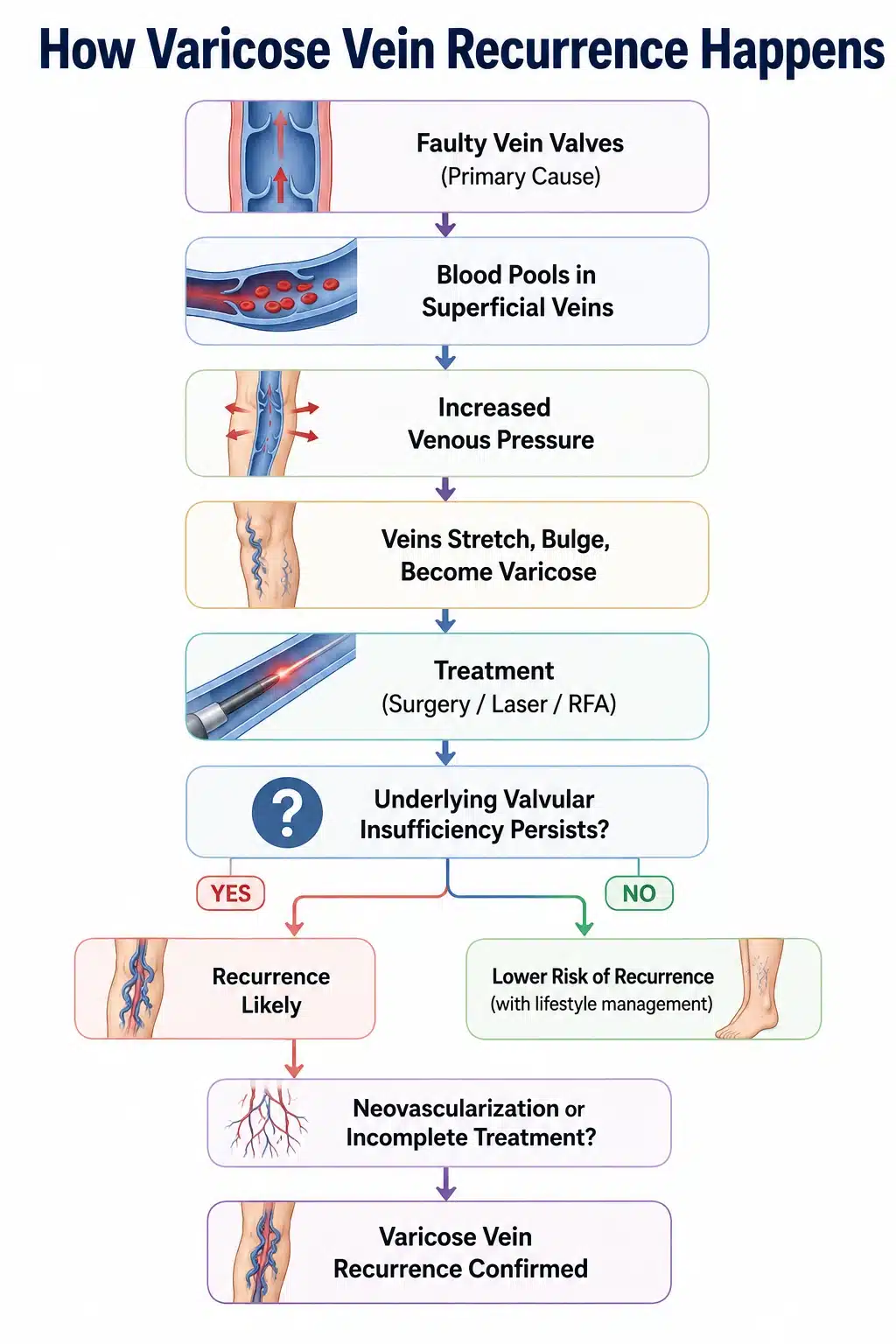
The flowchart: how varicose vein recurrence happens
This flow shows why treating just the visible vein is not enough. The root cause, valve failure in the deeper venous system, must be addressed to prevent varicose vein recurrence.
Signs that your varicose veins are coming back
If any of these appear, do not wait. Early evaluation at the best hospital in Noida can prevent the condition from progressing.
Catching varicose vein recurrence early makes retreatment simpler and more effective.
Watch for:
- New, visible twisted or rope-like veins on legs
- Recurring heaviness, aching, or fatigue in the legs
- Swelling around ankles or calves, especially by evening
- New spider veins forming in previously treated areas
- Skin discoloration or a brownish tinge near the ankle
- Itching or a burning sensation around old treatment sites
How to prevent varicose vein recurrence: a practical guide
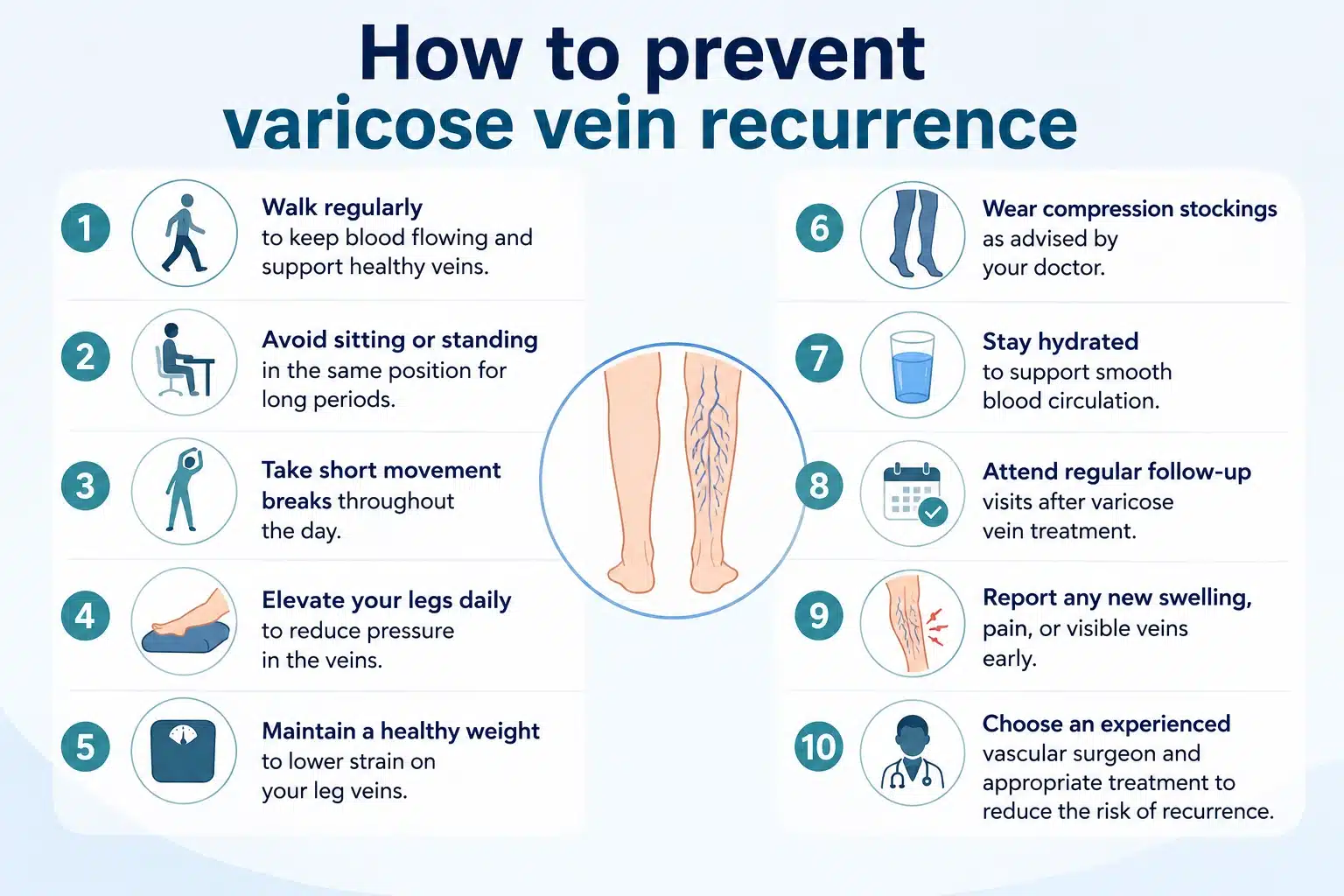
- Walk regularly to keep blood flowing and support healthy veins.
- Avoid sitting or standing in the same position for long periods.
- Take short movement breaks throughout the day.
- Elevate your legs daily to reduce pressure in the veins.
- Maintain a healthy weight to lower strain on your leg veins.
- Wear compression stockings as advised by your doctor.
- Stay hydrated to support smooth blood circulation.
- Attend regular follow-up visits after varicose vein treatment.
- Report any new swelling, pain, or visible veins early.
- Choose an experienced vascular surgeon and appropriate treatment to reduce the risk of recurrence.
Why patients in Noida choose Rama Hospital for varicose vein treatment?
Varicose vein treatment in Noida has advanced considerably in recent years. Patients no longer need to travel to Delhi for world-class vascular care.
The best vascular surgeon in Noida at Rama Hospital takes a comprehensive approach. The goal is not just to treat the vein in front of them. It is to understand your venous anatomy, identify every weak point, and build a treatment plan that addresses the root cause so that varicose vein recurrence remains unlikely for years.
Rama Hospital offers:
- Dedicated vascular surgery department with experienced specialists.
- State-of-the-art Duplex Doppler imaging for accurate diagnosis.
- Full range of minimally invasive treatments: EVLT, RFA, VenaSeal, sclerotherapy.
- Structured post-treatment monitoring to track and prevent varicose vein recurrence.
- Transparent pricing and insurance empanelment for cashless treatment.
Frequently Asked Questions (FAQs)
Q1. My varicose veins came back after surgery. Does that mean the surgery failed?
Not necessarily. Varicose vein recurrence can happen even after a successful procedure. The original treatment may have worked perfectly, but new veins can develop due to ongoing venous insufficiency, genetic factors, or lifestyle-related pressure.
Q2. How long after treatment can varicose veins come back?
Varicose vein recurrence can appear as early as 6 to 12 months or as late as 10 years after treatment. Most recurrences show up within 3 to 5 years. This is why annual follow-ups are recommended even when you feel fine.
Q3. Will my varicose veins definitely come back if I stand at work all day?
Not definitely, but prolonged standing is a significant risk factor for varicose vein relapse. Using compression stockings, taking movement breaks, and doing evening leg elevation can substantially reduce that risk.
Q4. Can I prevent varicose vein recurrence with diet?
Diet alone cannot cure or completely prevent varicose vein recurrence, but it plays a supporting role.
Q5. Is the second treatment for varicose veins more complicated than the first?
However, in experienced hands at a facility equipped for recurrent cases, like Rama Hospital, retreatment for varicose vein recurrence is still a day-care or short-stay procedure in most cases.
Q6. Do compression stockings really work to prevent recurrence, or is that just advice doctors give?
They are not a one-time fix, but consistent use is one of the most effective tools to prevent varicose vein recurrence.
Q7. How do I know if what I’m seeing is varicose vein recurrence or a new condition?
A vascular specialist at the best hospital in Noida can evaluate whether it is varicose vein recurrence, a new area of insufficiency, or a different vein-related issue.
Q8. Is varicose vein recurrence dangerous if left untreated?
Over time, yes. Untreated varicose vein relapse can progress to chronic venous insufficiency, skin changes, ulcers (venous ulcers), and deep vein thrombosis (DVT) in some cases.
Conclusion
Varicose vein recurrence is real, common, and treatable. But the best strategy is to understand why it happens before it does.
If you are already noticing signs of varicose vein relapse, the worst thing you can do is wait. The condition is almost always manageable when caught early.
For those in the Delhi-NCR region, varicose vein treatment in Noida at Rama Hospital, best hospital in Noida offers access to the best vascular surgeon in Noida with a full range of diagnostic and treatment capabilities under one roof. At Rama Hospital, recognized consistently as one of the best hospitals in Noida for vascular care, the focus is always on long-term outcomes, not just short-term relief.
Because your veins deserve more than just a temporary fix.